
Amorim's Milan win again, but the inconsistency he fears returns with the result
A 2-1 win at Genoa kept Milan's erratic run alive, and Ruben Amorim used it to demand the 'panic of losing' he says his squad still lacks between matchdays.
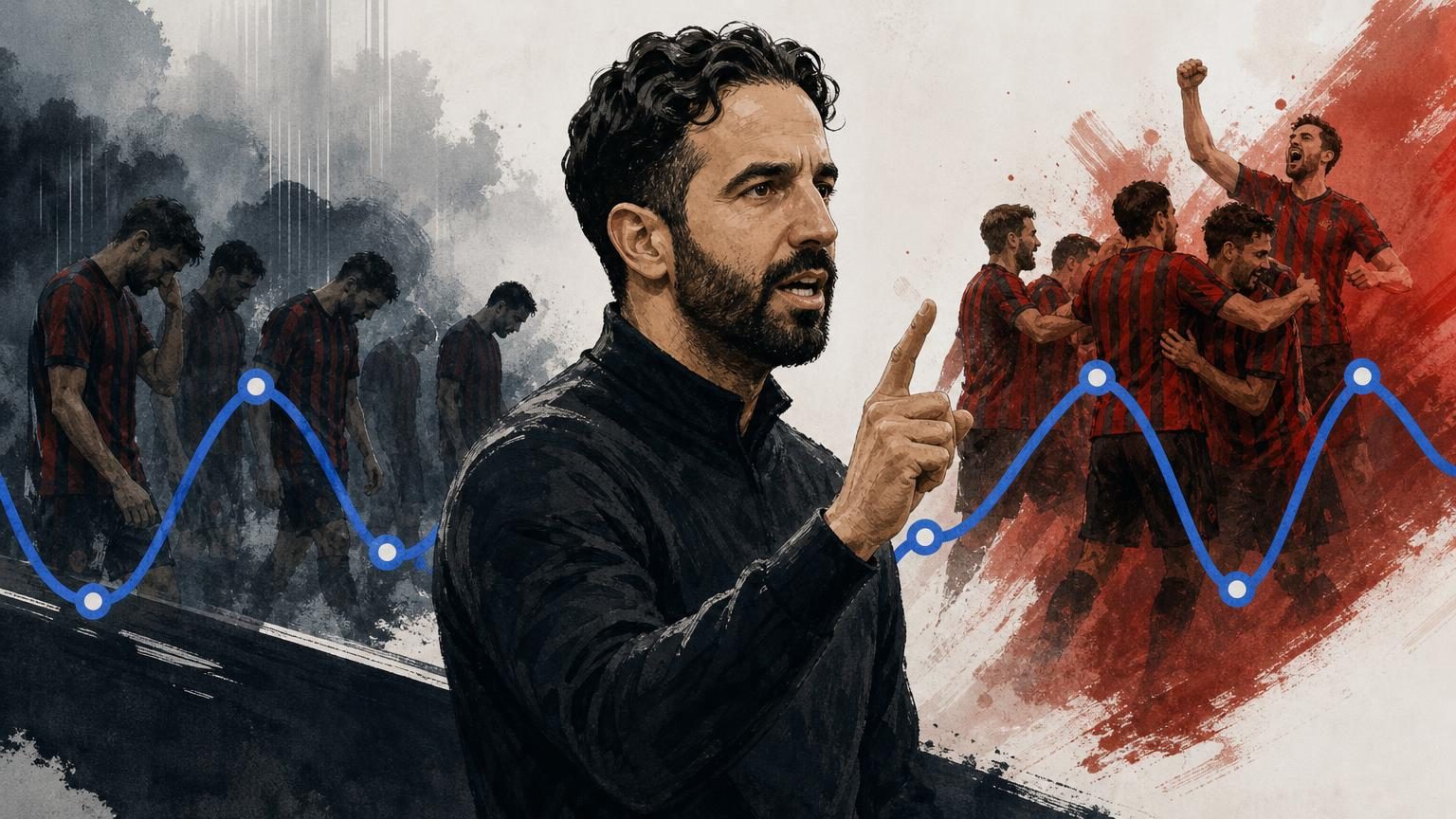
Milan beat Genoa 2-1 away on Saturday, continuing a run of results so wildly inconsistent that even the manager struggled to characterise it as progress, Football Italia reports.
The sequence tells its own story. A midweek round defeat to Bologna was followed by victory over Inter in the Derby della Madonnina, then a 2-0 Europa League loss to Ferencvaros on Thursday, and now a win at Stadio Luigi Ferraris. Alphadjo Cisse and Christian Pulisic scored early for Milan, Mikkel Ellertsson pulled one back with a deflected strike, and the visitors held on to end Genoa's run of three consecutive wins.
The result leaves Milan fourth in Serie A, five points off leaders Lazio, a position that flatters a side whose week-to-week output has been almost impossible to predict.
Why Milan oscillate between extremes
Ruben Amorim told DAZN Italia he was 'proud again' with his players, stressing that competitiveness, not any specific tactical plan, was the priority before kick-off. "I am proud again with my players, I said before the game the most important thing was to be competitive, because if we have this attitude in every game, we are closer to winning every game," he said.
He pointed to his side's ability to change approach mid-match as evidence of growth. "There are moments when we change the game, we go for the second ball and play different types of football, that is the sign of a great team, who can play different ways during the same match," Amorim added.
That adaptability is real, but it is also a symptom of the problem. A team that needs to switch styles inside a game because its first approach is not working is, by definition, still searching for a settled identity. Winning the second-ball battle and shifting build-up patterns are useful tools, but they are compensations for a baseline that keeps slipping, not evidence that the baseline itself has improved.
Amorim was careful not to overstate what the Genoa win proves. "We can win any game, but I cannot tell you we are going to reach this at the end of the season, as I cannot feel the consistency is there yet," he said, adding that the squad would be stronger across both Serie A and Europe with a full complement of fit players available.
The mentality Amorim is trying to install
Milan went into the weekend without Strahinja Pavlovic, Fikayo Tomori, Matteo Gabbia, Samuel Chukwueze, Ruben Loftus-Cheek, Pietro Terracciano and Alexis Saelemaekers, a list of absentees that helps explain why Amorim had already conceded his squad was 'not ready to be competitive every three days'.
Asked what competitiveness actually means to him, Amorim framed it in psychological rather than physical terms. "It's about the mentality. When you play for Milan, there is no day off. You cannot switch off on Thursday the way we did and then switch back on come Sunday. That is not possible. It's not going to work," he said.
He went further, describing the standard he wants as something closer to dread than discipline. "It's not physical, it's about having that panic of losing. That does not mean being afraid of losing, it's feeling that losing is the end of the world. That is the feeling I want in my team, so it depends on that," Amorim said.
The distinction he draws between fear and urgency matters. A team that is afraid of losing tends to sit deeper and take fewer risks in transition; a team gripped by the urgency he describes should, in theory, press with more intent and commit bodies forward with greater conviction, regardless of the opponent or the competition. Milan's problem across this cycle of games is that urgency has shown up against Inter and Genoa but not against Bologna or Ferencvaros.
Ramos's work in build-up still needs an end product
Goncalo Ramos was involved in the build-up to both goals against Genoa but has not been contributing goals or assists of his own, a pattern Amorim addressed directly rather than brushing aside.
"It's hard for a striker when he doesn't score a goal, but we don't spend a lot of time in the final third. We have a lot of possession, but when we reach the final third more often, Goncalo Ramos is going to score many goals. It is a team problem, the way we play is not helping Ramos, whereas he is helping the team," Amorim said.
He identified a specific target for Ramos's positioning going forward. "It is a process, we need to have Ramos spending 60 per cent of his time in the opponent's box, and we are not there yet," he concluded.
That framing shifts the responsibility away from the forward and onto the structure feeding him. If Milan's build-up is consuming most of the game without delivering sustained spells in the final third, a central striker will inevitably spend long periods outside the box simply waiting for service that rarely arrives in dangerous areas. Fixing Ramos's output, by this logic, is less about the player's movement and more about Milan compressing the game faster once possession is won.
Milan now go into the international break hoping the injury list shortens before their next assignments. Amorim's message, repeated in different forms throughout his comments, is that the result in Genoa changes nothing about the underlying issue: the team can win any given match, but has not yet shown it can do so without first losing one it had no business losing.