
Cristante Questions Penalty Call as Roma's Habit of Squandering Leads Resurfaces
Bryan Cristante says Roma 'must improve' after blowing a two-goal lead at Old Trafford for the second time this season, while disputing the penalty that turned the match.
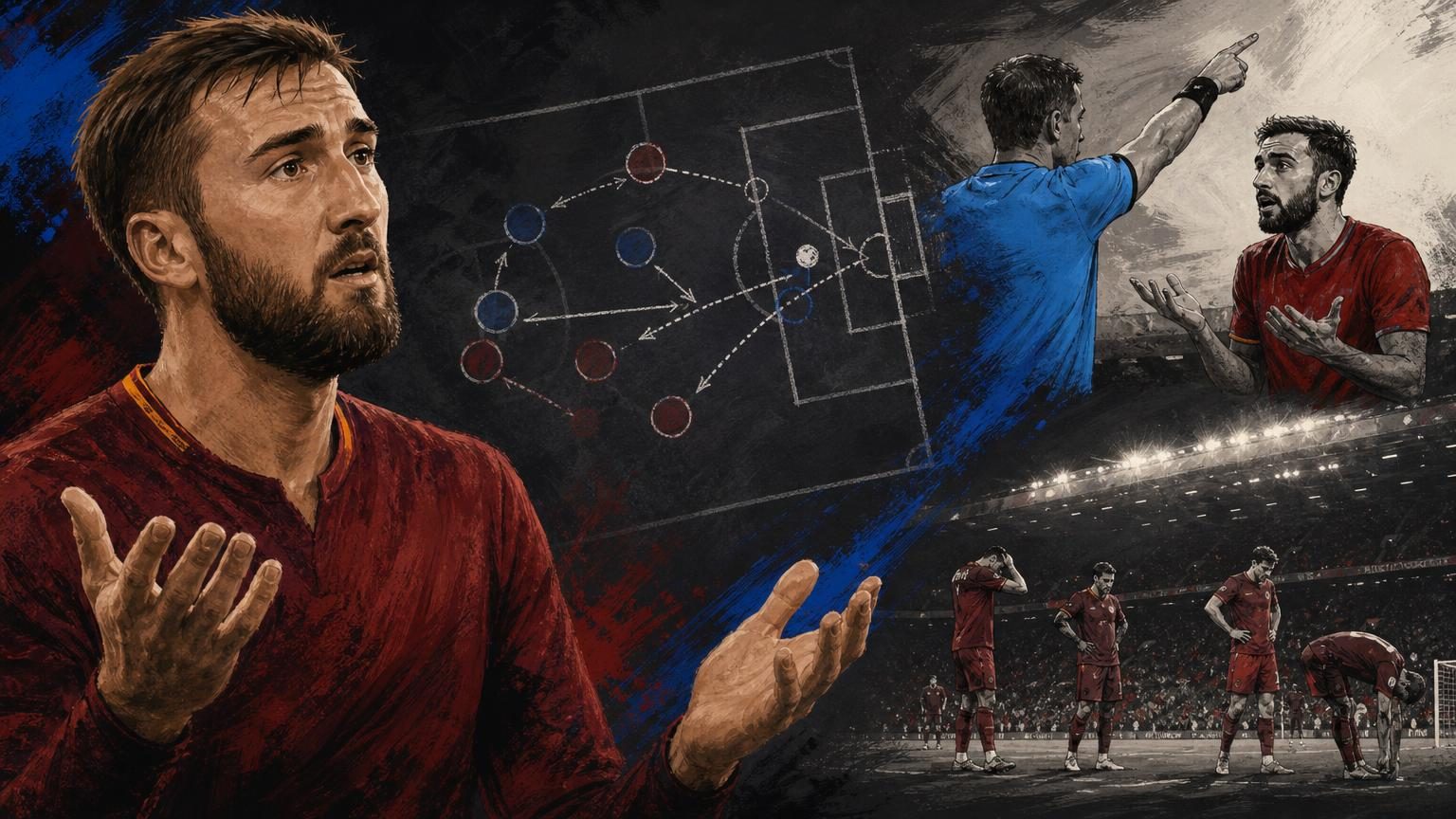
Bryan Cristante said Roma have to "learn and improve" after watching another two-goal advantage disappear, this time in a 3-2 defeat to Manchester United in the Champions League. The midfielder also questioned the penalty decision that let United back into the game, telling Sky Sport Italia that Roma's first-half performance deserved a better outcome.
"We played great in the first half. We could have scored more than two goals, but obviously, the opponents are strong, too. Sometimes, when they push, it's hard to contain them. Surely we had to do more, especially since we had already been there," Cristante said, as reported by Football Italia.
A two-goal cushion, familiar collapse
Roma were 2-0 up inside 17 minutes at Old Trafford. Matías Soulé opened the scoring after Rodrigo Mora switched play to find him unmarked, and he took a touch before finishing into the bottom corner, according to The Analyst (Opta). Six minutes later, Harry Maguire gifted possession to Soulé in the area, Ayden Heaven blocked with an outstretched arm, and Donyell Malen converted the resulting penalty.
That was not an isolated collapse. Football Italia noted this was Roma's second defeat of the season built on a wasted two-goal lead, after Real Madrid scored three times in the closing minutes to win 4-3 at the Stadio Olimpico in October. Twice now, a dominant opening has unravelled into a losing scoreline, and that repetition is the real story of Cristante's post-match comments rather than any single error on the pitch.
A side that creates a two-goal cushion inside the first quarter of an hour has done the hard part of a Champions League away fixture. What Roma have not solved is how to manage the half-hour or so that follows, when the opponent is forced to open up and transitions become stretched in both directions. Both collapses have come against sides willing to keep pushing numbers forward rather than settle for damage limitation, and Roma have twice failed to close the game out once the goals stopped coming.
Penalty flashpoint shifted the momentum
The turning point was Gianluca Mancini's challenge on Matheus Cunha early in the second half, which The Analyst (Opta) described as a clumsy tangle that referees punished with a penalty. Bruno Fernandes saw his first attempt saved by debutant goalkeeper Devis Vásquez, but the kick was ordered to be retaken for Roma encroachment, and Fernandes converted the second attempt to halve the deficit.
Cristante's objection to the award, as relayed by Football Italia, centres on the legitimacy of that initial contact rather than the retake itself. Penalty decisions of this kind sit in the category referees describe as marginal contact in the box: enough to draw contact, debatable as to intent or inevitability. Whether or not the award was correct, its consequence was clear. It gave United both a route back into the game and the psychological lift that comes from seeing a struggling team score against the run of play.
From there, the match turned decisively. Matheus Cunha scored twice within three minutes to complete the turnaround, though he was shown a stoppage-time red card, as detailed by The Analyst (Opta). United also lost Carlos Baleba to a hamstring injury shortly after half-time, a disruption that came just as the home side were finding the territory and tempo that had been absent in the opening period.
Carrick's survival night exposes Roma's recurring flaw
The Guardian's David Hytner framed the night around Michael Carrick's position as United manager, noting the pressure on him amid continued fan anger toward the club's ownership and describing United's first-half display as so poor that even a 2-0 deficit flattered them. Roma had chances to extend the lead before the break, with Malen seeing a low drive palmed away by Vásquez's opposite number and Soulé curling a shot against the outside of the post, according to The Analyst (Opta).
That context matters for how the collapse should be read. United were not simply resilient; they were rescued by a refereeing decision and a response from Cunha that few could have predicted given how comprehensively they had been outplayed. For Roma, the lesson Cristante points to is not about quality in the final third, where they were clearly superior for 45 minutes, but about control once the game state shifts and an opponent is forced to commit numbers forward.
Two collapses from two-goal leads in the space of a month suggest a pattern Roma cannot dismiss as misfortune alone. Cristante's acknowledgement that the team "must improve" points toward game management rather than individual quality, and that is the issue Roma now have to address before the next test in a competition where leads, however comfortable they look at half-time, have twice proven not to be safe.