
Amorim trades defensive solidity for attacking output at Bartesaghi's expense
Milan's 2-0 win at Udinese doubled as a stress test of squad depth, with Ruben Amorim pushing Davide Bartesaghi forward and accepting the defensive cost that comes with it.
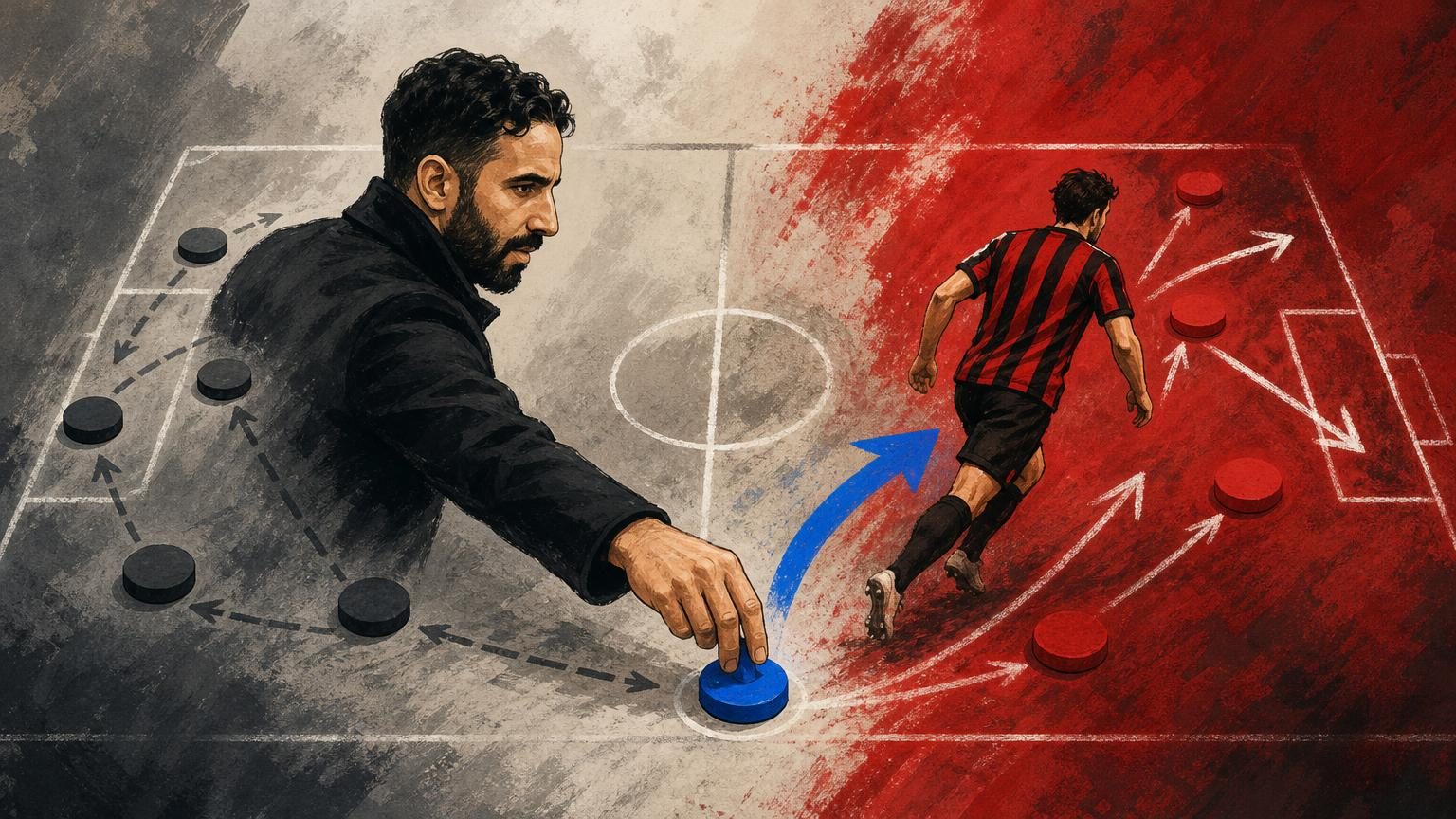
Milan won 2-0 away to Udinese on Saturday, a result that owed as much to squad management as to the quality of the football, with Ruben Amorim fielding a side shaped by a long absentee list rather than by tactical preference alone, Football Italia reported.
Christian Pulisic opened the scoring inside the opening minutes after Luka Modric took a free kick quickly enough to catch Udinese's back line still organising for an offside trap. Omari Hutchinson added the second on the rebound from an Ardon Jashari effort, and Goncalo Ramos later struck the crossbar.
Why Bartesaghi's role tells its own story
The most instructive detail from Udine is not the scoreline but the position in which Amorim used Davide Bartesaghi, pushed higher up the pitch into a more advanced role rather than the deeper defensive brief he has typically occupied.
Amorim was explicit about the trade-off that decision involves. He told DAZN Italia that Bartesaghi "is better offensively than defensively," and that the player "needs to improve his defensive side, be more aggressive in one against one."
That is a specific diagnosis, not a general compliment. Weakness in one-on-one defending is a structural problem for any full-back or wing-back asked to track wide runners, and shifting Bartesaghi forward effectively hides that weakness by reducing how often he has to defend in isolation.
The upside Amorim described is just as precise: Bartesaghi "crosses really well" and has "quality" finishing in training, with the coach wanting him to get into the box more often. Moving him higher turns a defensive liability into an attacking asset, provided the players behind him can cover the space he vacates.
Squad depth under real pressure
This reshuffle was not experimentation for its own sake. Milan were without Adrien Rabiot, Diego Moreira, Mario Gila, Samuel Chukwueze, Matteo Gabbia, Alexis Saelemaekers and Pietro Terracciano, according to Football Italia, forcing Sankhoun Diawara and Fikayo Tomori into their first Serie A starts of the season.
Amorim framed the congestion as a defining feature of his job right now rather than an excuse. "If you see the schedule in Europe, it's impossible, because every game there's a new muscular injury," he said, adding that his responsibility extends beyond picking a winning XI to preparing players who may be needed at short notice.
That context matters for reading the Bartesaghi experiment correctly. A manager without injury problems can afford to keep a player in his best position and develop him gradually. Amorim does not have that luxury this autumn, so he is testing Bartesaghi in a role that maximises what the team needs immediately, attacking width and delivery, even if it exposes a defensive gap he will eventually have to close.
A result built on absorbing pressure, not just scoring early
Milan's control of the second half is the part of the performance that should outlast the headline. Amorim said that "even when we got tired in the second half, we controlled the game," which points to a team managing a lead through game management rather than simply holding on.
That matters after Thursday's 3-0 Europa League defeat at Bournemouth, played with ten men for over an hour, a result Football Italia noted had left Milan under strain heading into this fixture. Ruben Loftus-Cheek limped off late with an injury, adding another name to a list Amorim will need to manage before Milan host Bologna in midweek.
The win keeps Milan unbeaten in Serie A and level with Roma on 18 points in joint third. Amorim brushed aside a question about Monday's Ballon d'Or announcement, saying his focus was on "who survives to play in two days," a line that captures the squad-management reality now shaping his team selection as much as tactics do.