
Amorim tells Milan the derby high means nothing until Ferencvaros
Ruben Amorim says Milan's Europa League form has swung between poor and promising, and wants Wednesday's derby win over Inter to mark a turning point rather than a one-off.
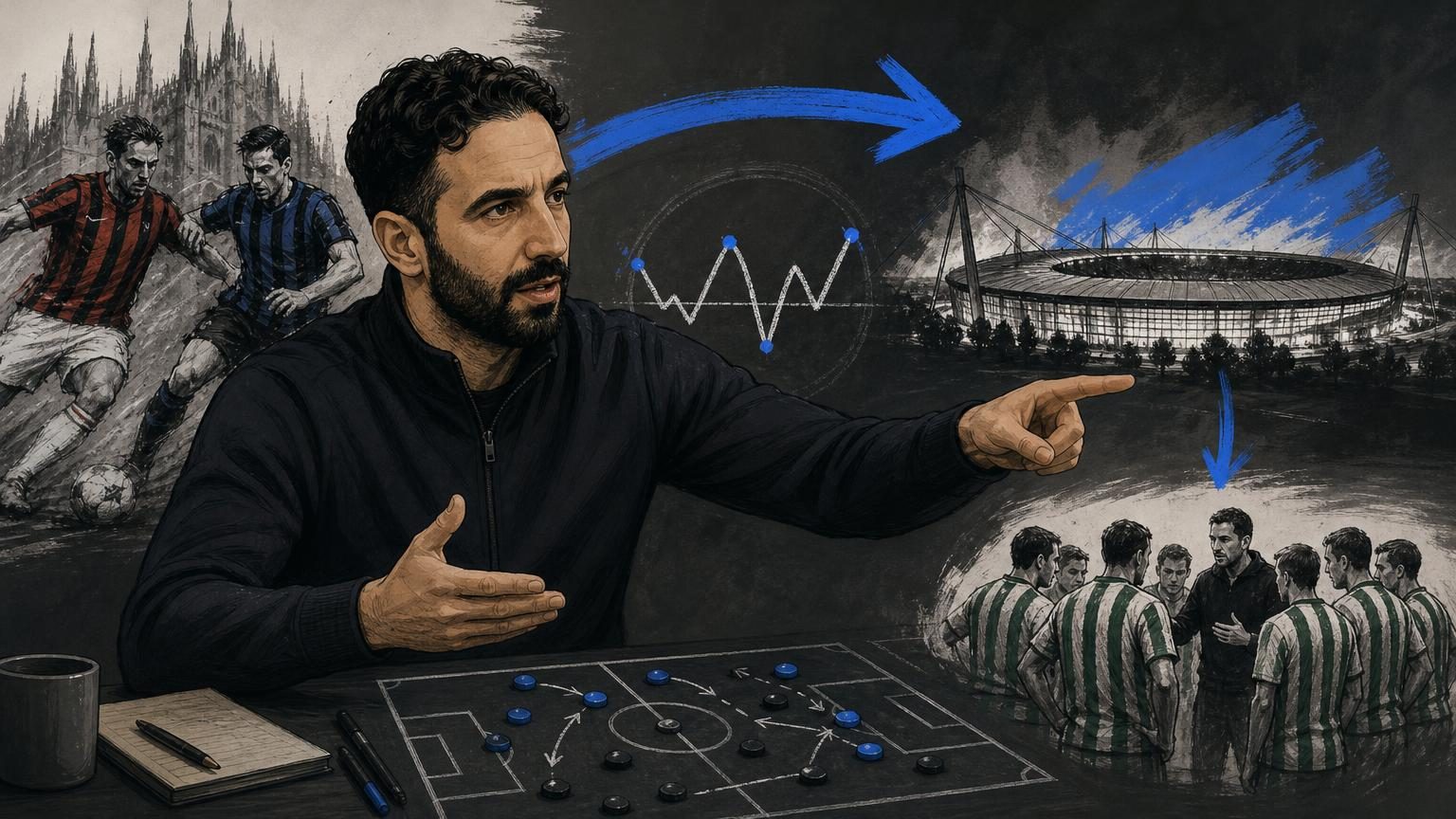
Ruben Amorim is refusing to let Milan's derby win define their week. Speaking before Thursday's Europa League Round 4 tie against Ferencvaros at San Siro, the coach said beating Inter 3-1 in Serie A counted for nothing unless his side carried the same habits into a different competition, as reported by Football Italia.
"We need to forget about Inter; there's a new competition," Amorim said. "More than the result, we need to maintain that consistency." The distinction matters: he is not asking his players to repeat a scoreline, but to reproduce the behaviour that produced it.
Three games, three different problems
Milan's Europa League campaign has yielded three points from three matches, one win and two defeats, a return Amorim does not dress up. Asked to explain the inconsistency, he walked through each fixture rather than offering a single excuse.
Against Benfica, he said, Milan controlled more of the ball but "didn't play our game" — a reminder that possession share on its own does not describe how a team is actually functioning. Salzburg, by contrast, produced what he called a very good performance. Bournemouth was shaped by a sending-off and two penalties conceded, which Amorim linked directly to what he described as the "Mike situation" undermining Milan's ability to compete once down to ten men.
Read together, those three results describe a side whose level has moved for reasons beyond simple quality: a tactical mismatch in one game, game-management failure after a red card in another, and genuine control in the third. Amorim's own conclusion was blunt: "I'm not satisfied in the Europa League; I'm not satisfied in Serie A, but sometimes it goes like that."
Rotation without losing the identity that beat Inter
Milan sit fifth in Serie A but have lost only once domestically, a stability Amorim contrasted with the European inconsistency. He flagged a congested schedule as the next challenge, saying the club "can't lose many players in the next games" and that rotation against Ferencvaros is close to unavoidable.
That creates a tension he addressed directly. Changing personnel, and sometimes changing how the team plays, is part of managing a heavy fixture list — but Amorim was explicit that rotation cannot become an excuse. "Doesn't matter rotations, players on the pitch. We need to be a very good team and win tomorrow," he said, framing responsibility for the result as Milan's alone regardless of who starts.
His summary of the team's broader character was the clearest statement of what he wants fixed: "We can lose any game; we can win any game. This is the characteristic of this team. It depends on how we face the game." That is a coach naming a problem of application rather than talent, and tying Wednesday's result to whether Milan can impose the same humility and attention to detail he credited for the Inter win.
Reading Ferencvaros through a 4-2-3-1
Amorim was equally specific about the opponent. Ferencvaros arrive with nine points from their Europa League group and an unbeaten domestic league record. He described them playing a 4-2-3-1 with rotations that reveal a settled footballing identity, built around midfielder Nagy, whom he singled out for his role initiating attacks as Ferencvaros build up with three players at the back.
That build-up structure, using a back three in possession to draw opponents and open passing lanes through midfield, is the kind of detail Amorim suggested Milan must account for rather than simply overpower. He noted Ferencvaros will travel to San Siro with little pressure of their own, which he turned into an argument for urgency rather than complacency: "They come to San Siro with nothing to lose... the responsibility in San Siro is ours."
A personal stake dressed as a tactical one
The derby that preceded this test carried weight for Amorim beyond the three points. As a boy in Lisbon he supported Benfica locally but was captivated from afar by the Milan side of Maldini, Baresi, Gullit, Rijkaard and Savicevic, telling Portuguese newspaper Expresso in 2017 that playing for Benfica and coaching Milan were both childhood ambitions, as reported by the Guardian's Nicky Bandini. That context does not change the tactical demands of Thursday's game, but it explains why Amorim framed the derby win as a marker to build from rather than an achievement to enjoy.
Milan's task now is translating that marker into a European campaign that has so far refused to settle into a pattern. A win over a Ferencvaros side with a defined identity and an unbeaten domestic record would do more than add three points — on Amorim's own terms, it would be the first sign that the consistency he wants has actually arrived.