
Amorim reshuffles Milan again as Tomori and Camarda get their chance
With pressure mounting after a Europa League defeat to Benfica, Ruben Amorim turns to Fikayo Tomori and Francesco Camarda for a must-navigate trip to Salzburg.
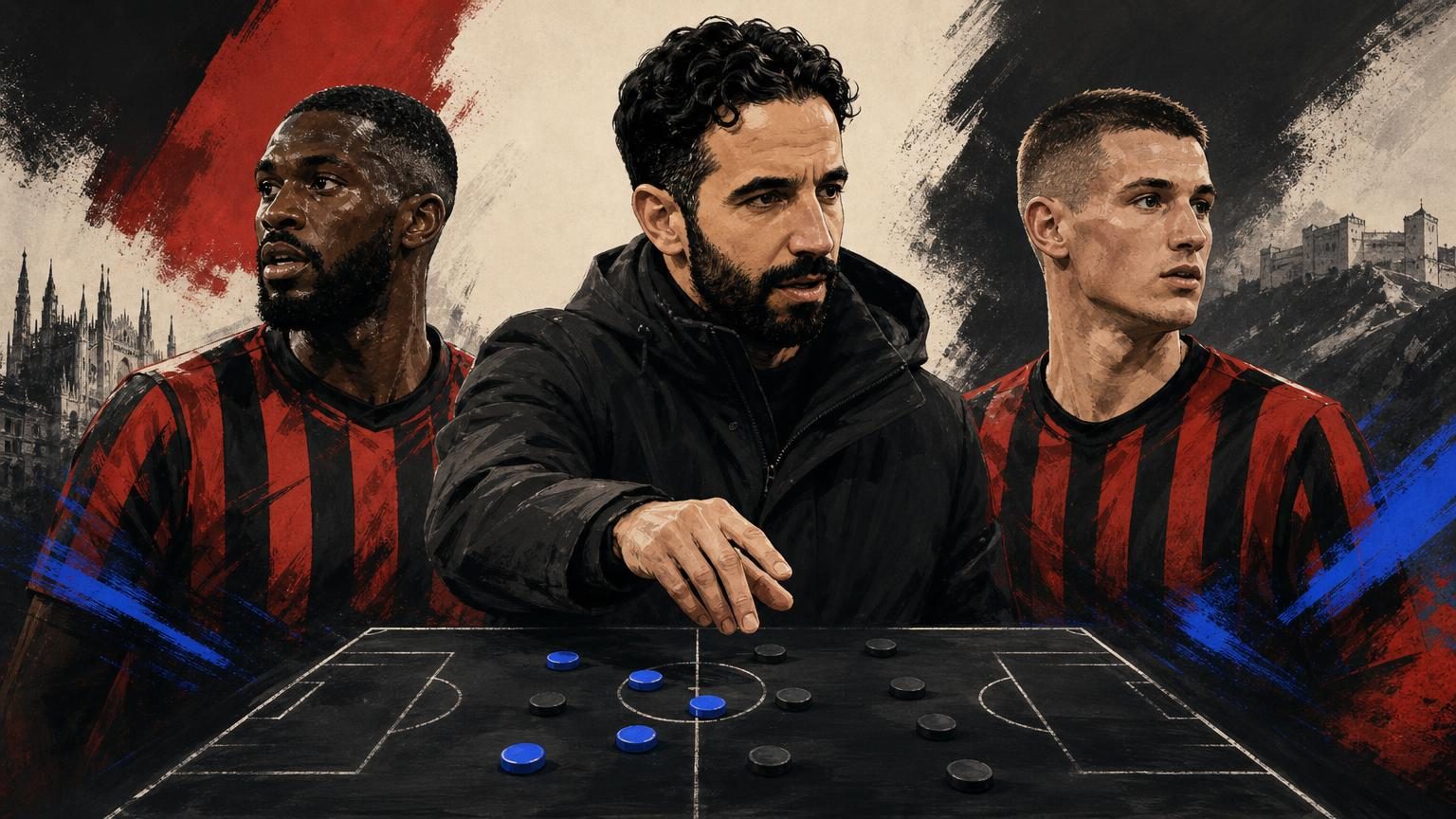
Ruben Amorim is starting Fikayo Tomori and Francesco Camarda for Milan's Europa League trip to RB Salzburg, handing both players their first appearances of the campaign in a game the coach called no different from any other, according to Football Italia.
The timing says otherwise. Milan opened their European campaign with a 2-0 home defeat to Benfica, and have drawn three of their last four Serie A fixtures. Against that backdrop, two reintroductions at once look less like rotation for its own sake and more like a coach testing fresh answers under pressure.
A back three that adapts mid-game
Amorim's Milan are nominally set up with a three-man defence, but Football Italia notes the system has already shown it can shift to a back four within matches. Asked about it directly, Amorim waved the question away, telling Sky Sport Italia it was for others to pick apart: "Nothing better for you guys to analyse! It doesn't matter that much to me, it's the principles that count, we just have to play our game."
That answer is itself informative. A coach happy to let a shape flex between three and four at the back, without treating the switch as a tactical statement, is prioritising principles of positioning and coverage over a fixed numerical system. It also suggests Milan's current identity is still being built match by match rather than imposed as a settled blueprint, which fits a side yet to find consistency in either competition this season.
Tomori's recall and what it signals
Tomori's recall carries its own story. Frozen out over the summer, the centre-back had not featured this season before this trip to the Red Bull Arena. Amorim's explanation pointed to an ongoing conversation rather than a sudden change of heart: "I speak with all the players, he's an experienced player, I said a month or so ago that when he stayed in the team, he would be one of the players like anyone else."
That phrasing matters. It frames Tomori's return not as a reaction to results but as something flagged weeks in advance, once his situation at the club was resolved. For a defence that has had to adjust its shape in-game, adding an experienced centre-back who already knows Serie A and San Siro gives Amorim a more reliable option at the back, regardless of whether he lines up in a back three or four.
Camarda and Hutchinson fill gaps up front
Francesco Camarda's recall is the more striking of the two. The striker had managed only a handful of minutes all season before Thursday, and this is both his first European start and his first start of any kind in 282 days. Amorim's framing was simple: wearing the Milan shirt is "always special" whether in Italy or Europe, and he backed the forward to contribute.
Omari Hutchinson is also involved, with his only previous start this season having ended at half-time against Benfica. Pairing a striker short of minutes with a winger substituted at the break in Milan's last European outing is not the look of a side settled on its best XI. It reads instead as a coach working through his available options while two key contributors are unavailable for an extended period.
That absence is central to understanding the selection. Alexis Saelemaekers and Matteo Gabbia are both out for two to three months, according to Football Italia, which removes two established squad members from Amorim's planning regardless of form or tactics. Rotation at Salzburg is therefore not purely a tactical experiment; it is also a squad shaped by who is actually fit to play.
What the selections suggest for Milan's season
None of this guarantees improvement. Milan have struggled for results in both competitions, and asking a long-absent striker and a previously sidelined defender to solve that in one match in Austria is a big ask. But the selections do suggest Amorim is willing to lean on experience and give under-used players responsibility rather than persist with a formula that produced the Benfica defeat and a run of draws in Serie A.
The next marker will be whether Camarda and Tomori can hold their places once Saelemaekers and Gabbia are available again, and whether the back three Amorim refuses to defend in words continues to morph into a back four whenever matches demand it. For now, Milan's trip to the Red Bull Arena is as much about managing a squad under strain as it is about tactics.