
Bartesaghi's repositioning gives Amorim a tactical puzzle worth solving
Pushed higher up the left for Milan's win at Udinese, Davide Bartesaghi insists he can cover both boxes just as well as he can cover ground.
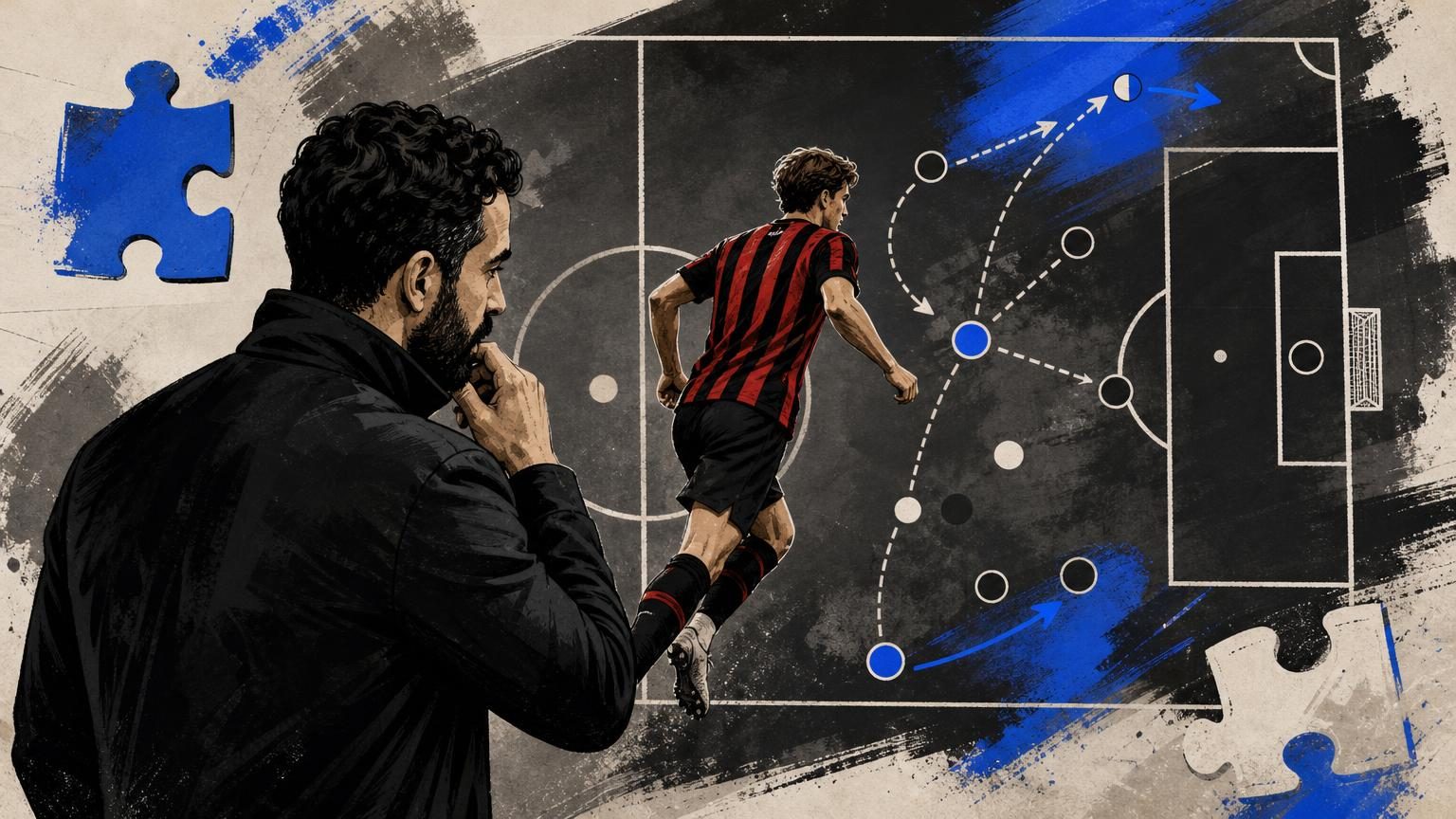
Davide Bartesaghi says he felt "at ease" playing in a more advanced left-sided role for AC Milan's 2-0 win away to Udinese on Sunday, and pushed back on the idea that his game is weighted entirely towards attack.
Milan needed the response. Four days earlier they had been thrashed 3-0 at Bournemouth in the Europa League, reduced to ten men for more than an hour after Mike Maignan was sent off, according to Football Italia.
At the Bluenergy Arena, Ruben Amorim's side set the tone early. Luka Modric took a free kick quickly to spring an offside trap and release Christian Pulisic, and Omari Hutchinson added a second, scoring his first goal for the club from the rebound after Ardon Jashari's effort was parried, Football Italia reported.
Why Amorim moved him higher up the pitch
Bartesaghi operated further forward on the left than his usual full-back berth, with Sankhoun Diawara dropping into the left-back slot behind him — an arrangement Football Italia described as an unfamiliar position for the young Italian defender.
Amorim's stated reasoning, relayed by Bartesaghi himself, was blunt: the player is "better offensively than defensively", which is why he was handed the more advanced role rather than left to defend the width on his own.
That is a coach making a selection based on a clear read of a player's attacking phase strengths — his forward runs and link-up play — over his contribution without the ball. It also reshapes what Milan ask of the position: instead of a conventional full-back's defensive phase duties, Bartesaghi is tasked with occupying the opposition in transition and supporting the front line, while Diawara absorbs the covering role in behind him.
Bartesaghi's own case for playing both ways
Bartesaghi did not dispute Amorim's assessment so much as complicate it. "He said that to me too after the game. Fortunately I am able to do both phases," he told DAZN Italia, as quoted by Football Italia.
He was equally candid about the gaps in his game: "I know that I have a lot to improve in both areas, I could've done a lot better with several situations today, but I am young and eager to learn."
That self-assessment matters because it frames the role switch not as a fixed template but as an experiment Amorim is still running. A player who can credibly argue he covers both the defensive and attacking phases gives a coach more license to move him around the pitch depending on the opponent, rather than locking him into one job.
Bartesaghi also pointed to conditioning as part of why the switch worked on the night: "I feel that I am in good physical shape, I train hard every day to improve. I felt at ease in this position and really enjoyed it." Comfort in a role is not the same as mastery of it, but it is the precondition for a coach trusting a young player with it again.
The injury crisis behind the reshuffle
The experiment was not purely tactical curiosity. Milan travelled to Udine without Adrien Rabiot, Diego Moreira, Mario Gila, Samuel Chukwueze, Matteo Gabbia, Alexis Saelemaekers and Pietro Terracciano, Football Italia reported — a list heavy enough to force changes across multiple lines, not just at full-back.
Bartesaghi framed the response as collective rather than individual. "It is a fabulous group and the coach is at the head of the table. We try to give 100 per cent, no matter who steps onto the field, and we need everyone because of those injuries," he said.
He added that the underlying approach stays consistent even when personnel does not: "Things change tactically, but the principles remain the same. We need grit and determination from the very start, that's the most important thing."
That last point is the one worth testing against what Milan actually did. The two goals came from quick thinking in transition — Modric's rapid free kick to beat the offside line, then a second phase of pressure after Jashari's shot was only parried — rather than from a settled passage of possession football. Whatever system Amorim fields with a depleted squad, the instinct to attack spaces immediately looks like the constant he is protecting.
For Bartesaghi, the challenge now is converting one convincing audition into a sustained argument for minutes. Amorim has already stated his reservation about the defensive side of the teenager's game; a single clean sheet and an eye-catching performance further forward will not settle that question on its own. But with Milan's injury list unlikely to clear quickly, he may get more chances to answer it.