
Bruno Fernandes's frustration exposes the tactical drift behind Como humiliation
Manchester United's 4-1 collapse in Como left Bruno Fernandes visibly angry at his own substitution and pointed squarely at Michael Carrick's approach, as United suffered their heaviest European defeat since 1994.
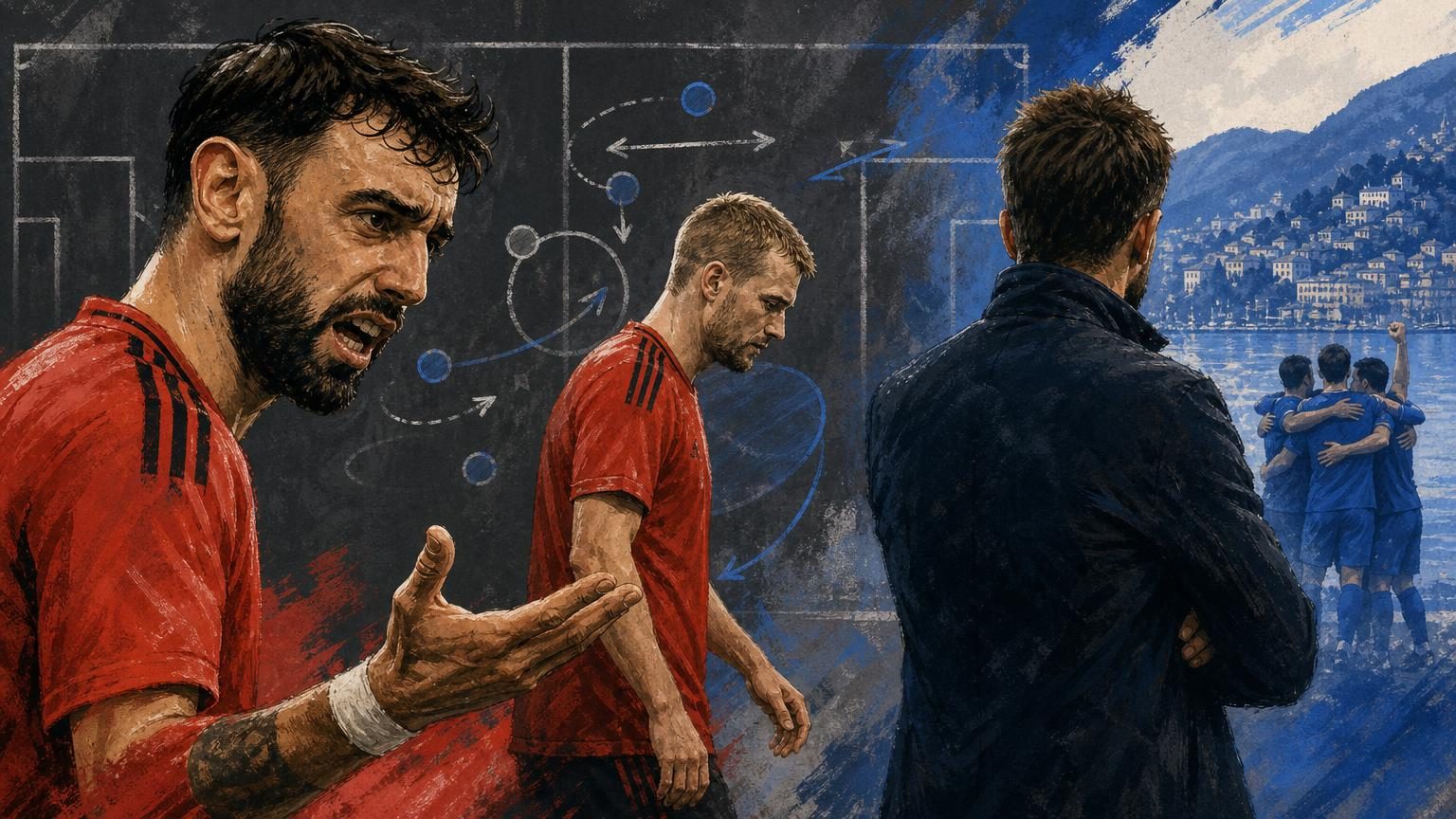
Manchester United's capitulation at Como was not merely a scoreline problem. It was a performance that left their own captain publicly questioning the plan behind it.
Bruno Fernandes was substituted during the 4-1 defeat and reacted with visible anger, telling TNT Sports afterwards that the call had come from the bench rather than from him. "It's a decision from the staff," he said, a line that read as pointed given the context of a team being picked apart.
Nico Paz scored twice, with Tasos Douvikas and Jacobo Ramon also on target, as Como - in Serie C as recently as 2021 - overran a United side that offered little resistance. Jamie Jackson, reporting for the Guardian from the Giuseppe Sinigaglia Stadium, described it as United's worst defeat in continental football since 1994, inflicted by Cesc Fàbregas's side in their Champions League debut season.
Why conceding early has become a pattern
Fernandes was explicit about the psychological toll of United's start to matches. "Conceding early makes us go into game with a mood of defeat," he said, adding that breaking out of that mindset "is going to be very difficult" if United cannot find the bravery to keep the ball and create chances once behind.
This was the second successive Champions League fixture in which United shipped a goal inside the opening five minutes, following the 2-0 defeat to Atletico Madrid. A team conceding early that consistently is not simply unlucky with set pieces or individual errors in the first moments - it points to a structural problem in how United set up to start games, whether in their positioning at kickoff or their readiness to press in the opening exchanges.
Fernandes went further, suggesting the passivity that followed was not accidental. He described "not much pressure on the ball" and "not many good movements with the ball" as Como dominated possession, and the sense from his comments was that United had been set up to sit off rather than engage - a tactical choice he attributed to Carrick's staff rather than a breakdown in execution alone.
Sitting deeper against a possession-dominant side can be a legitimate low-block strategy, but it only works if the team defending has the organisation and discipline to deny space between the lines. Como's control of the ball suggests United's block was porous rather than compact, allowing the hosts to progress through central areas rather than being forced wide.
The defence that has not changed in years
The chaos at Como did not emerge from nothing. Writing for Planet Football before the game, Matt Stead noted that Manchester United remain one of only two Premier League teams without a clean sheet this season, with Ipswich the other. He traced this to a backline - Diogo Dalot, Harry Maguire, Lisandro Martinez and Luke Shaw - that has featured regularly under three different managers since Erik ten Hag's first defeat in August 2022.
Stead's argument was that United's transfer strategy under INEOS, which he described as limiting recruitment to one position per summer window, has left Carrick protecting Senne Lammens in goal with largely the same personnel that has long been exposed defensively. That continuity without resolution is now playing out on the European stage as much as domestically.
The comparison Stead drew was with Unai Emery's Aston Villa, who sit just a point and a place above United in the Premier League despite using some of United's own discarded parts alongside ageing recruits of their own. Villa have won four of their last five league games and hold a perfect Champions League record, a trajectory Stead framed as evidence of momentum United have been unable to generate for years.
What the Como result changes
None of this excuses Como's performance, which was built on quick, incisive movement and sustained pressure that turned a genuinely talented but inexperienced squad into Champions League conquerors of a three-times European champion. But it does suggest United's problems are not confined to one bad night in northern Italy.
Fernandes's on-camera frustration, combined with the specifics of his critique - the lack of defensive pressure, the passive body language, the repeated early goals - amounts to a player publicly distancing himself from his manager's setup. For Carrick, already facing scrutiny over results, that kind of dissent from his captain adds pressure that results alone were already generating.