
Buffon's defence of Spalletti points to Juventus' deeper structural problem
Gianluigi Buffon says Juventus' crisis runs deeper than the coach's bench, framing Bremer's outburst, a crowded injury list and a pattern of managerial churn as the real issues.
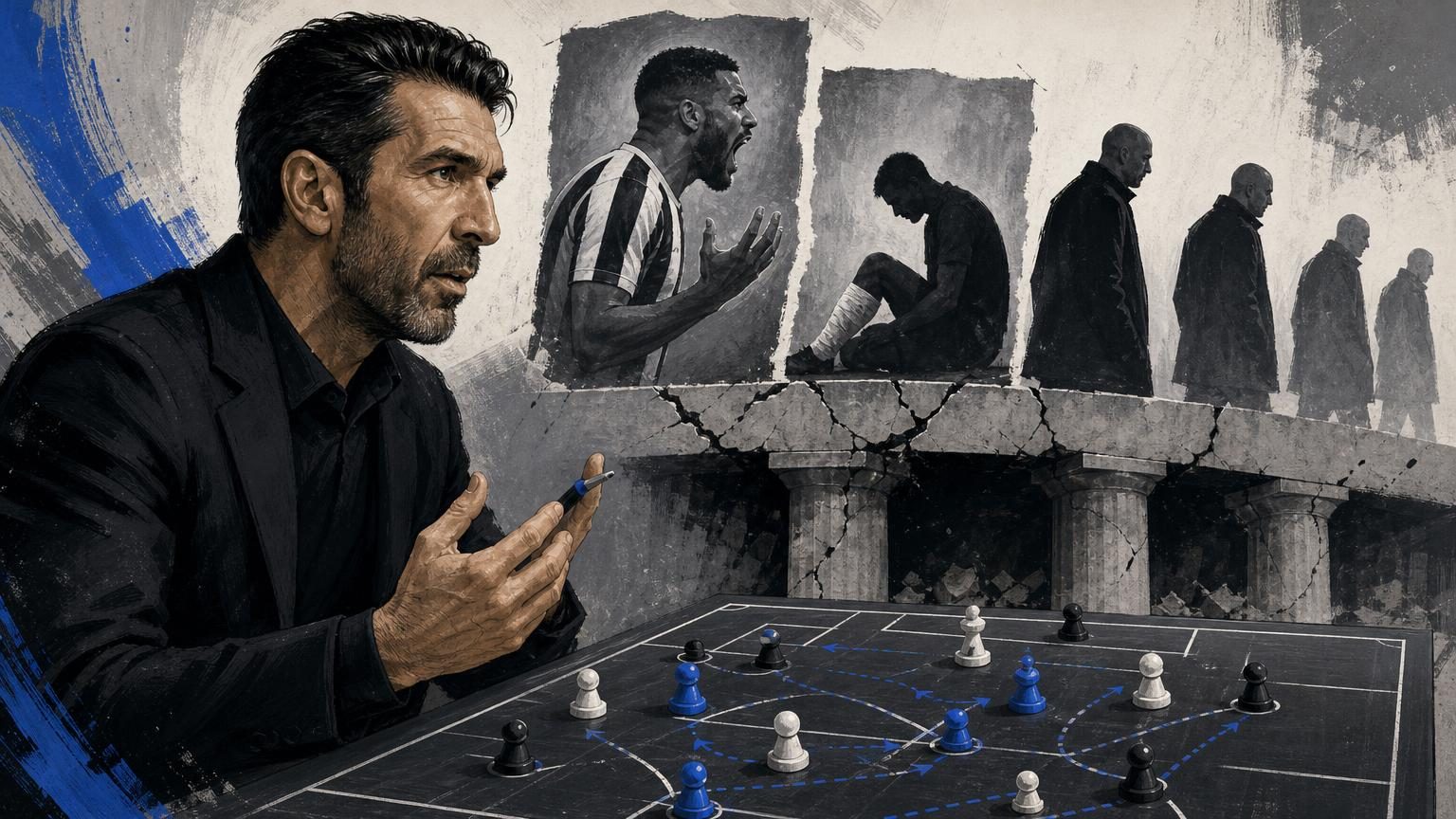
Gianluigi Buffon has defended Luciano Spalletti and argued that Juventus' problems cannot be reduced to who occupies the dugout, speaking to La Gazzetta dello Sport after a 3-0 home defeat to Lazio left the club eight points off the Serie A summit after seven rounds, Football Italia reports.
The result sharpened scrutiny on Spalletti and followed a post-match outburst from centre-back Bremer, who accused unnamed teammates of being 'scared' and 'hiding'. Football Italia reports that Juventus will continue backing Spalletti for now and that Bremer has since apologised to colleagues.
Bremer's outburst reflects a specific defensive role under strain
Bremer's comments carry particular weight because of where he plays. A centre-back is the player most exposed when a team's structure breaks down defensively, reading the first phase of buildup against the press and organising the line behind a midfield under duress. When that reading goes wrong repeatedly, as it has in a game where Juventus conceded three at home, the instinct to call out teammates publicly often comes from the position itself rather than simple frustration.
Buffon, a former goalkeeper who spent his career marshalling a backline from deeper still, said he recognised the impulse. "I did that as well, and it was always instinctively," he said. "I never planned a speech, I always thought it was right to speak in the moment. I knew that I had to say certain things at certain points."
He was careful to qualify the point rather than simply endorse it. "I understand Bremer's outburst. However, when you talk, you always have to be in the position where you're the one who is giving the most and can afford to make certain jabs. But, you have to question yourself first. Sometimes I needed to be told off as well."
An injury list that hits every structural line of the team
Buffon's central argument is that Juventus' output cannot be judged fairly while so many first-choice players are absent. He listed Yildiz, Locatelli, Thuram, Ekhator, Milik and Grabara as unavailable, comparing the gap to removing Cannavaro, Buffon, Totti, Nesta and Pirlo from an Italy squad.
That list is notable for its spread across the pitch rather than a cluster in one area. Locatelli anchors a double or single pivot in midfield, Thuram and Yildiz carry attacking buildup and chance creation, Milik offers a finishing option, and Grabara is a goalkeeping absence that affects distribution and shot-stopping depth. Losing players across that many structural roles at once strips a coach of the rotation options needed to maintain an approach rather than simply patch gaps.
Buffon framed this as a rebuilding phase rather than a form slump. "They have to rebuild and instead they're lacking," he said, adding that Spalletti had also had to manage a fixture only three days after a Celta Vigo match and a return journey that finished at five in the morning, a scheduling burden that compresses recovery time and training work on shape before the next league game.
Managerial turnover undermines any coach before the project starts
Buffon's strongest point is structural rather than situational: Juventus have changed coach five times in four years, a pattern he says makes it implausible that the coach is consistently the single variable at fault. "The problem can't just be the coach if you fire five of them in four years," he said.
Repeated managerial turnover disrupts far more than results. It resets tactical identity, pressing triggers, build-up patterns and the relationships between a coaching staff and senior players like Bremer, who has to adjust his defensive reading to a new system and a new set of instructions each time. Buffon's reasoning suggests Juventus' instability is less about any single appointment failing and more about a club that has not let a structure embed long enough to be judged on its own terms.
His final message was unambiguous. "If I have one hope, it is to see Spalletti continue his work until the end."
Juventus' immediate task is narrowing an eight-point gap to the league leaders after seven games, with Spalletti still backed by the club for now and key absentees across midfield, attack and goalkeeper due back to offer him the squad depth his approach has lacked.