
Carrick's press dilemma exposed as Como expose Man Utd's shape
Michael Carrick says the 4-1 Champions League loss to Como 'hurt' him, but the tactical breakdown behind the defeat points to a deeper structural problem than one bad night.
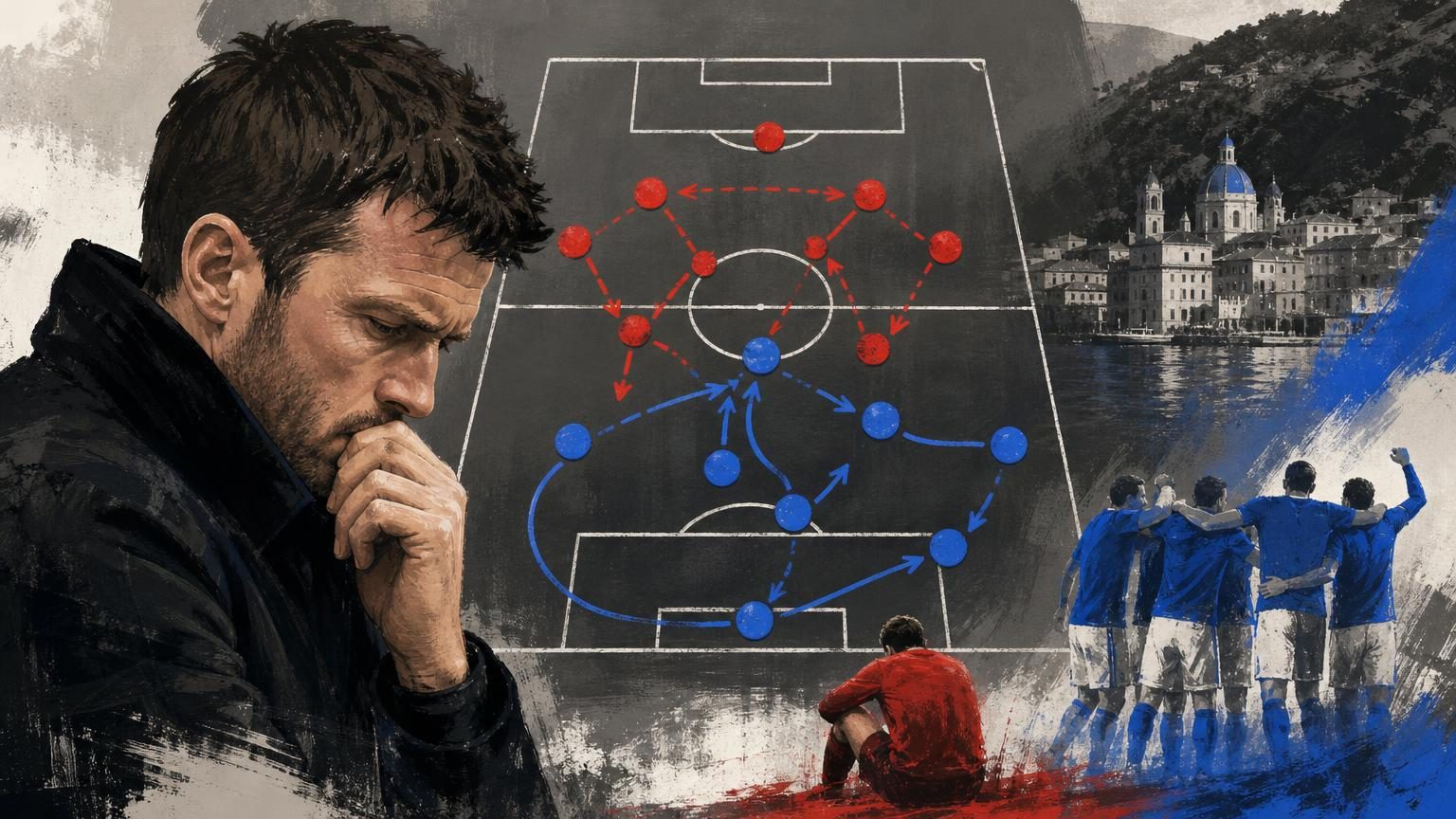
Michael Carrick has admitted the 4-1 Champions League defeat to Como was a wound he is still carrying, telling a press conference on Friday that the manner of the loss 'hurt a lot' to watch unfold, as quoted by The Manchester Evening News via Football Italia.
The scoreline alone understated the gap between the sides. Jamie Jackson of the Guardian reported that United's loss in Como was the club's worst defeat in continental football since 1994, suffered against a club that was playing only its third ever European fixture and had been in Italy's fourth tier as recently as 2019.
That context matters more than the result itself. Como are not an established continental force exploiting superior resources; they are a newly promoted side under Cesc Fàbregas who identified and attacked a specific structural weakness in how United set up without the ball.
Fernandes named the problem, but was part of it
Bruno Fernandes did not wait for the inquest to begin privately. Speaking to TNT Sports after the game, United's captain said the decision not to press man-to-man had let Como settle into possession, warning that 'when you give too much [of] the ball to these teams they get confidence,' as reported by The Analyst.
Pressed on whether Carrick had got his tactics wrong, Fernandes distanced himself from the call, saying it was 'on the manager and staff to see it, not me,' before adding that the team needed to 'be more brave under pressure, take the risk of pressing high and making them uncomfortable.'
Carrick's reply was pointed rather than defensive. He noted that United did attempt a man-to-man press after the break and it backfired, saying 'we half pressed man-to-man in the second half and ended up conceding a goal from that,' a detail reported by The Analyst that complicates Fernandes's diagnosis.
That exchange matters tactically because a half-press — committing bodies forward without full man-oriented coverage behind — is often more dangerous than a settled low block. It opens exactly the kind of space in behind that a team built around a free-roaming number ten can exploit, and Nico Paz did precisely that in leading Como's rout.
A structural problem, not just a bravery one
Fernandes framed the issue as one of courage, but the deeper question is one of coordination. A high, man-to-man press only works if every outfield player trusts the next to follow the trigger; a single mistimed jump, or a captain pressing on his own initiative, invites the kind of space Como used to carve United open.
That is the uncomfortable possibility sitting underneath Fernandes's criticism: that United's problems in Como were not purely a conservative tactical choice from the bench, but a team unable to execute either a coordinated press or a disciplined block consistently for ninety minutes.
Carrick's own words after the match reinforced how badly the collective performance sat with him. 'It was really unacceptable for us to play like that and to be like that,' he said, according to Football Italia, before turning to the supporters who had travelled to Lake Como and 'spend the money to come and support us' only to watch the heaviest defeat of the European campaign so far.
Carrick's position and what comes next
Carrick confirmed he remains in 'conversations' with the club, language that leaves his long-term position deliberately unresolved rather than settled either way. Coming in the same week that Lisandro Martínez's comments had already dominated headlines, Fernandes's intervention adds a second senior dissenting voice inside the dressing room within seven days.
The tactical fix is not simply a switch to pressing higher, since Wednesday's second-half attempt at exactly that conceded a goal. United's task is to build a press the squad can execute together, or a block it can hold without being pulled apart by a player of Paz's quality — and to do it before the next fixture arrives with the same questions still unanswered.