
Chivu says half-time calm, not tactics, salvaged Inter's win over Shakhtar
Cristian Chivu explains how Inter weathered Alessandro Bastoni's red card and Shakhtar Donetsk's provocation to claim their first Champions League win of the season.
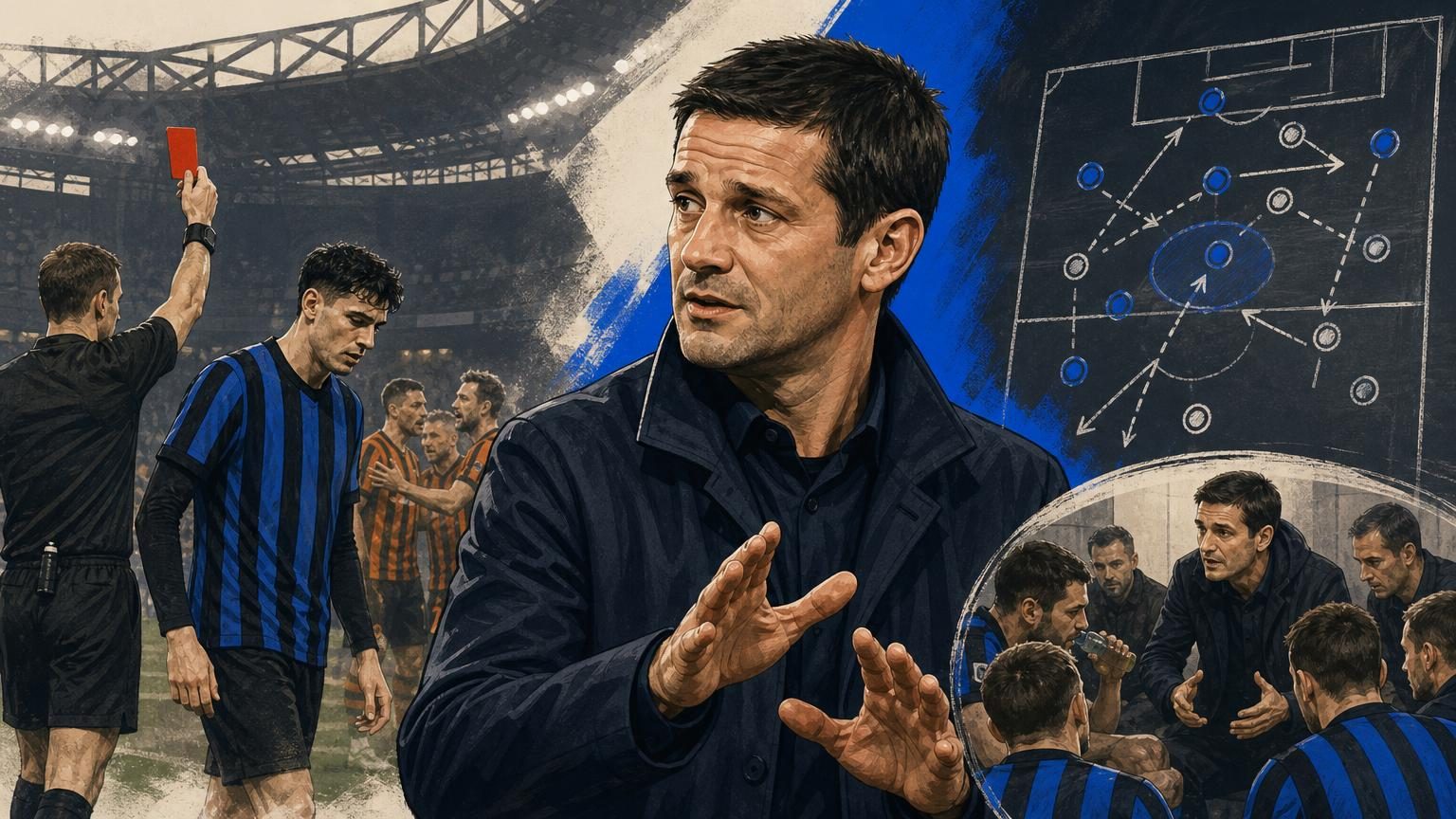
Inter needed more than a tactical tweak to beat Shakhtar Donetsk 1-0 at San Siro on Wednesday. They needed their players to stop reacting, Cristian Chivu said afterwards, after Alessandro Bastoni's dismissal left the hosts to see out most of the second half a man short.
Carlos Augusto scored the only goal after the break, giving Inter their first Champions League victory of the season and lifting them to three points from three matches in the competition, Football Italia reported.
Bastoni was sent off for two yellow cards shown within two minutes of each other, the second for pushing Oleh Ocheretko as he waited to meet a Nicolò Barella cross. Chivu did not see the incident itself, he admitted, because he was already working out how to reorganise his side defensively.
A dismissal that forced an immediate reshuffle
Losing a starting centre-back mid-half is never just a disciplinary problem. It is a structural one. Inter had to go from managing the game with a full complement to defending a numerical disadvantage for close to 45 minutes, which changes everything about spacing, pressing triggers and who covers the width Bastoni would otherwise have occupied.
Chivu's own words point to that split focus. He said he "didn't see the second incident" because his attention had already shifted to reorganising the team, which suggests the red card's tactical consequence mattered to him as much as, or more than, the card itself in the moment it happened.
That a side missing a man still found a winner through Carlos Augusto is the more striking half of the story. Holding a one-goal lead with ten men typically pushes a team into a deeper, more compact defensive block, conceding territory to protect the result rather than chasing a second goal — a trade-off Chivu's remarks imply Inter accepted once the red card went up.
Provocation, frustration and the game Chivu wanted avoided
Chivu was explicit that Shakhtar's approach played a part in what unfolded. He said he told his players at half-time to "stay calm, not let themselves get frustrated, and accept that it would be an ugly game and that their passing would frustrate us. We needed to manage our frustration better."
That framing describes a deliberate attempt by the visitors to disrupt Inter's rhythm through slow, interrupted passing rather than open, attacking football — the kind of game that invites frustration precisely because it denies a team the transitions and sustained pressure it wants to build.
Bastoni's first yellow, by Chivu's account, came when the expectation that the goalkeeper would simply clear the ball did not materialise, and the Italian defender's temper slipped as a result. The manager called the dismissal "naive" rather than malicious, a distinction that matters: Chivu was describing a lapse in composure under provocation, not a tactical or technical failure.
His wider point was about discipline as a team skill rather than an individual one. "These are the kinds of frustrations that can often affect the course of a game, and we need to keep a clear head and stay calm, accepting that sometimes opponents will try to provoke us," he said, treating emotional control as something to be managed collectively rather than left to a single player to sort out alone.
What the result changes for Inter's run-in
Three points from three Champions League matches leaves Inter with work still to do in the league phase, even with Wednesday's win banked. Their next continental fixture takes them to Feyenoord on Tuesday, 3 November, a trip where they will not have the cushion of a home crowd if another match turns scrappy.
Before that, domestic business resumes on Sunday, when Inter host a struggling Fiorentina at San Siro in Serie A. A fixture against a side lower in form offers a more straightforward platform to manage without the kind of in-game discipline test Shakhtar presented, though Bastoni's suspension status for that return to San Siro was not addressed in Chivu's comments.
The win itself will matter less in the long run than what Chivu asked of his players once Bastoni walked off. Managing a one-man deficit against a side set up to frustrate is precisely the kind of situation that exposes whether a team's composure holds, and on this occasion, Inter's did.