
Jurgen Klopp and the press that defined three clubs
Gegenpressing, not possession, was the organising idea behind Klopp's Mainz, Dortmund and Liverpool sides, and it shaped everything from training to trophies.
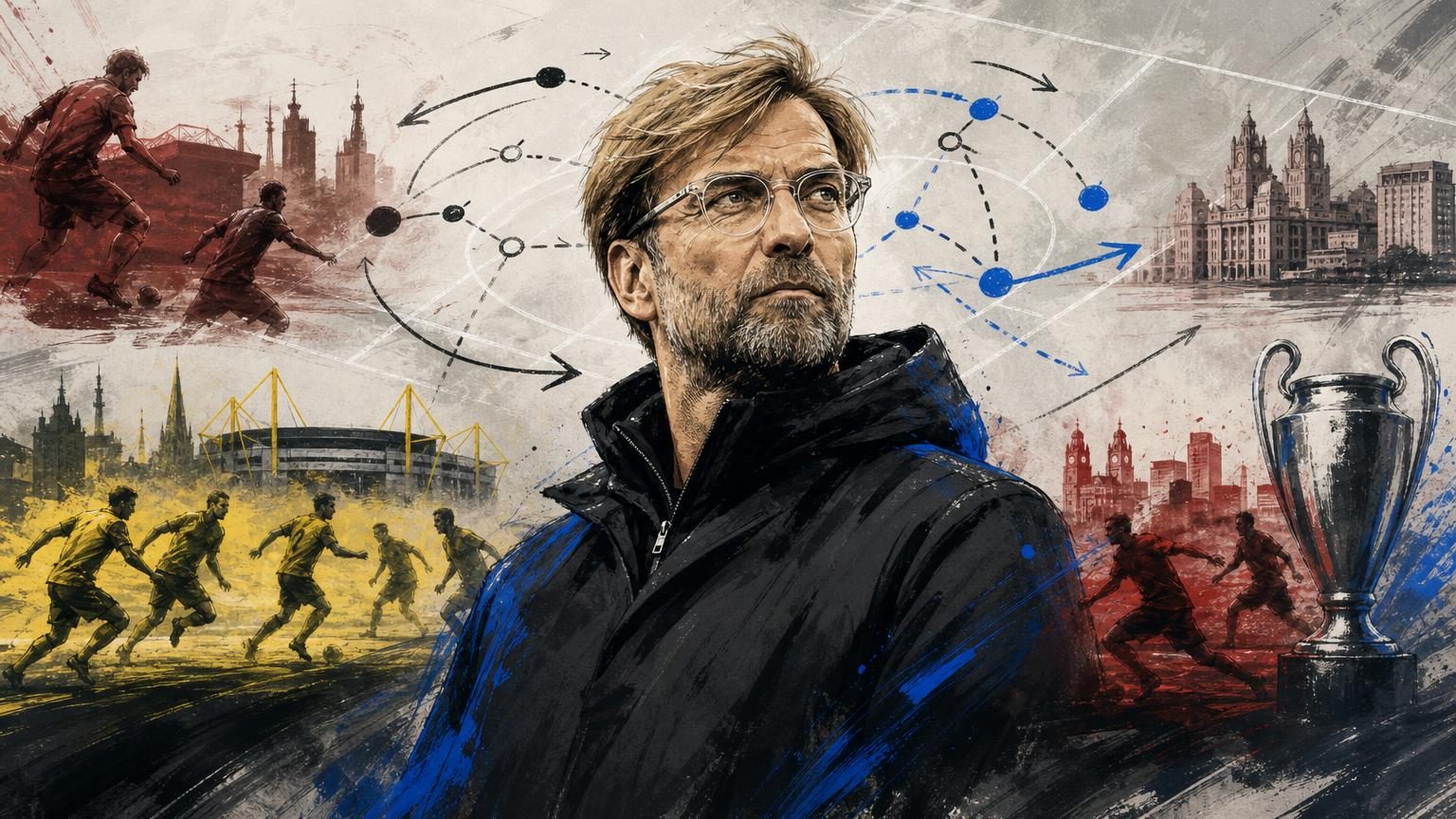
Jurgen Klopp's coaching has one idea running through it more than any other: what a team does in the seconds after it loses the ball. Wikipedia describes him as a notable proponent of Gegenpressing, a method in which the team immediately attempts to win back possession the moment it is lost, rather than retreating into shape to regroup.
Why winning the ball back beats retreating
The logic of this approach is about timing. A team that has just lost the ball is, for a brief moment, the best-organised side on the pitch defensively, because its players were already positioned to attack. An opponent that has just won the ball, by contrast, is often still finding its passing options and shape. Pressing in that window, rather than dropping off, is designed to exploit that imbalance before the other side can settle into possession.
This is different from a team simply chasing the ball man-to-man across the pitch.
Association football's defensive theory distinguishes between zonal defending, where players move in relation to space and teammates, and man-to-man defending, where they track individual opponents; most pressing systems are hybrids of the two. A coordinated press also depends on what is sometimes called pressure width — how far out towards the touchline a team is willing to commit players when it presses — because a press that is too narrow or too wide creates gaps the opponent can escape through.
Klopp's version of this demanded intensity from every outfield player, not just those closest to the ball, because the moment of transition only works if the whole team shifts together rather than leaving isolated chasers. Wikipedia notes he described his sides as playing "heavy metal" football, a phrase he used in reference to their pressing and high attacking output.
The emotional charge behind the system
Klopp has consistently stressed emotion as part of how his teams function, and this has been visible in his touchline behaviour throughout his career, according to Wikipedia. A pressing system built on repeated, collective sprints after losing the ball is physically demanding, and the emotional register Klopp brought to matches and training was presented as inseparable from sustaining that effort over a season.
His own route into coaching reinforces how deliberately he thought about the game rather than simply playing it. Klopp, who began as a striker before moving to defence during his playing days at Mainz 05, once summed up his limitations as a player by saying he had "fourth-division feet and a first-division head". He has cited Arrigo Sacchi and former Mainz coach Wolfgang Frank as his main influences, pointing to a coaching education built on studying structure and method rather than instinct alone.
Three clubs, one method, repeated success
The pressing approach travelled with Klopp across his career. At Mainz, where he became manager after retiring as a player in 2001, he secured Bundesliga promotion in 2004 before relegation and his resignation in 2008. At Borussia Dortmund, he won the Bundesliga title in 2010–11, then a domestic double, before reaching the 2012–13 Champions League final as runner-up and adding DFL-Supercup wins in 2013 and 2014.
At Liverpool, appointed in 2015, Klopp reached Champions League finals in 2018 and 2022 and won the competition in 2019. His Liverpool side finished second in the 2018–19 Premier League with 97 points, then won the title the following season with a club-record 99 points, also claiming the UEFA Super Cup and Liverpool's first FIFA Club World Cup that campaign. He added an EFL Cup and FA Cup double in 2022 and a further EFL Cup in 2024, the year he departed the club.
Those results, across three different clubs and two decades, are the clearest evidence that the pressing identity was not tied to a single squad or league.
In his first Liverpool press conference, Klopp called the club "it is not a normal club, it is a special club. I had two very special clubs with Mainz and Dortmund. It is the perfect next step for me to be here and try and help", a framing that fit a career built on finding clubs willing to commit to his method rather than adjusting it to suit them.
After a two-year break from coaching, Klopp was appointed head coach of the German national team in 2026, according to Wikipedia. Whether the same pressing principles translate to the international calendar, with its shorter preparation windows and less daily training contact, is the question his new role will answer.