
Johan Cruyff's Coaching Philosophy: Space, Interchange and Total Football
Cruyff's teams built their control of matches on a single idea: manipulate space, not just the ball, and let players rotate freely through it.
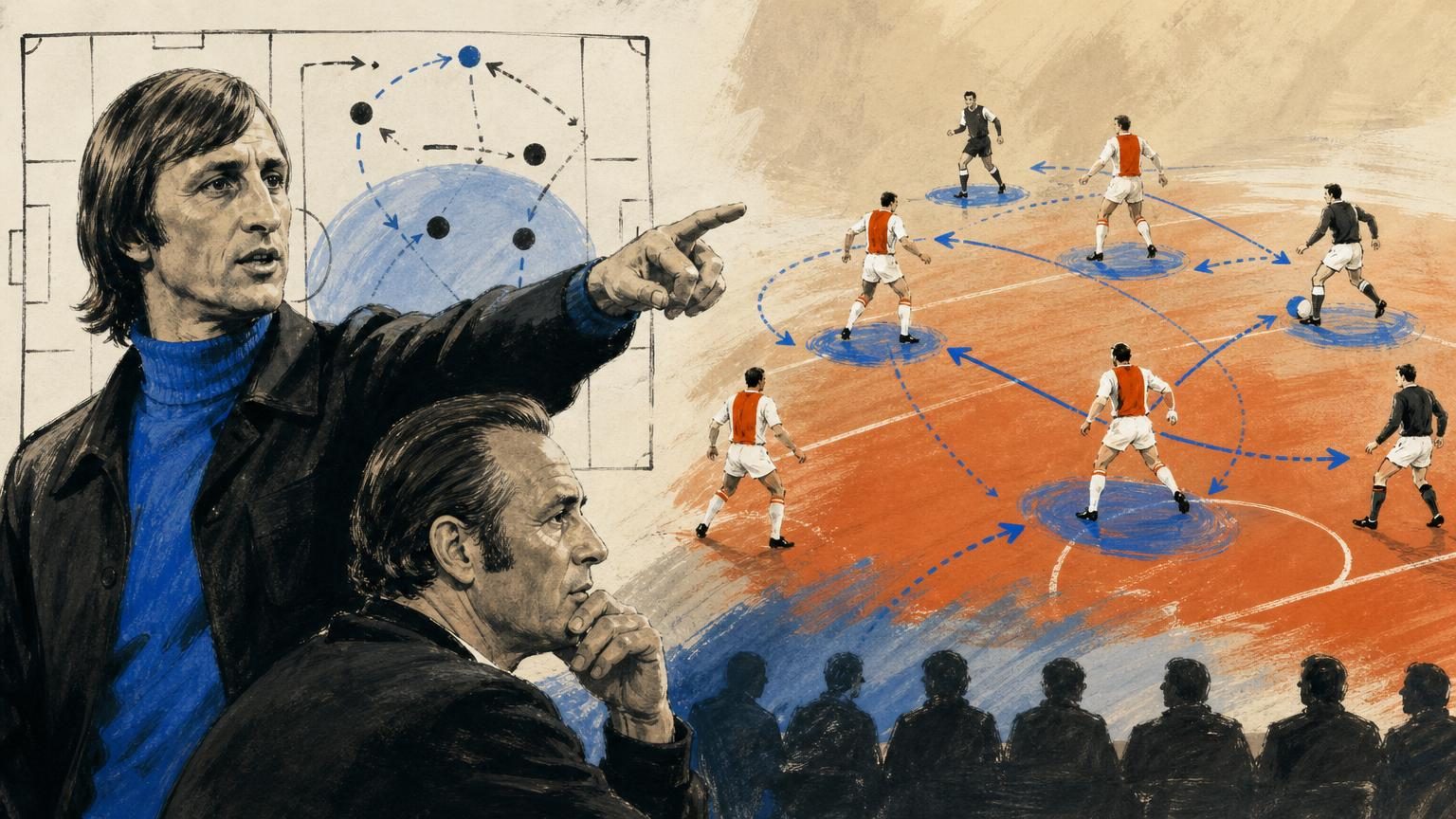
Johan Cruyff's approach to coaching cannot be separated from Total Football, the system developed by Rinus Michels at Ajax, where any outfield player could take over another's role so long as a teammate filled the vacated position, according to Wikipedia.
Cruyff was the system's most prominent player before he became its most influential coach, first at Ajax and then at Barcelona, where he won four La Liga titles and the European Cup, having earlier taken Ajax to the 1987 European Cup Winners' Cup.
How Total Football redefined space
The defining shift under Michels was not a new formation alone, though Ajax settled into a 4-3-3 from the 1969–70 season onward. It was a different way of thinking about the pitch itself.
British author David Winner, cited by Wikipedia, argued that Ajax's abstract conception of space was distinctive enough that it could only have emerged from a specifically Dutch relationship with land and environment.
In possession, Cruyff and his teammates stretched the playing area as wide as possible, shifting play to the flanks to create room. Out of possession, they did the opposite: they compressed the pitch.
That compression came from pushing the defensive line up near the halfway line, pressing into the opponent's half, and using the offside trap to shrink the space available to attackers even further.
The false nine and controlled chaos
Cruyff's own role gave the system its most recognisable feature. Nominally a centre forward, he dropped into wide areas or deep midfield, anticipating what later became known as the false nine.
If his marker held position, Cruyff created a numerical overload wherever he dropped. If the marker followed him, he opened the central space he had just vacated for a teammate to exploit.
Wikipedia records that Simon Kuper credits this habit of shifting position as the actual source of Ajax's trademark positional rotations, since teammates adjusted intuitively around Cruyff rather than following a fixed script.
Cruyff himself called this pattern controlled chaos. As he grew older, his influence over teammates increased to the point where he effectively functioned as a player-coach, directing formation changes and even requesting substitutions from the bench.
Arsène Wenger, quoted by Wikipedia, said it was practically impossible to copy Ajax precisely because the presence of a coaching figure like Cruyff on the pitch itself was unique.
Michels' Ajax paired its spatial ideas with an aggressive, physical style of pressing, which the squad referred to internally as hunting, intended to deny opponents time on the ball.
Former Ajax defender Barry Hulshoff, cited in Wikipedia's entry on Total Football, said positional interchange was only possible because of players' spatial awareness, describing constant discussion among the squad about where to run and where to stand.
Hulshoff also described the system as proactive, built around pressing to recover possession or to pin opponents under sustained pressure rather than waiting passively in a defensive block.
The high defensive line was not solely a coaching instruction. Wikipedia notes that players themselves pushed for it in part to conserve energy by playing on a physically smaller patch of pitch.
This combination of a high line, aggressive pressing and the offside trap meant Ajax's defensive shape and their attacking occupation of space were two expressions of the same underlying principle: control territory, and the ball follows.
The approach had a clear limit. In the 1974 World Cup final, Berti Vogts' marking of Cruyff blunted the Dutch side's playmaking in the second half, allowing Franz Beckenbauer, Uli Hoeneß and Wolfgang Overath to take hold of midfield as West Germany won 2–1.
What carried forward into modern positional play
Wikipedia traces a direct line from these ideas to the Juego de Posición, or tiki-taka, developed at Barcelona under Pep Guardiola in the late 2000s and early 2010s, built on the same foundation of manipulating space through positioning and circulation.
The throughline from Michels and Cruyff to that later era is the insistence that a team's shape in possession and its compactness out of possession are not separate problems to solve but one continuous idea about controlling the size of the pitch.