
How Manchester United turned a crisis tie into a 7-1 rout of Roma
Ten goals, a tactical gamble forced by suspension, and one of the great Champions League evenings: inside United's 7-1 demolition of Roma in 2007.
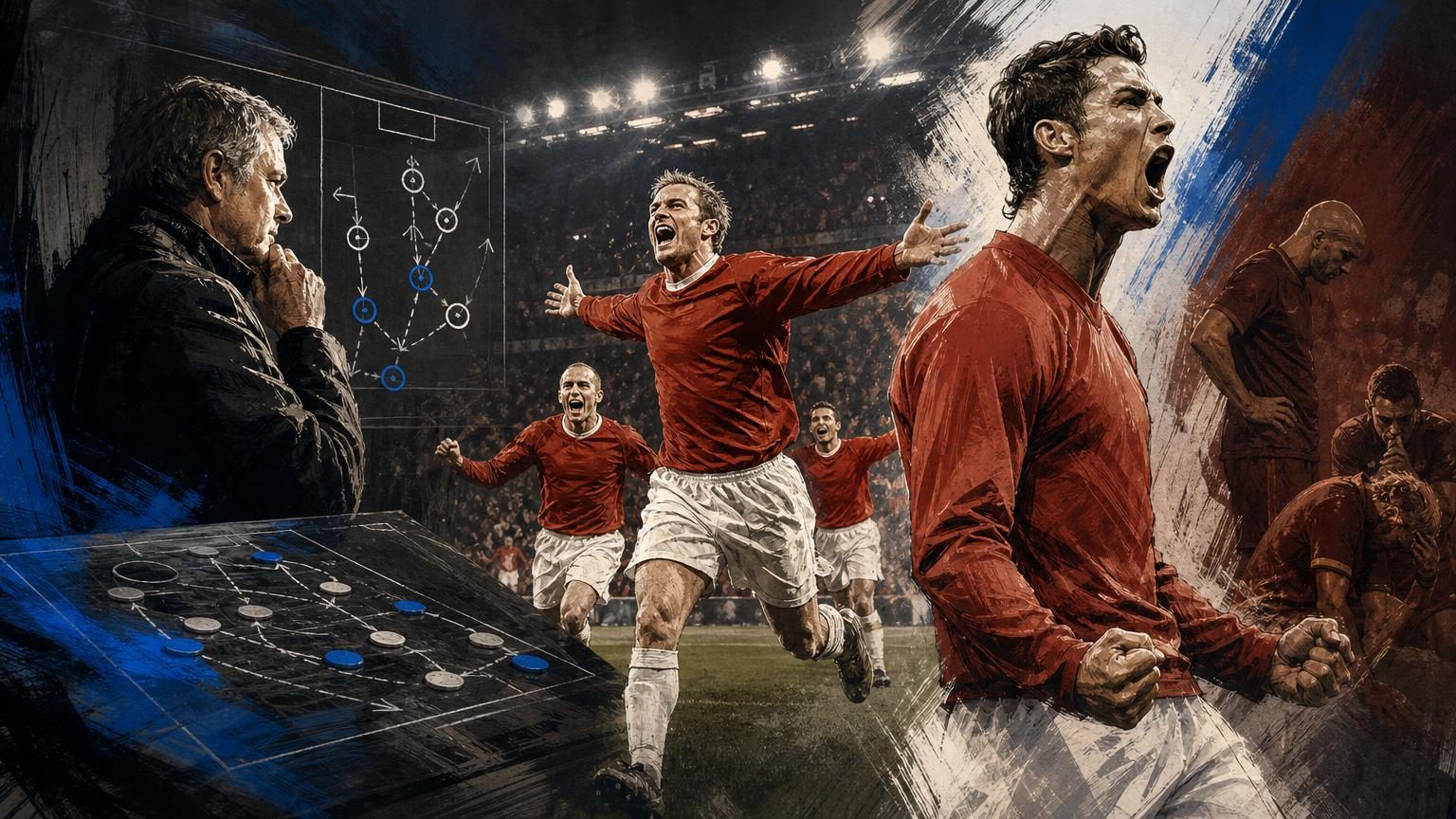
Manchester United went into the second leg of their 2007 Champions League quarter-final against Roma needing only a one-goal win to progress, having lost the first leg 2-1 in Rome, according to Planet Football. Paul Scholes had been sent off in that first leg after two bookable offences, leaving Sir Alex Ferguson without his first-choice central midfielder for Old Trafford.
That suspension forced a reshuffle that shaped everything that followed. Michael Carrick and Darren Fletcher started together in central midfield, while Alan Smith, just over a year removed from the horrific injury he suffered against Liverpool, was given a rare start up front, Planet Football reported.
A midfield pairing built for distance, not control
Carrick and Fletcher were not an orthodox double pivot in the sense of shielding a back four against a possession-heavy opponent. Roma did not dominate the ball long enough for that question to matter. Instead, the pairing gave United a platform to spring quickly into the final third and, crucially, license for Carrick to shoot from distance once space opened in front of him.
That licence paid off twice. Carrick opened the scoring after 11 minutes with what Planet Football described as a wonderful, clipped effort from long range that beat Doni, and he repeated the trick in the second half with another long-range strike that again left the Roma goalkeeper clutching thin air. Two goals from a central midfielder picking his spot from outside the box said as much about the space Roma allowed as it did about Carrick's technique.
Commentator Clive Tyldesley's live reaction to the opener, quoted by Planet Football as "1-0 will do for Manchester United," captured the mood at that point: United only needed the aggregate scoreline to tip in their favour. What followed was something closer to collapse.
Transitions Roma could not contain
The second goal illustrated the pattern that would recur all night. Ryan Giggs fed Alan Smith in a quick move from build-up play, and Smith scored his first goal since November 2005, sending Old Trafford into raptures, Planet Football reported. Roma's stated objective, needing only to score once themselves to swing the tie back their way, barely altered after that goal, but the momentum had already shifted decisively.
By the 19th minute United led 3-0, a goal involving Fletcher, John O'Shea, Cristiano Ronaldo, Smith, Giggs and Rooney in combination, which Guardian writer Kevin McCarra, quoted by Planet Football, called proof that "no one believed it possible to treat an Italian club quite like this." The speed of the move, and the number of players involved in a single sequence, showed a team exploiting an opponent whose defensive shape had stopped functioning as a unit.
Ronaldo's fourth goal, converted after he controlled the ball on the right flank in first-half stoppage time, was his first in the Champions League and arrived after 30 matches in the competition without one, according to Planet Football. He added a second early in the second half from a low Giggs cross that Smith failed to connect with, taking United to 5-0 before the hour mark.
Roma's structure, and why it kept breaking
What makes the scoreline instructive rather than simply freakish is how little Roma's response changed across 90 minutes. Each United goal came from a different source: a midfielder shooting from range, a forward finishing a low cross, a six-man combination move, a winger turning a full-back. That variety suggests Roma's problem was not one exploitable weakness but a general inability to reorganise once the game state turned against them.
Daniele De Rossi's goal in the 69th minute, a twisting volley from a cross that Planet Football called his greatest for Roma, briefly interrupted the pattern but changed nothing about the final outcome. Patrice Evra, introduced as a substitute right-back for O'Shea, completed the scoring with a drive from the edge of the area to make it 7-1 on the night and 8-3 on aggregate.
Before the game, Francesco Totti had told reporters, as quoted by Planet Football, that the tie meant more to him than the World Cup final, underlining how seriously Roma treated the fixture. Ferguson, in his programme notes also cited by the outlet, had written that a United goal would be enough to see the job through. Neither man's words anticipated the gap that actually opened up.
Roma manager Luciano Spalletti's post-match reflection, quoted by Planet Football, was blunt: "What would I change if I could do it again? Stay at home." It remains one of the heaviest defeats suffered by an Italian club in the competition, and a reminder of how quickly a tie balanced on a single away goal can turn once the side chasing it finds its rhythm.