
Real Madrid's patient build-up turns Mourinho ball on its head at Camp Nou
José Mourinho's Real Madrid beat long-unbeaten Barcelona 2-1 with a late Kylian Mbappé winner, built on a possession game few expected from the Portuguese.
Real Madrid beat Barcelona 2-1 at Camp Nou on Sunday, with Kylian Mbappé scoring twice either side of a Raphinha equaliser to end Barcelona's nine-game winning start to the season, the Guardian's Sid Lowe reported from the stadium.
It was José Mourinho's first match against Barcelona since 2013, and the winning goal arrived with three minutes left when Jude Bellingham's skill released Eduardo Camavinga, who beat Pau Cubarsí before squaring for Mbappé to finish, according to the Guardian's account.
What stood out before that winner, though, was how Madrid built their opener. Mbappé's first goal came after a Barcelona defender botched a clearance straight into his path, Planet Football's Samuel Bannister noted, but the move that forced the error was the more revealing part of the night.
Build-up play Mourinho rarely trusts
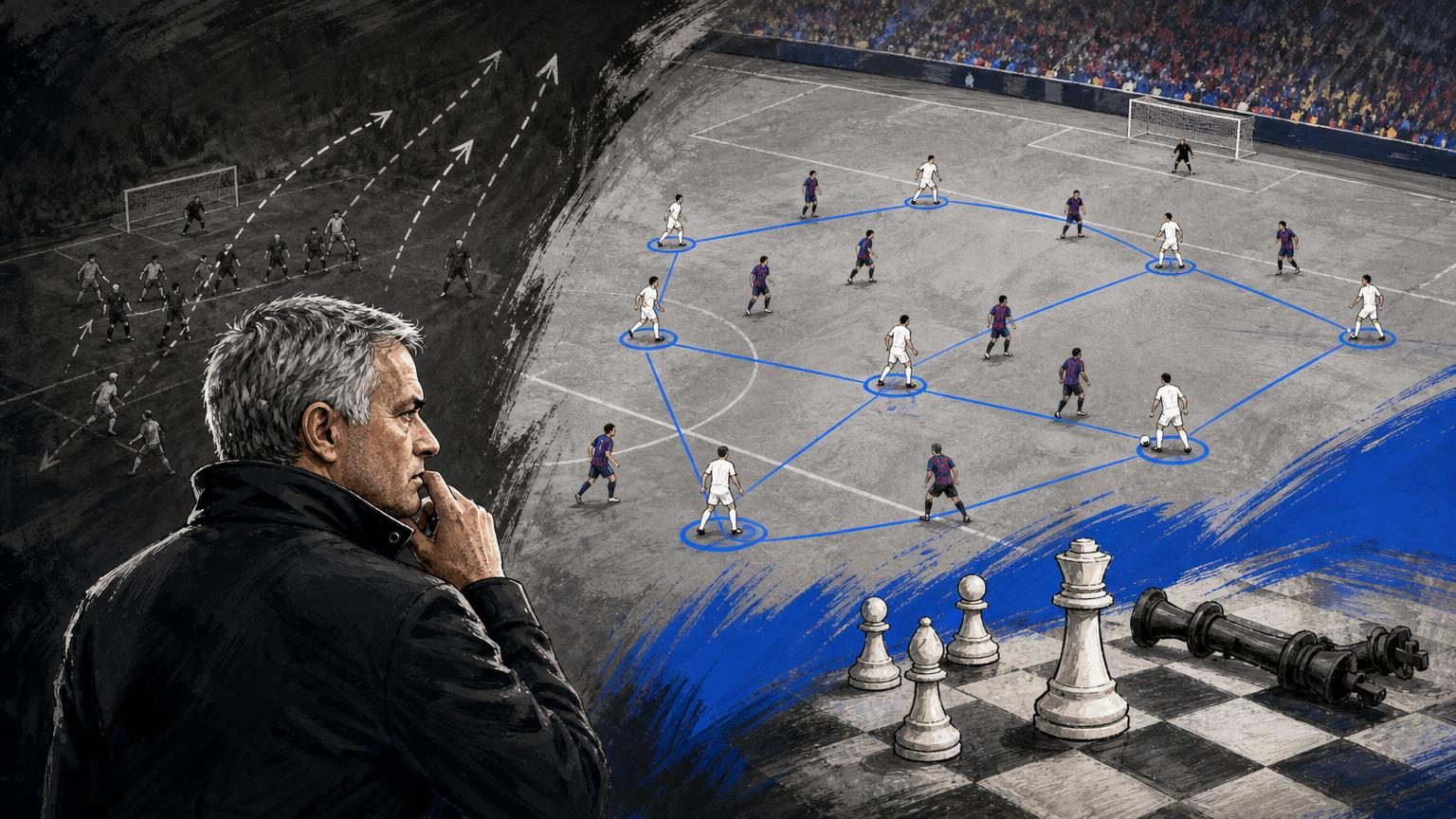
Madrid strung passes through their own back four before that opener, with every defender touching the ball and stand-in goalkeeper Andriy Lunin drawn into the sequence as well, Planet Football reported. That is the language of possession-based build-up play, not the compact, counter-first setup Mourinho is known for.
The point of circulating the ball through the back line in that way is to manipulate an opponent's press: if Barcelona's forwards commit to one side, space opens on the other, and the goalkeeper becomes an auxiliary passer rather than a last resort. Madrid used exactly that shape to escape Barcelona's press rather than simply clearing their lines, which is a notable departure for a manager whose sides have traditionally preferred to concede territory and strike on the transition.
None of that diminishes how scrappy the actual finish was. But a deliberate passing sequence that draws out a mistake is still a different kind of goal to the smash-and-grab counter that has defined so much of Mourinho's career, and it suggests his Madrid side can now threaten in more than one register.
How the winner flipped the script late on
The second goal was a different mechanism entirely: a direct transition move in the 87th minute, with Bellingham and Camavinga combining at pace to isolate and beat Cubarsí before the ball was squared for Mbappé. That is the Mourinho signature reasserting itself — quick vertical combinations exploiting space left by a tiring opponent, rather than patient circulation.
Lowe's report frames the context sharply: Barcelona had arrived on a nine-match winning run and with the prospect of pulling nine points clear at the top of the table before the end of October. Madrid's victory, coming right at the death, closes that gap and reopens a title race many had already written off.
What Mourinho's record at Camp Nou now shows
Opta's pre-match data put the result in historical context. Mourinho had gone unbeaten in his previous five meetings with Barcelona across all competitions as Real Madrid manager, winning three and drawing two. Only two Madrid managers have ever gone six or more Clásicos unbeaten: Miguel Muñoz, who won all seven between 1962 and 1965, and Vicente del Bosque, unbeaten in seven between 2001 and 2003.
Barcelona, for their part, had become only the second team in La Liga history to win each of their opening nine league matches, after Real Madrid achieved it in 1968-69; no team has ever won its first ten. Opta's figures also showed Madrid had won three of their previous six league visits to Camp Nou, matching the total they had managed across the sixteen visits before that.
Those numbers describe streaks and head-to-head tallies — they say nothing about how a given match was played. What Sunday added to them is a performance that combined patient buildup with a late transitional strike, giving Mourinho a result that fits his historical dominance of this fixture while hinting that his present Madrid side may be more adaptable in possession than his reputation suggests.
The damage to Barcelona is immediate and tangible: a nine-game winning run ended, and a lead that could have stretched to nine points instead evaporates into a genuine title race. Madrid's challenge now is proving this was a method rather than a one-off reading of a specific opponent.