
Araujo's Liverpool reinvention shows how context shapes a defender
Ronald Araujo struggled under Hansi Flick's high line at Barcelona but has become an instant fit at Liverpool, a shift that says as much about system as talent.
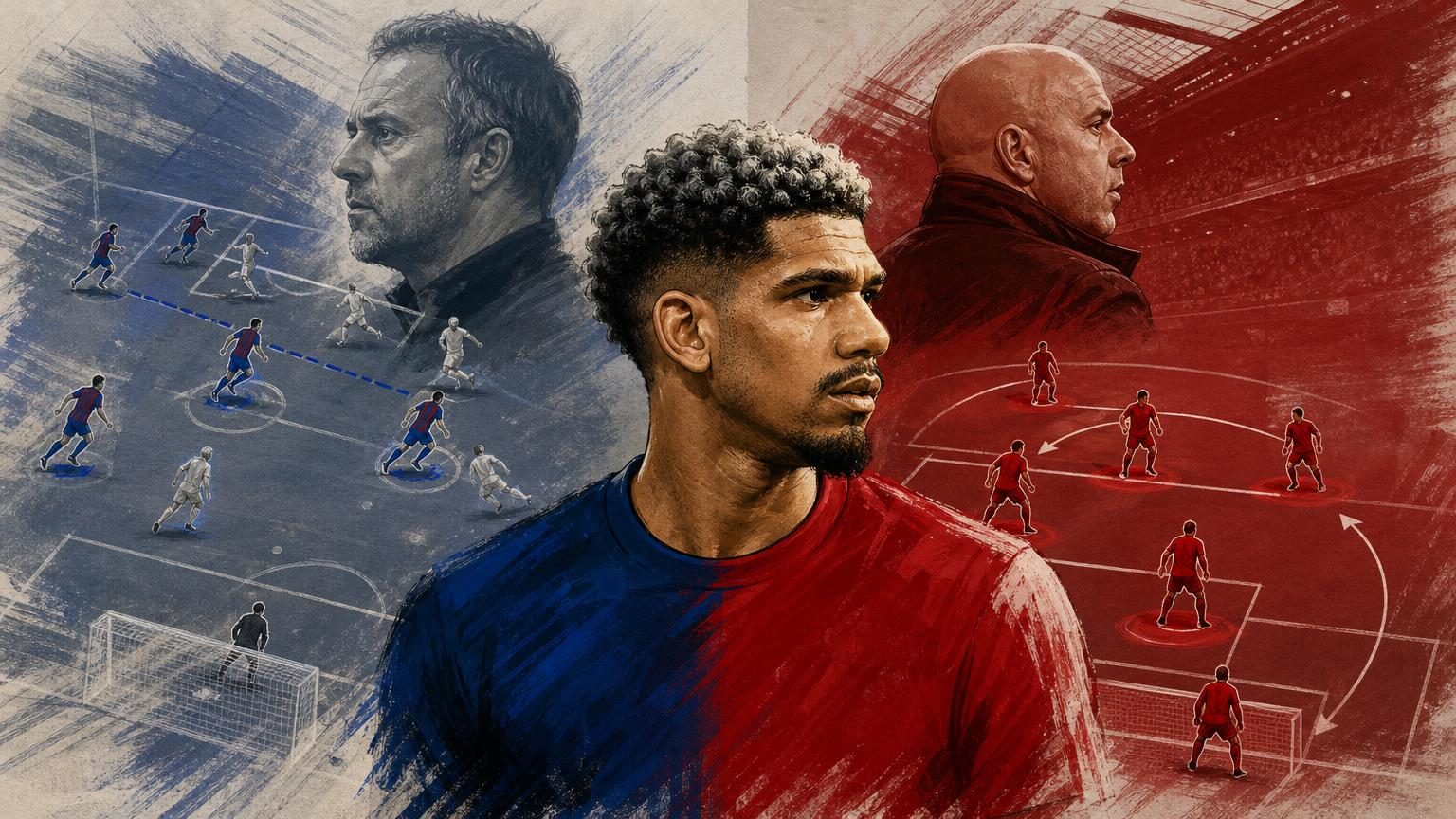
Ronald Araujo has gone from a scapegoat in Catalonia to one of the feel-good stories of the Premier League season, and the story behind that turnaround is less about a player rediscovering form than about a player finally being asked to do things he is actually good at.
Planet Football traces the roots of his decline to the structure Hansi Flick built at Barcelona, which demanded an aggressive, high defensive line that repeatedly exposed Araujo's reading of space behind him. His mistakes multiplied, the criticism intensified, and after a Champions League exit he stepped away from the squad to deal with his mental health.
Why the system, not the player, had changed
It is worth remembering that Araujo was not always a liability at the Camp Nou. Under Xavi Hernandez in 2022-23, Barcelona were a pragmatic, compact side rather than a flowing, possession-dominant one, and they shipped just 20 league goals on their way to the title, according to Planet Football. In that deeper, more controlled structure, Araujo's physicality and timing in duels were assets rather than exposed weaknesses.
Flick's refusal to soften his high line changed the calculation entirely. A centre-back who thrives on last-ditch duels and recovery pace in a settled back line is a different proposition to one asked to defend vast space in behind against runners in transition. Araujo increasingly looked like a player stranded in the wrong system rather than one who had simply lost his qualities.
A captain's armband amid the collapse
There was a brief moment of redemption before the move away. Barcelona handed Araujo the captaincy on his return from leave, and he lifted the Spanish Super Cup in January after a win over Real Madrid in Saudi Arabia, Planet Football reported. Raphinha framed it as an act of collective care rather than simply a footballing decision.
"He's had a bad time personally and that's normal because of the demands we have, the shirt we wear, who we are," Raphinha said, adding that he himself had struggled in his early seasons at the club. "For him to lift this cup was a demonstration of our love for him, that we're counting on him for everything."
That gesture did not resolve the underlying tactical mismatch. Araujo still became the identifiable face of Barcelona's defensive problems even in games where he was not primarily at fault, and he was left out of the side for most of their Champions League elimination by Atletico Madrid, a match in which they conceded four goals, per Planet Football.
What the numbers at Liverpool actually show
The picture under Andoni Iraola has been very different. In Liverpool's 2-0 win over Brighton, Araujo recorded more touches than any other Liverpool player on the pitch, 59 in total, according to The Analyst. He won possession six times, second only to Alexis Mac Allister's seven, and made eight clearances, behind only Virgil van Dijk's ten.
Those figures describe a defender whose value is built on duels, interceptions and recoveries rather than on calm distribution from a high defensive line under pressure. That is precisely the profile that struggled against pace in behind at Barcelona but looks ideally suited to a Liverpool side that needed its centre-backs to win individual battles against an in-form Brighton attack.
The viral moment from that game, Araujo blocking a shot from Maxim De Cuyper and then throwing himself to head away the follow-up, was treated as comedy by Liverpool's social channels, but it is also a useful shorthand for the kind of defending that made him captain material in a deeper structure and a liability in an exposed one.
A loan that tests how quickly reputations can be rewritten
Liverpool's willingness to take a 27-year-old defender on a one-year loan was, as The Analyst noted, a departure from a club that generally prefers long-term planning, but it was not without logic given Araujo's prior captaincy and pedigree at Barcelona. Two matches into his redemption arc, the deal already looks shrewd.
The broader point both outlets circle is that Araujo's season raises a fair question about how quickly players get labelled finished when the real problem was never their ability but the demands placed on them by a specific system. A defender judged a declining asset in one structure has, in a different one, become an instant cult figure at Anfield.