
Sarri's Atalanta stall again as injury crisis strangles the rebuild
A 1-1 draw with Kairat Almaty leaves Atalanta still searching for a win in seven matches, with Maurizio Sarri blaming a threadbare squad for a stuttering transition away from Gian Piero Gasperini's football.
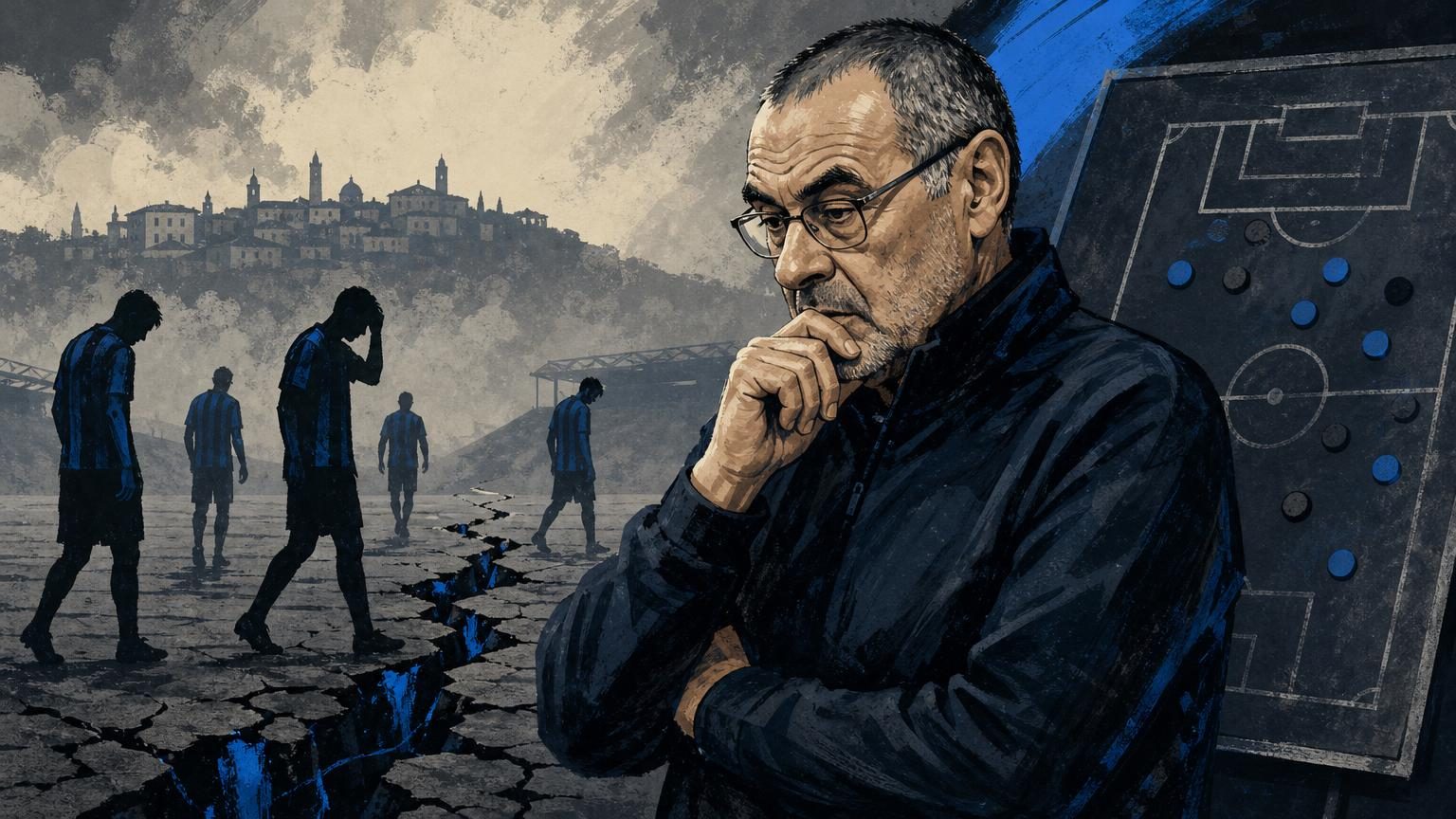
Maurizio Sarri called it a stupid goal conceded, and still argued Atalanta were right to settle for the point they got against Kairat Almaty.
The Conference League draw in Bergamo followed a win over Pafos and a 2-0 defeat away to Ajax, and arrived in a week Atalanta needed to use to rebuild confidence after Monday's 3-0 home loss to Parma. Instead they fell behind to a Marc Gual counter-attack before substitute Nikola Krstovic equalised, extending a winless run that now stands at seven matches across Serie A and Europe, Football Italia reported.
Sarri told Sky Sport Italia that ten players were injured and four more were restricted by the medical staff to a maximum of 30 minutes, a constraint that effectively halved the pool of fit, trusted bodies available to him before kick-off.
Why a makeshift back line invites exactly this kind of goal
Two Under-23 defenders with Serie C experience started at the back, alongside Kamaldeen Sulemana, who had been back in full training for only four or five days after being sidelined since August. Sarri said the goal came from exactly what you would expect from such a patchwork unit: a lapse in concentration turned into a clean counter-attack that a more settled defence would likely have snuffed out before it reached Gual.
That matters tactically because Sarri's build-out model depends on defenders comfortable enough in possession to resist pressure and recycle the ball through midfield rather than concede it in transition. Throwing in players whose recent football has been at a lower level, in a system still being installed, multiplies the risk of the kind of individual error that turned a winnable game into what Sarri called an uphill struggle.
The style shift that injuries are stalling
Sarri is attempting to move Atalanta away from the aggressive, man-oriented pressing and three-at-the-back structure that defined more than a decade under Gian Piero Gasperini, toward his own possession-based approach built on patient circulation and positional rotations to create space between the lines. He admitted Atalanta moved the ball too slowly against a deep, defensive Kairat side and could not find the gaps that approach is designed to open up.
That failure to unlock a low block is a direct symptom of the transition itself. Sarri's attacking principles rely on players understanding specific rotations and timed runs that take time to drill, and he pointed out that none of his current squad has a history working under him, layering a fresh tactical education on top of an already threadbare squad list.
Gianluca Scamacca's situation illustrates the scale of the problem. Sarri said he had only seen the striker train for the first time the day before the match, making it unrealistic to expect a contribution so soon after injury, let alone fluency in a system still being taught to everyone else.
A fixture pile-up with no margin for error
Sarri framed the congestion as structural rather than a one-off: Atalanta are playing eight matches in 23 days with what he described as the same limited group rotating through. That schedule leaves little room to manage minutes carefully even when the medical department is already restricting four players to half an hour at most.
The consequence is a squad being asked to execute a more technically demanding system while short of numbers, short of fit bodies in key positions, and short of time on the training pitch together. Sarri's own framing was pragmatic rather than alarmed: a point taken now, with qualification for the Conference League knockout stage to be chased later once more of the squad returns.
That calculation depends on Atalanta recovering personnel fast enough for the remaining group matches to still be winnable. For now, the explanation Sarri gave was a club absorbing the cost of transformation at the worst possible moment, with the League Phase table offering little patience for an answer.