
Arsenal's Corners Are Finding Men, Not the Net
Seven games into the season, Arsenal have gone from the Premier League's deadliest set-piece side to one that can't convert a single corner — and the data suggests the problem isn't the delivery.
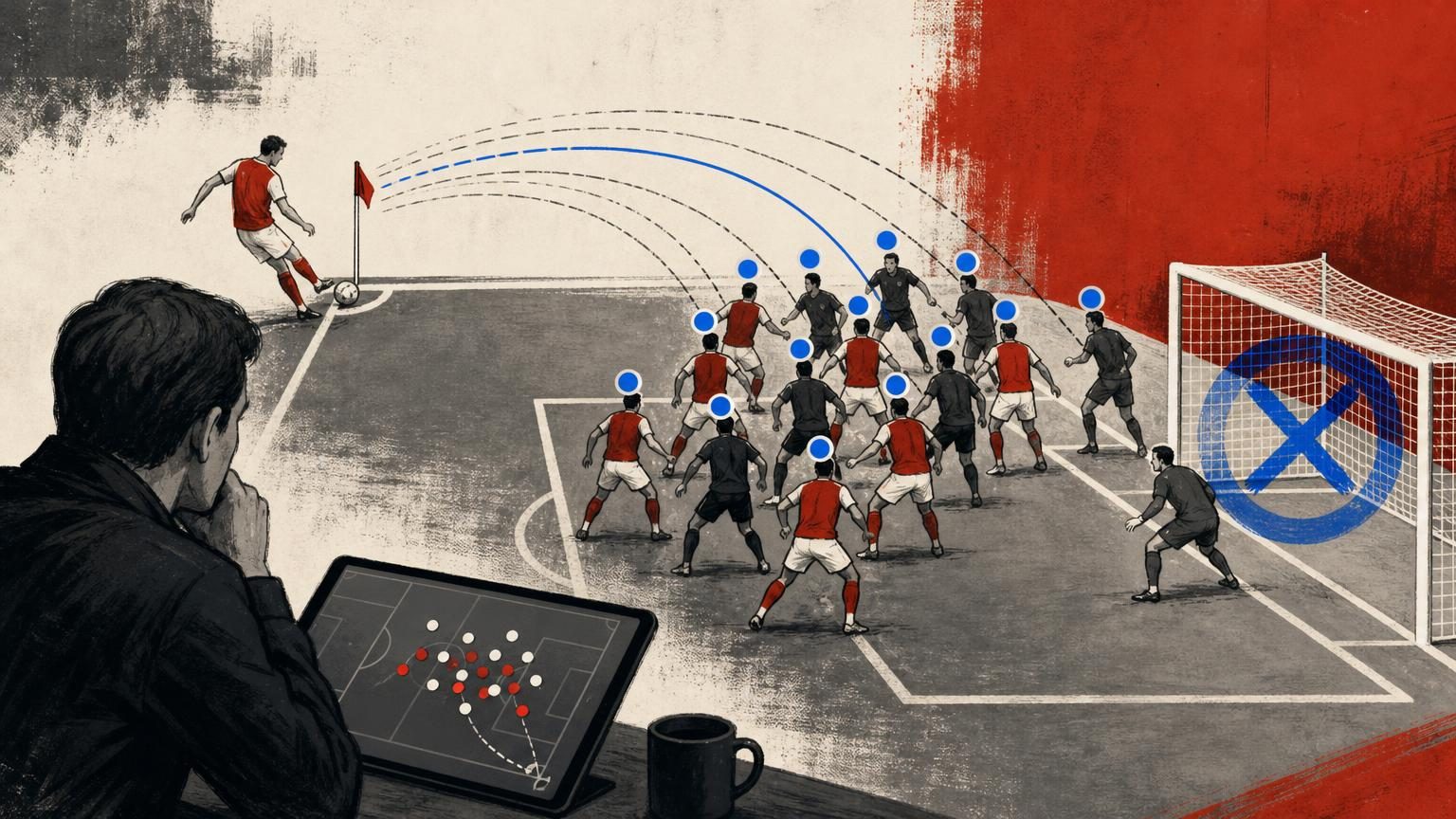
Arsenal have failed to score from a corner in any of their first seven Premier League games this season, a stark contrast to the team that broke the division's record for corner goals in 2025-26, according to data from The Analyst (Opta).
Last season Arsenal scored 19 goals from corners, the most of any side in a single Premier League campaign, with those goals making up 26.8% of their total — the highest share for any champion. At the equivalent stage last term, they had already scored six corner goals in the league alone. This year: zero, and across all competitions they have yet to score from any non-penalty set piece.
The numbers show a real decline, not just bad luck
Expected goals data, which measures the quality of a chance based on factors like shot location and type rather than the outcome, backs up the eye test. Arsenal led the league last season with 13.8 total xG from corners, working out at 0.36 per game and 0.064 per individual corner — meaning roughly a 6.4% chance of a goal from every corner they won, the second-best rate in the division. They then overperformed that number, converting 8.8% of their corners, the best conversion rate anywhere.
This season that figure has fallen to 0.047 xG per corner, a drop of more than a quarter in the average quality of each delivery, and Arsenal have slid from the second-most dangerous corner-taking side to ninth. Shot volume has fallen too, from 2.8 shots per game from corners last season (second in the league) to 2.1 this season (ninth).
Even so, Arsenal have still generated 1.55 xG from corners in 2026-27, the seventh-highest total in the Premier League, which implies they should reasonably have scored by now. Only Liverpool, who have underperformed their corner xG by 2.05, have fared worse than Arsenal's shortfall of 1.55.
Nothing has changed about how they take them
The explanation is not a shift in approach. Arsenal crossed into the box from 86.6% of corners last season and 84.9% this season, with the remainder played short — 13.0% then, 15.1% now. Their commitment to the inswinging corner, long their signature set-piece weapon, has if anything hardened: 96.3% of crossed corners were inswingers last season, and that figure is now 100%.
So the routine is the same, and the delivery method is unchanged. The breakdown is happening somewhere else in the sequence.
Contact is up, conversion is down
Perhaps counterintuitively, Arsenal are winning first contact on their corners far more often than last season. Their first-contact rate from crossed corners has risen from 28.3% — a modest 12th in the league last term — to 42.9% this season, the second-highest in the Premier League.
That rules out delivery accuracy as the obvious culprit. Arsenal are finding their targets inside the box more reliably than before; the issue is what happens once contact is made, not whether it happens at all.
Personnel changes offer a partial answer. William Saliba and Jurriën Timber have both missed significant chunks of the campaign, and Timber in particular was central to Arsenal's set-piece threat last season. He scored twice from corners — more than any other Arsenal player — and made seven headed first contacts from corners, the second-highest total at the club.
With two of the squad's more reliable set-piece operators unavailable for long stretches, the players now winning those headers appear less able to turn contact into a genuine chance, even as the raw frequency of contact has improved. That would explain how Arsenal can be making contact more often while generating lower-quality shots overall.
The underlying numbers suggest this is unlikely to continue as a long-term trend. An xG total of 1.55 from corners with zero goals to show for it points to variance as much as a structural problem, and Arsenal's broader method — the short-corner share, the inswinging delivery, the volume of crosses into the box — has barely moved from the title-winning blueprint. The return of fit, in-form targets inside the box may be the more pressing factor than any tactical rethink.