
Barella says Inter needed the win more than the performance against Shakhtar
Captain Nicolò Barella conceded Inter's 1-0 win over Shakhtar Donetsk owed more to a sharp counter-attack than control, after Alessandro Bastoni's two-yellow dismissal forced the Nerazzurri into survival mode.
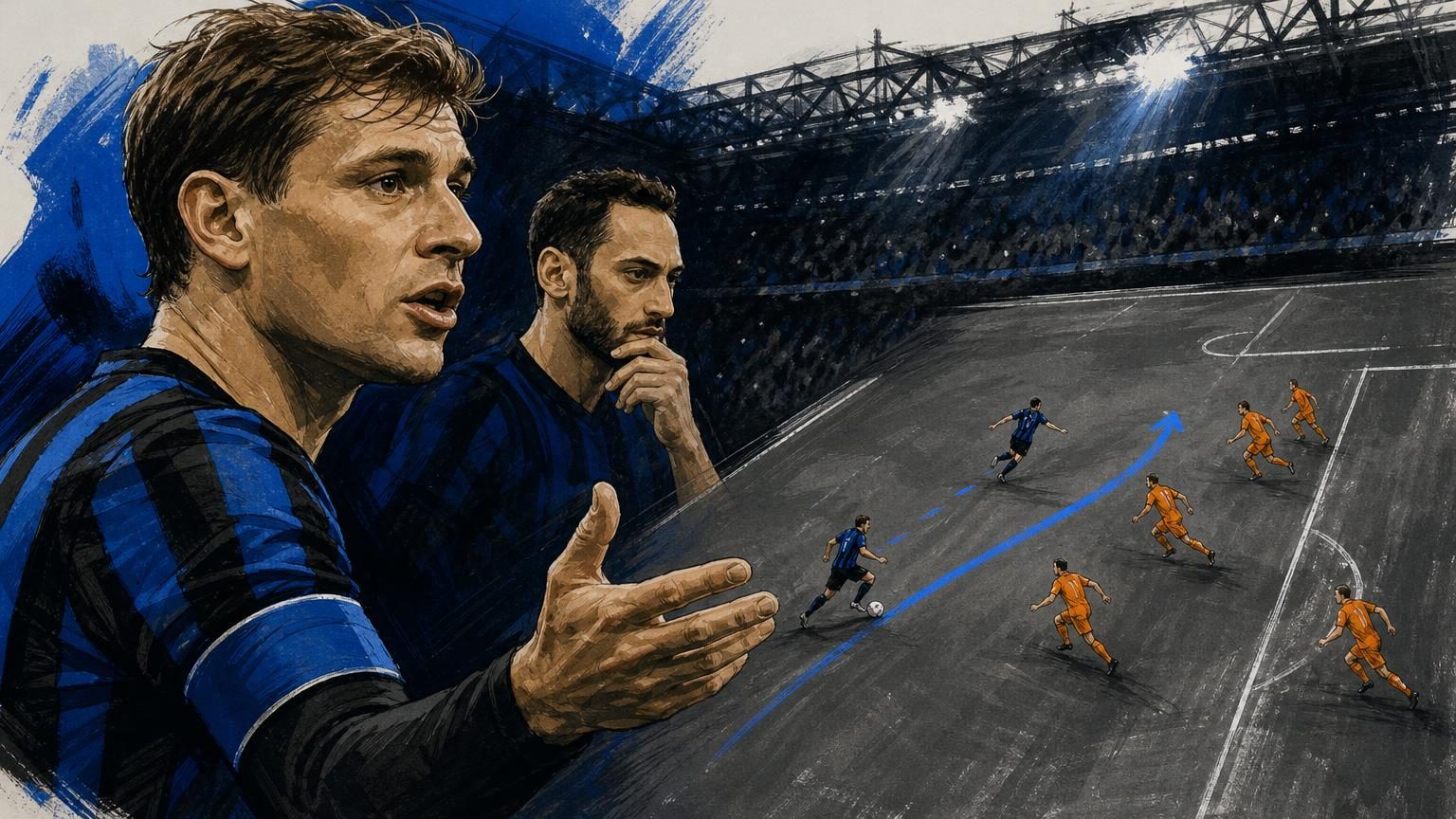
Inter beat Shakhtar Donetsk 1-0 at San Siro on Matchday 3 of the Champions League league phase, but captain Nicolò Barella made no claim that the performance matched the result.
"Let's be honest here, we needed this victory," Barella told Sky Sport Italia, as reported by Football Italia. "Playing good football is nice too, but what mattered the most today was the result. I don't know how deserved it was, but we'll take it."
Wearing the armband in the absence of the injured Lautaro Martinez, Barella oversaw a performance that was sluggish for long stretches before Alessandro Bastoni was sent off for two quick yellow cards, leaving Inter to see out the closing stages a man short.
Why the tempo mattered more than the shape
Barella's own diagnosis pointed to a problem of energy and management rather than system. He said Inter had been "lacking some energy at the start, perhaps all that talk of needing the victory made us tense," and admitted the side's opening approach to matches remains a recurring issue, pointing to games this season where Inter have fallen two goals behind early.
That matters because a team that starts slowly against high-intensity opposition invites exactly the kind of spells Shakhtar produced. Barella credited the visitors directly, calling them a side that "confirmed they have quality, tempo and intensity," and noting their record coming into the match: a 1-1 draw away at PSV Eindhoven and a 3-1 win over AEK Athens, both evidence Shakhtar were unbeaten in the competition before San Siro.
Barella also pointed the finger partly inward, saying he himself could have done more to organise teammates during that sluggish opening. That kind of in-game leadership becomes more important, not less, once a team is forced to defend with a numerical disadvantage, as Inter were after Bastoni's dismissal.
How the red card reshaped the game
Going down to ten men against a team already playing with tempo and intensity is, in Barella's words, "a big disadvantage in modern football." The practical effect was that Inter had less control of midfield and had to accept Shakhtar would commit more numbers forward to chase the game.
That is precisely what happened, by Barella's account: Shakhtar pushed forward in search of a winner, stretching their own defensive structure in the process. Inter's response was not to try to match Shakhtar man for man further up the pitch but to look for the gap that opening left in behind, which is a standard defensive adaptation once a side is reduced to ten and cannot sustain prolonged possession.
The goal itself came from exactly that kind of transition. Carlos Augusto ran onto a long ball played by Henrikh Mkhitaryan and finished calmly past the advancing goalkeeper. Barella's praise afterwards was direct: "Carlos is an animal, I want to congratulate him, as on top of being a great player, he's a lovely guy who deserves everything."
The sequence illustrates how a team playing with one fewer player can still generate a high-value chance. Rather than building through midfield, where Inter were outnumbered, the route to goal was a single long pass exploiting the space Shakhtar's forward commitment had opened up. It is a low-cost, high-reward mechanism precisely suited to a side defending a numerical deficit.
What the result says about Inter's European ambitions
Bastoni had used his press conference the day before the match to argue that Inter needed to move past their Champions League final appearances in 2023 and 2025 rather than lean on them. Barella's comments after the win echoed that caution rather than contradicting it.
Asked directly about Inter's targets in the competition, Barella called the Champions League "something we have targeted in recent years" and acknowledged the level required is "very high," while conceding the team is some way from its best form in the competition this season. He added that Inter would "try to do our best with the potential that we have," a phrase that reads as measured rather than declarative given the performance just delivered.
That caution lines up with the run of results Barella referenced: a Champions League campaign already featuring defeats to Real Madrid and Club Brugge, grumbles from a San Siro crowd growing impatient, and now a win that the captain himself would not call deserved. The three points keep Inter's group-stage position moving, but Barella's own assessment suggests the underlying issues, slow starts, lapses in energy, moments requiring more vocal leadership on the pitch, remain unresolved heading into the next round of fixtures.