
Bruno Fernandes's pressing criticism cuts both ways for Manchester United
The United captain blamed Michael Carrick's tactics for the 4-1 Champions League defeat to Como, but his own high press left gaps the Italians exploited.
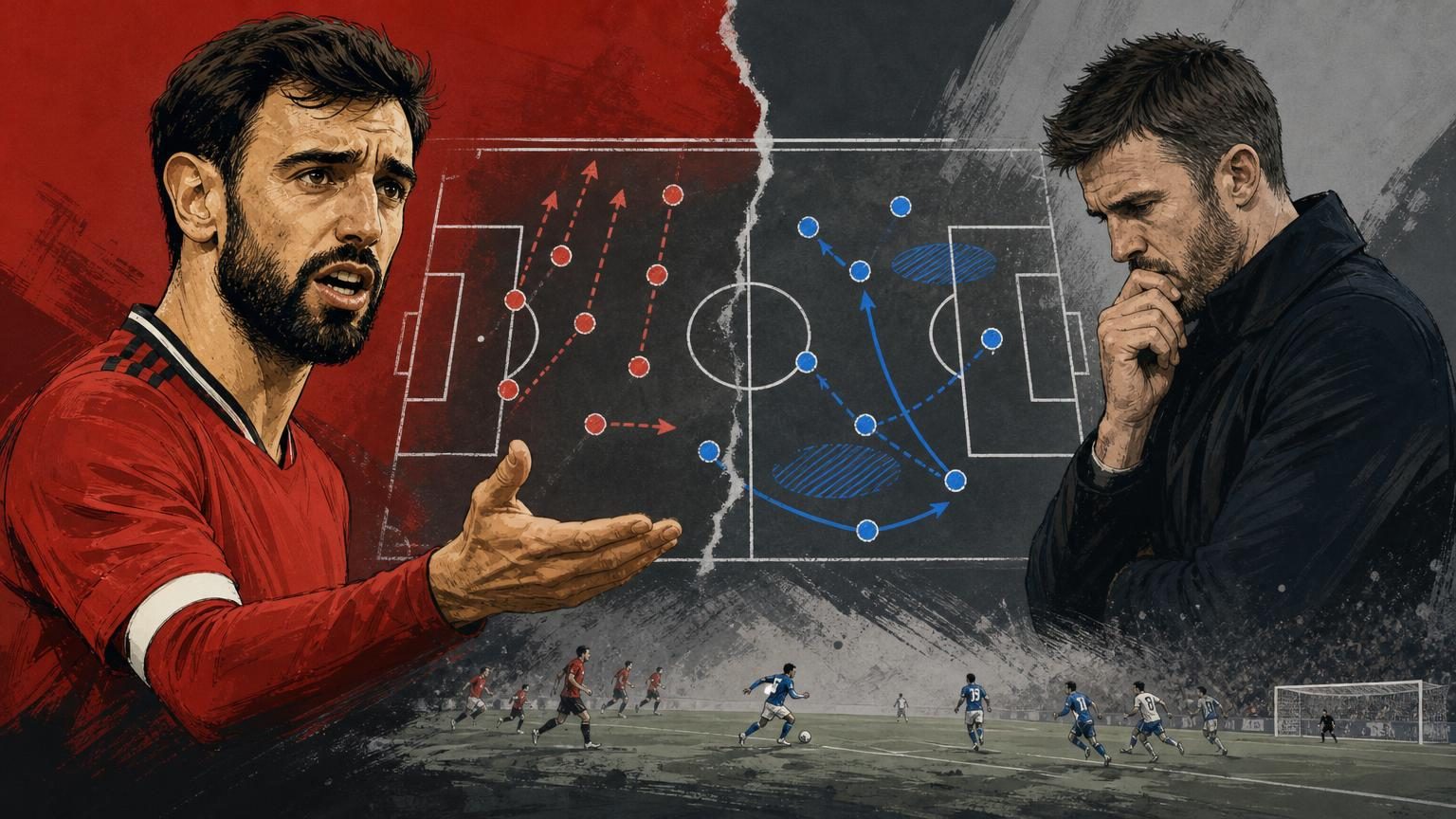
Manchester United's captain became the story again on Wednesday night, not for anything he did on the pitch but for what he said afterwards. Bruno Fernandes used a post-match interview to question Michael Carrick's approach following a 4-1 Champions League defeat to Como, a club that was playing in Italy's fourth tier as recently as 2019 and was contesting only its third ever European fixture, as reported by The Analyst (Opta).
Cesc Fabregas's side, inspired by Nico Paz, dismantled United at the Stadio Sinigaglia. The Analyst described the performance as a new low for a club already under severe pressure after a poor start to the 2026-27 season.
Fernandes did not hold back when asked about the tactical set-up. He told TNT Sports, quoted by The Analyst: "It's a decision from the staff to not press man to man and sometimes leave space behind and try to get the ball, but sometimes when you give too much [of] the ball to"
The press he criticised was partly his own
The quotation, as reported, points the finger at the coaching staff for instructing United not to press man-to-man and for leaving space in behind. The Analyst's framing of the match suggests Fernandes himself operated as something close to a lone presser against Como, engaging opponents individually rather than as part of a coordinated structure.
That distinction matters. A team can set up to press collectively, stepping together to close passing lanes, or it can rely on an individual - often the most advanced central midfielder - to chase the ball alone. The second approach invites exactly the problem Fernandes described: space opening up behind the presser because the rest of the shape has not moved to support him.
If United's issue was a single player pressing without the cover of his teammates, then blaming the staff's instructions obscures a simpler explanation: the execution, not just the plan, broke down. A high press only works as a unit; one man pressing in isolation against a side as comfortable on the ball as Como's proved easy to play around.
United's press office tried to limit the damage
The fallout extended beyond the pitch. Sky Sport Italia's pitchside reporter in Como, Pierluigi Bagnulo, said United's press office did not allow Fernandes to answer in Italian after the game, a decision he suggested stemmed from fear that his words would not be understood, according to Football Italia.
Bagnulo was blunt about what he saw from his vantage point. He wrote that it was "almost disturbing to see how disjointed a team that has 'United' in its name is," adding that he had witnessed "the caption of the actual state of Manchester United in four episodes happening in the space of ten minutes," per Football Italia.
Those comments, filed independently of Fernandes's own remarks, reinforce the picture of a club whose problems are now visible to outside observers as much as to its own captain.
The Eddie Howe blueprint already being sketched out
With Carrick's position increasingly precarious, Planet Football has already modelled what United might look like under Eddie Howe, who is tipped to replace him. Howe's Bournemouth and Newcastle sides were built on intensity, consistently ranking among the highest-pressing teams and near the top of distance-covered tables in their respective seasons.
Tactically, that intensity was delivered through a 4-3-3 with a holding midfielder screening the back line. Bruno Guimaraes filled that defensive six role 132 times at Newcastle before Howe later pushed him into the eight, with Sandro Tonali dropping into the pivot behind him - evidence of a coach willing to reshape a double pivot around form and fitness rather than fixed roles.
Howe's wide forwards were chosen for pace and directness, with Anthony Gordon a particular favourite for his speed before his move to Barcelona. Physical profile mattered too: Jacob Murphy is the only player among Howe's five most-used attackers under six foot, and the repositioning of Joelinton from striker into midfield ranks among his most effective individual tactical reworkings at St James' Park.
Planet Football raised two doubts about transplanting that model to Old Trafford: whether United's squad, shaped more by reputation than by Howe's usual template of unheralded, hard-running players, would adapt to his demands, and whether he could command the dressing room in the way he did at a Newcastle side without established stars. The publication also noted Howe would be right to demand defensive reinforcements before taking the job, given it remains United's most obvious weakness.
For now, Carrick remains in charge, and the next fixture will determine whether the captain's public criticism and the growing noise around a managerial change compound United's problems further or force a response on the pitch.
Sources
- The Analyst (Opta): Bruno Fernandes Blamed Michael Carrick, But His One-Man Press Played into Como’s Hands
- Football Italia: Why Man United didn’t let Bruno Fernandes speak Italian after Como loss
- Planet Football: Manchester United predicted XI under Eddie Howe as ex-Newcastle boss tipped to replace Michael Carrick