
Bastoni's two-minute meltdown leaves Inter facing Shakhtar with ten men
Alessandro Bastoni was shown two yellow cards in the space of two minutes during Inter's Champions League match against Shakhtar Donetsk, turning a frustrating evening into a numerical crisis at San Siro.
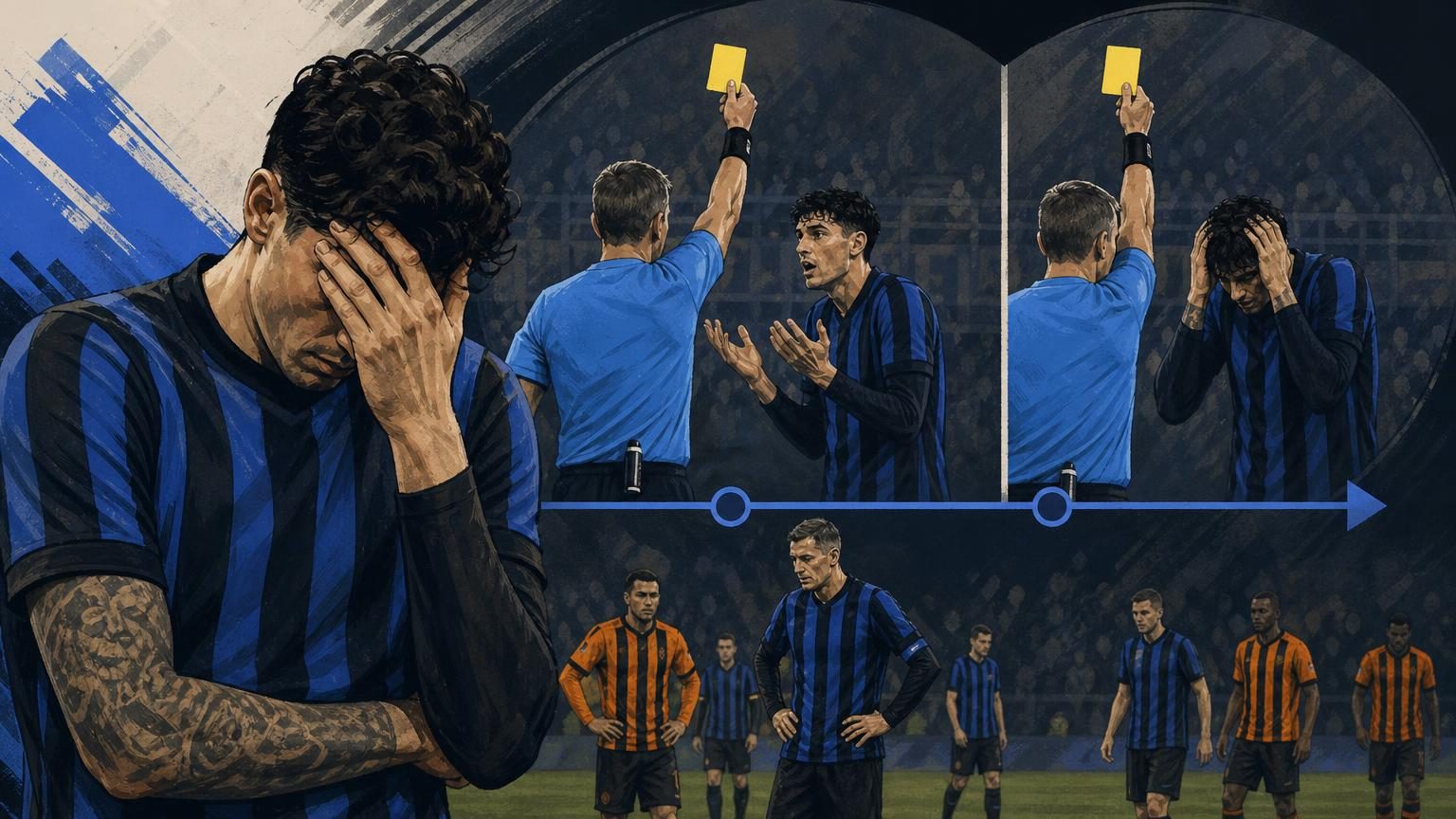
Alessandro Bastoni was sent off midway through the second half of Inter's Champions League group-phase match against Shakhtar Donetsk at San Siro on Tuesday, picking up two yellow cards within two minutes of each other, according to Football Italia.
The dismissal came at the worst possible moment for Cristian Chivu's side, who had gone 65 minutes without finding a way through a well-organised Shakhtar defence despite starting as favourites with home advantage, Football Italia reported.
Why the first caution mattered more than it looked
The sequence began in the 66th minute as Nicolo Barella prepared to take a corner from the right. Referee Harm Osmers stopped play before the set-piece was delivered to book Bastoni following an argument with Shakhtar's Alisson Santana, Football Italia said.
A yellow card shown away from the ball, rather than in a goalmouth collision, is rarely about a single foul. It is usually the referee drawing a line under running tension that has built up over several passages of play, often triggered by handling, verbal exchanges or shirt-pulling that the officials have already been watching closely.
That context matters for what followed. Once a centre-back has been cautioned for conduct rather than a clear tactical foul, every subsequent contact in the area he is defending becomes a disciplinary risk, because the referee's threshold for a second card drops sharply.
Bastoni's visible confusion, reportedly asking Osmers 'why?' in English, suggests he did not immediately register how exposed the first booking left him. Centre-backs are conditioned to defend the near-post zone at corners aggressively, using contact to disrupt attackers before the ball arrives; with one yellow card already shown, that same physicality becomes far harder to referee in the defender's favour.
The delay before the corner was eventually taken included a separate warning for Manuel Akanji after he shoved an opponent, though Akanji was not booked, Football Italia reported. That Osmers was already intervening twice in the same stoppage shows how combustible the build-up to this particular set-piece had become, even before the corner was delivered.
How the second phase of the corner turned into a red card
The initial delivery from Barella was unsuccessful, but Shakhtar failed to clear their lines completely, and the move continued into what is generally described as the second phase of the attack, when Barella looked to find a teammate inside the box from a loose ball rather than a fresh set-piece routine.
It was in that phase that Oleh Ocheretko went down after contact from Bastoni, prompting Osmers to blow for a foul and, after a pause to consult what had happened, show a second yellow card and a subsequent red, Football Italia reported. Ocheretko's visibly animated reaction once Osmers began walking towards Bastoni indicated he understood the consequence before the card was shown.
Second-phase corner situations are notoriously difficult for defenders precisely because the structured marking of the first delivery breaks down. Players scramble for second balls in congested space, and the clean, planned jostling of a corner routine gives way to reactive, often risky challenges. A defender already on a yellow card has far less margin in that chaos than one who is not.
The practical consequence for Chivu is immediate and severe. Losing a first-choice centre-back to a second yellow card forces an in-game reshuffle of the back line, typically either shifting a full-back inside or reorganising the structure into a back four without like-for-like cover, all while defending a one-man numerical disadvantage for whatever remains of the match.
Inter had already lost their opening two matches of the 2026-27 Champions League league phase and had lost seven of their previous eight European games before this one, Football Italia noted. A red card on home soil against Shakhtar, with the scoreline still goalless after 65 minutes, left the Nerazzurri needing to find a breakthrough with ten men rather than eleven, against a side set up to frustrate them even at full strength.