
Conte denies advanced Manchester United talks as Carrick's position weakens
Antonio Conte has rejected claims of advanced negotiations with Manchester United, even as Michael Carrick's authority is questioned following the Como defeat and Eddie Howe is floated as an alternative.
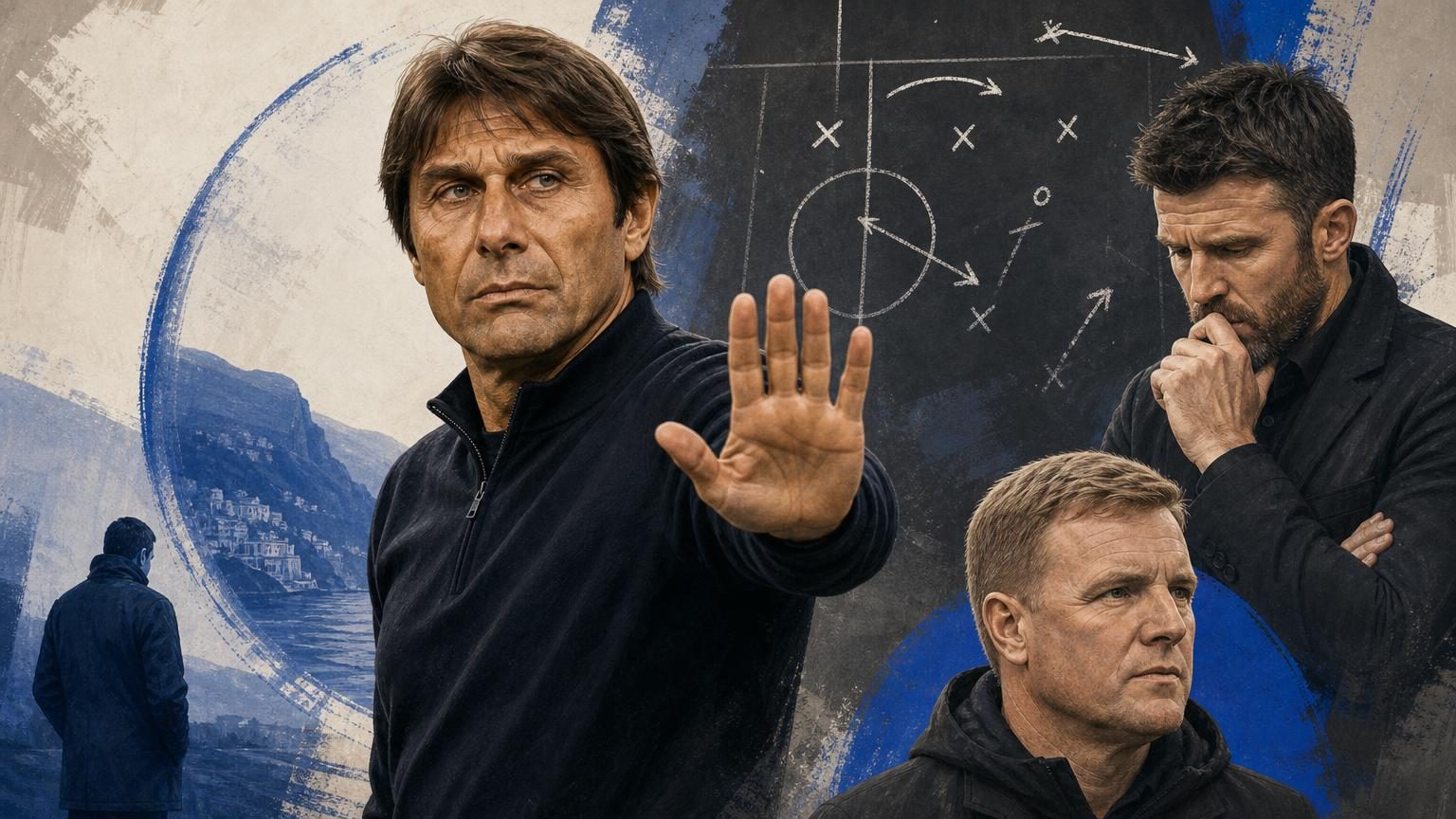
Antonio Conte has pushed back against reports linking him to Manchester United, insisting there are no advanced talks over replacing Michael Carrick, according to Football Italia.
The denial follows a week of speculation after Manchester United's 4-1 defeat to Como in the Champions League intensified scrutiny of Carrick's position. Football Italia reported that Conte has described suggestions he is in negotiations as unfounded, saying there is "No negotiations at an advanced stage" and that the reports circulating are, in his words, "These reports are unfounded".
Conte, out of work since leaving Napoli at the end of last season, has previously won Serie A with three different clubs and the Premier League with Chelsea. Reports in Italy, cited by Football Italia, had claimed he wanted carte blanche over transfers as a condition of taking the United job, a demand Conte has not confirmed.
Why the dressing room is already testing Carrick
The pressure on Carrick is not confined to managerial gossip. Guardian Football's Jamie Jackson reported that the head coach refused to deny he could strip the captaincy from Bruno Fernandes or drop him altogether for Sunday's visit of Bournemouth to Old Trafford.
That question matters because of what Fernandes said after the Como defeat. He told reporters the team had been instructed not to press man-to-man and to concede space in behind, adding: "sometimes when you give space to these teams they get confidence," as quoted by Guardian Football.
Read as tactical criticism, that is a player publicly questioning a structural choice: whether to engage opponents with a man-oriented press high up the pitch or sit off and protect space, only for the latter approach to invite sustained pressure rather than deter it. Read as a dressing-room signal, it is also a challenge to the head coach's authority, which is how Guardian Football frames it.
Jackson's analysis goes further, noting that Fernandes and Lisandro Martínez are out of contract at the end of the season, with the club holding an option for an extra year in both cases. Given their recent conduct, Guardian Football suggests a January sale — potentially raising £40m for Fernandes and £25m for Martínez — could fund a rebuild rather than risk losing both for nothing.
What an Eddie Howe appointment would actually look like
If Carrick is replaced, Eddie Howe remains the name most heavily tipped, according to Planet Football. His Bournemouth and Newcastle sides were among the most intense pressers in their respective leagues and consistently ranked near the top for distance covered, built around a 4-3-3 with a holding midfielder screening the back line.
Planet Football's analysis points to Bruno Guimarães as the template, deployed as the defensive midfielder in that six role 132 times at Newcastle before Howe later pushed him forward into an eight alongside Sandro Tonali dropping into the pivot. Howe has also favoured quick, direct wingers capable of crossing or shooting — Anthony Gordon was a particular beneficiary before his move to Barcelona — and physical presence across his most-used players, with only Jacob Murphy standing under six foot among his preferred attackers.
The tactical fit at United is not straightforward. Howe's transformation of Joelinton from striker into midfielder was cited by Planet Football as one of his sharpest man-management successes at Newcastle, achieved with players who arrived without the egos now present in United's squad. Planet Football's assessment is that Howe would be entering a dressing room containing established, high-profile names rather than the group he shaped relatively unopposed on Tyneside.
Defensive reinforcement is flagged as the non-negotiable condition in any negotiation, with Planet Football describing the back line as the most glaring area requiring investment before Howe could implement his usual pressing structure.
The contrast between Conte and Howe
The two names represent different solutions to the same crisis. Conte's demand for control over recruitment, as reported by Italian outlets and referenced by Football Italia, points to a manager seeking to reshape the squad from the top down, in keeping with his history of imposing structure quickly at previous clubs.
Howe's model, by contrast, depends on buy-in and a settled double pivot or six-eight relationship built over time, the kind of project Planet Football suggests is harder to install at a club with senior players already pushing back on tactical instructions, as Fernandes did after Como.
Whichever direction United choose, Sunday's visit of Bournemouth offers the most immediate test. Carrick's response to Fernandes's comments — whether the captaincy stays, and whether the current approach to pressing and space is altered — will shape how much credit he is given before any change at the top is seriously considered.
Sources
- Football Italia: Conte hits out after Manchester United links: ‘No negotiations at an advanced stage’
- Guardian Football: Change captain? Play the kids? How to solve the problems at Manchester United
- Planet Football: Manchester United predicted XI under Eddie Howe as ex-Newcastle boss tipped to replace Michael Carrick