
Joe Cole and the making of a Mourinho-era winger from a No.10
How West Ham's teenage prodigy, burdened with Gazza comparisons, found his best form only after Jose Mourinho forced him to change his game at Chelsea.
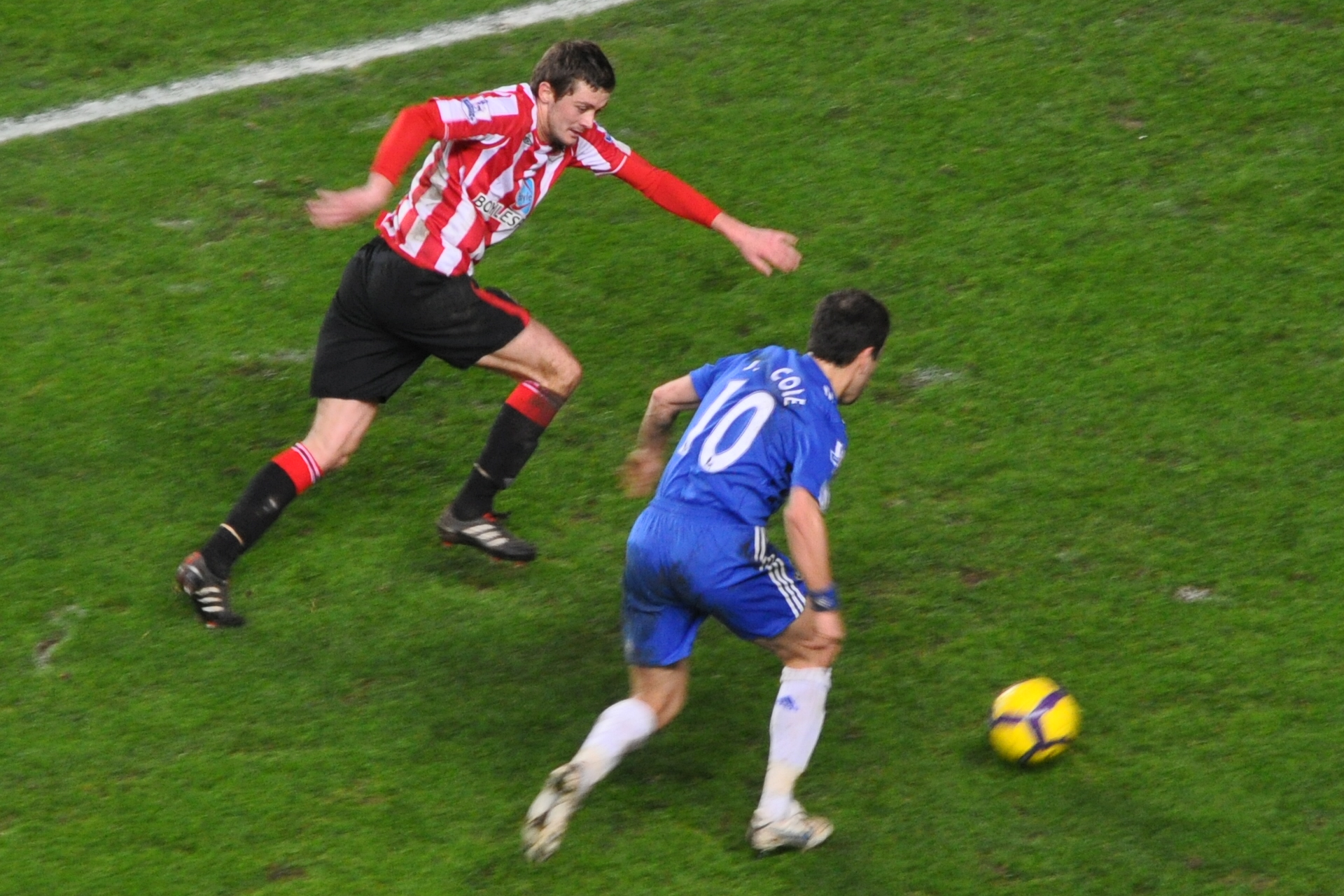
Joe Cole was marked out as an exceptional talent before he had kicked a ball as a professional. Planet Football recounts how, at 15, his performances for England schoolboys were already drawing praise in the national press and interest from Arsenal and Manchester United.
By 17 he had helped West Ham thrash Coventry City 9-0 over two legs in the FA Youth Cup final, a display good enough for Kevin Keegan to invite him to train with the senior England squad, according to Planet Football.
The label attached to him soon after was not subtle. Cole became one of the first teenagers tagged as the ‘Next Gazza’, and when he signed his first professional contract at half-time of a league match against Chelsea, the Upton Park announcer told the crowd they would one day tell their grandchildren they had witnessed it.
A free spirit built for a formation that was disappearing
Cole's gift was obvious long before the hype: a dribbler who studied Italian and African football as a boy and tried to reproduce what he saw. His old coach at Camden and Islington Boys, Terry Howard, told him simply to express himself, and Cole never stopped trying to embarrass a full-back.
He went on to make 150 appearances for West Ham and was handed the captaincy by Glenn Roeder in 2002-03 at just 21. The Hammers were relegated that season, but Cole's performances were strong enough to win him the club's Player of the Year award.
That form took him to Chelsea for £6.6million, with Claudio Ranieri comparing him to Gianfranco Zola and handing him the No.10 shirt. The comparison only added to the weight of expectation that had followed Cole since his schoolboy days.
His first season at Stamford Bridge did not match the billing. Half of his 50 appearances across all competitions came as a substitute, and a league goal eluded him right through to the final month of the campaign as he struggled to find a settled role.
Part of the problem was structural rather than personal. English football was shifting from 4-4-2 towards 4-3-3 during Cole's early Chelsea years, and neither system offered much room for an old-fashioned, free-roaming No.10 whose instinct was to drift and improvise rather than occupy a fixed zone.
Mourinho's blunt diagnosis changed the trajectory
The appointment of Jose Mourinho in 2004 reshaped Cole's career. Rather than ask the game to bend to his style, Cole adapted under a manager regarded as one of the most tactically precise of his generation, a process that pushed him toward greater defensive discipline without stripping out his flair.
John Terry, described by Cole as like an older brother at the time, had a video analyst compile a reel of his best moments to remind him of his own quality. That intervention mattered, but the sharper turning point came after a Chelsea win over Liverpool in October 2004.
Cole scored the winner that day, only for Mourinho to criticise his lack of defensive application afterwards. “He has two faces – one beautiful and one I don't like,” Mourinho said. “He must keep one and change the other one.”
Cole did not sulk. At 22, he framed the criticism as shared ambition rather than rejection. “We are on the same page,” he said. “He wants Chelsea to win games and I want Chelsea to win games. He wants Joe Cole to be a better player than he already is – and so do I.”
He added: “We both want to make me a better player for Chelsea and if that is the end result then that is all that matters. It hurt when people said I was showing off.”
Why the rebuild worked
The significance of that exchange is tactical as much as psychological. Mourinho was not asking Cole to abandon his dribbling or his instinct for the final third; he was asking him to add defensive work-rate to a game that had previously been built almost entirely around attacking improvisation in a withering No.10 role.
That combination, an entertainer who could also track back and contribute off the ball, was precisely what a 4-3-3 required from a wide forward, and it explains why Cole's most productive and celebrated spell at Chelsea followed directly from Mourinho's arrival rather than preceding it.
Cole never stopped being judged against the outsized expectations set when he was a teenager being compared to Gazza and Zola in the same breath. Planet Football's account of this period is a reminder that between 2004 and 2009, whatever formation he was squeezed into, Cole was still one of the most watchable players English football produced.