
Luis Figo at Inter: the diamond, the drama and a title won without kicking a ball
Planet Football's account of Figo's four seasons in Milan shows how a midfield diamond, positional freedom and a points deduction combined to reshape his legacy at Inter.
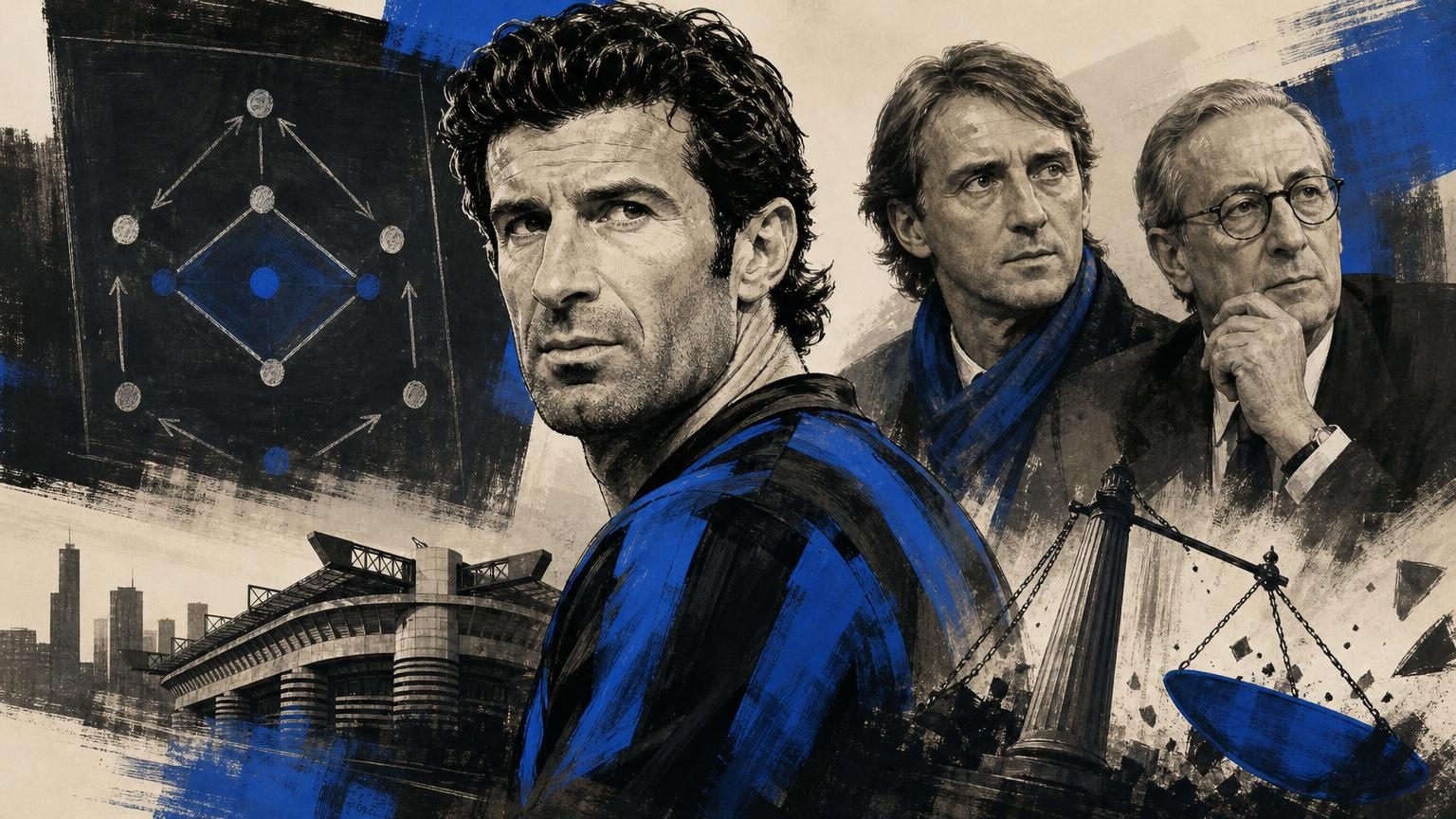
Luis Figo's move to Inter Milan in 2005 was framed as a late-career soft landing, but the shape Roberto Mancini built around him turned it into something sharper, according to Planet Football.
Figo arrived at 32 into a squad already strong enough to finish third in Serie A and win the Coppa Italia the previous season, with Adriano scoring 28 goals and Javier Zanetti, Esteban Cambiasso and Dejan Stankovic anchoring the spine of the team, Planet Football reports.
The one obvious gap was the right flank, which had been shared the year before between Andy Van der Meyde and Ze Maria. That made Figo close to an automatic selection the moment he signed.
Why the diamond gave him licence to roam
Mancini set Inter up with a midfield diamond that season, and Figo operated either out wide or tucked in behind two strikers depending on the phase of play, per Planet Football.
A diamond midfield concentrates central numbers and relies on width coming from deeper full-backs or from a nominal winger drifting infield, which is precisely the role Figo was given — not fixed to a touchline, but free to drift into the half-space between the opposition full-back and centre-back.
Mancini's own description of the arrangement, quoted by Planet Football, makes clear this was deliberate rather than Figo simply ignoring instructions: "I don't tell him to stay on the wing or move him if he moves to the middle," the manager said. "Figo knows he can go and play where he wants at a certain point in the match if he feels it's right."
That positional interchange is a specific kind of license, distinct from merely playing as a winger — it asks the player to read the game and relocate himself rather than execute a printed role, and it is why Figo's numbers in his debut season looked less like a wide forward's and more like a creator operating centrally when it mattered: a goal against Parma in November 2005 and a hat-trick of assists against Reggina weeks later, both recorded by Planet Football.
What the points table actually measured that season
On the pitch, Inter's underlying results did not immediately reward the reshaped midfield. Planet Football notes the club won more matches than the previous season but also lost six more, finishing on 76 points and third place again — a tally that, taken at face value, measured only steady improvement rather than a title-winning campaign.
Points totals capture results, not process, and in isolation that 76-point finish told a story of marginal progress. What the table could not show was a scandal unfolding in parallel: Calciopoli saw Juventus and Milan retroactively docked points, and third place was recalculated into first, handing Inter their first Serie A title since 1989, as Planet Football details.
That distinction matters for how the diamond and Figo's role should be judged. The system produced a competitive, improved side, but the trophy itself arrived through an administrative correction rather than a swing in results the formation itself generated — a separation between footballing cause and sporting outcome that a bare league table erases.
Rotation, not form, ended the Mancini relationship
The following season brought reinforcement rather than subtlety: Zlatan Ibrahimovic and Patrick Vieira arrived from a relegated Juventus, while Milan and Fiorentina absorbed their own points deductions before a ball was kicked, according to Planet Football.
Figo's individual high point came in the Supercoppa Italiana, scoring the extra-time winner as Inter overturned a 3-0 deficit against Roma to win 4-3 — Planet Football calls it his finest strike for the club — and Inter went on to string together 17 consecutive league wins between October 2006 and February 2007.
Yet Figo, by then 34, was increasingly rotated out of the side during that run, and Planet Football reports the relationship with Mancini deteriorated over selection rather than performance. Figo later said: "I have always behaved in the same professional way, but [Mancini] showed a lack of respect with some of his choices. A coach is always free to criticise his players, but Mancini did it in the wrong way with me."
Squad rotation is ordinarily framed as load management across a long season, but here it became the fault line that pushed a player of Figo's stature toward the exit, even as the team he was leaving behind won the title with five games still to play.
By January 2007 a move to Al-Ittihad, the Saudi club Figo had scored his first Inter goal against in a sparsely attended friendly, was confirmed, with Figo himself saying he was "looking for a soft solution" and had "needed to feel important" — language that, set against Mancini's rotation policy, reads less like retirement planning and more like a player seeking a role he was no longer guaranteed in Milan.