
Dirk Kuyt and the art of making a team greater than its parts
Signed from Feyenoord for £10million in 2006, Dirk Kuyt became Rafa Benitez's most reliable outlet and a scorer of decisive goals in Liverpool's biggest matches, writes Planet Football.
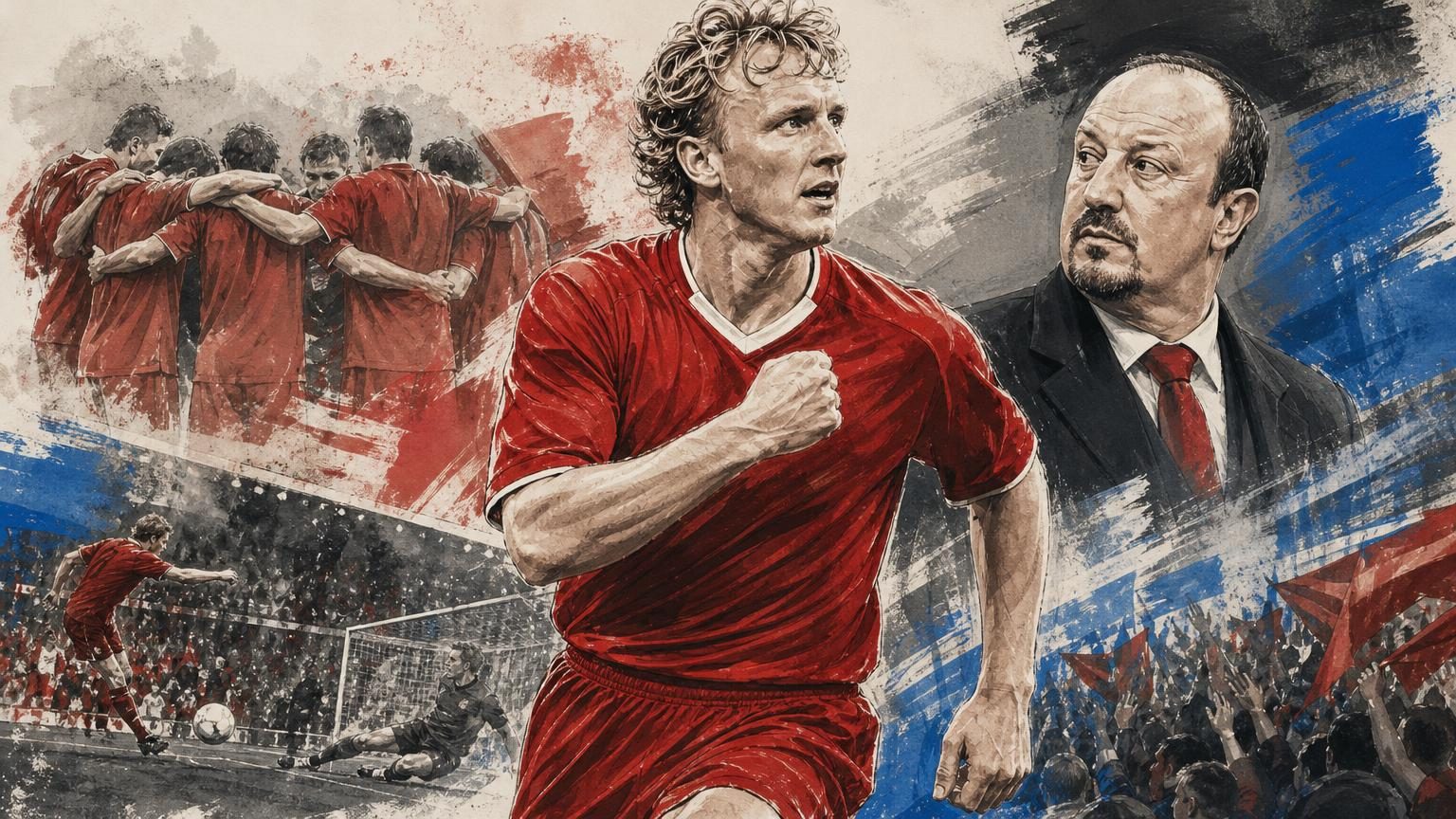
Liverpool paid Feyenoord £10million for Dirk Kuyt in the summer of 2006, a fee that looked modest given he had scored 71 goals in 101 games for the Dutch club, according to Planet Football.
He made his debut as a substitute for Peter Crouch in a 2-1 win over West Ham on 26 August 2006, arriving into a Liverpool squad that was still working out what kind of centre-forward it needed.
Crouch offered aerial presence, Craig Bellamy brought craft and nuisance value, and Robbie Fowler was in his second spell more as a sentimental figure than a regular starter. None of them represented a settled answer up front.
Rafa Benitez had already won the Champions League in 2005 with a Liverpool squad built on balance rather than individual brilliance, and the next target was a sustained Premier League title challenge, which required a consistent goalscorer rather than a cast of occasional contributors.
The numbers never matched the billing, and that was the point
Kuyt scored 14 goals in his first season, a serviceable return rather than a spectacular one, and his tally settled into a pattern over the years that followed: 11, then 15, then 11 again, then 15 once more in 2009-10.
Those figures never announced a superstar, and Planet Football notes that supporters were left somewhere between hope and doubt in his early months at Anfield, uncertain whether he was the finishing piece Benitez needed or simply a solid squad option.
What changed the calculation was Benitez's decision to redeploy him. Instead of staying as an out-and-out striker, Kuyt was shifted into a wide role within a front three, tasked with covering a full flank defensively and offensively across 90 minutes.
That repositioning turned a modest goal return into a defining feature of Liverpool's shape under Benitez. A front three with a genuine workhorse on one side allowed the Spaniard to control transitions, track opposing full-backs, and still keep an attacking outlet who could finish when the chance arrived.
Big occasions brought out a different player
He got on the scoresheet when AC Milan met Liverpool in the 2006-07 Champions League final, and he also converted the winning penalty in the 2007 semi-final shootout against Chelsea.
No one had scored a hat-trick against Manchester United in the previous 21 years until Kuyt did so, with Planet Football noting that each of his three goals was a close-range finish rather than a moment of individual brilliance.
There was an injury-time penalty to win a Merseyside derby at Everton, a goal scored in extra time during the 2012 League Cup final against Cardiff, and the shootout strike that sealed the trophy afterwards. He also scored seven times during the 2007-08 Champions League campaign and contributed important strikes against Arsenal.
None of this fits the profile of a poacher relying on instinct alone. It reflects a player whose positioning and timing in the penalty area remained sharp even as his primary job shifted toward pressing, tracking back and supporting the build-up from wide areas.
A squad built on more than headline signings
Benitez's Liverpool was never going to be assembled purely from star names, and Planet Football frames Kuyt as the embodiment of that approach: tactically disciplined, physically relentless, and capable of elevating his output precisely when a semi-final, a final or a derby demanded it.
That blend of defensive graft and clutch finishing is not easily replicated, and it explains why Liverpool supporters came to value him well beyond what his season-by-season goal totals might suggest to anyone glancing at a stat sheet in isolation.
Kuyt left Liverpool in 2012 with a collection of decisive goals that speak to his temperament under pressure rather than raw conversion numbers. Planet Football suggests that at his peak he would not start regularly for Liverpool's modern sides, but would still have earned a place in Jurgen Klopp's squad as a dependable, battle-tested option for the biggest nights.