
Manchester United's Numbers Expose a Pattern Against Ten Men
Opta data examined by The Analyst shows United have repeatedly failed to punish depleted opponents, with Saturday's 1-1 draw against ten-man Tottenham the latest example of a recurring problem.
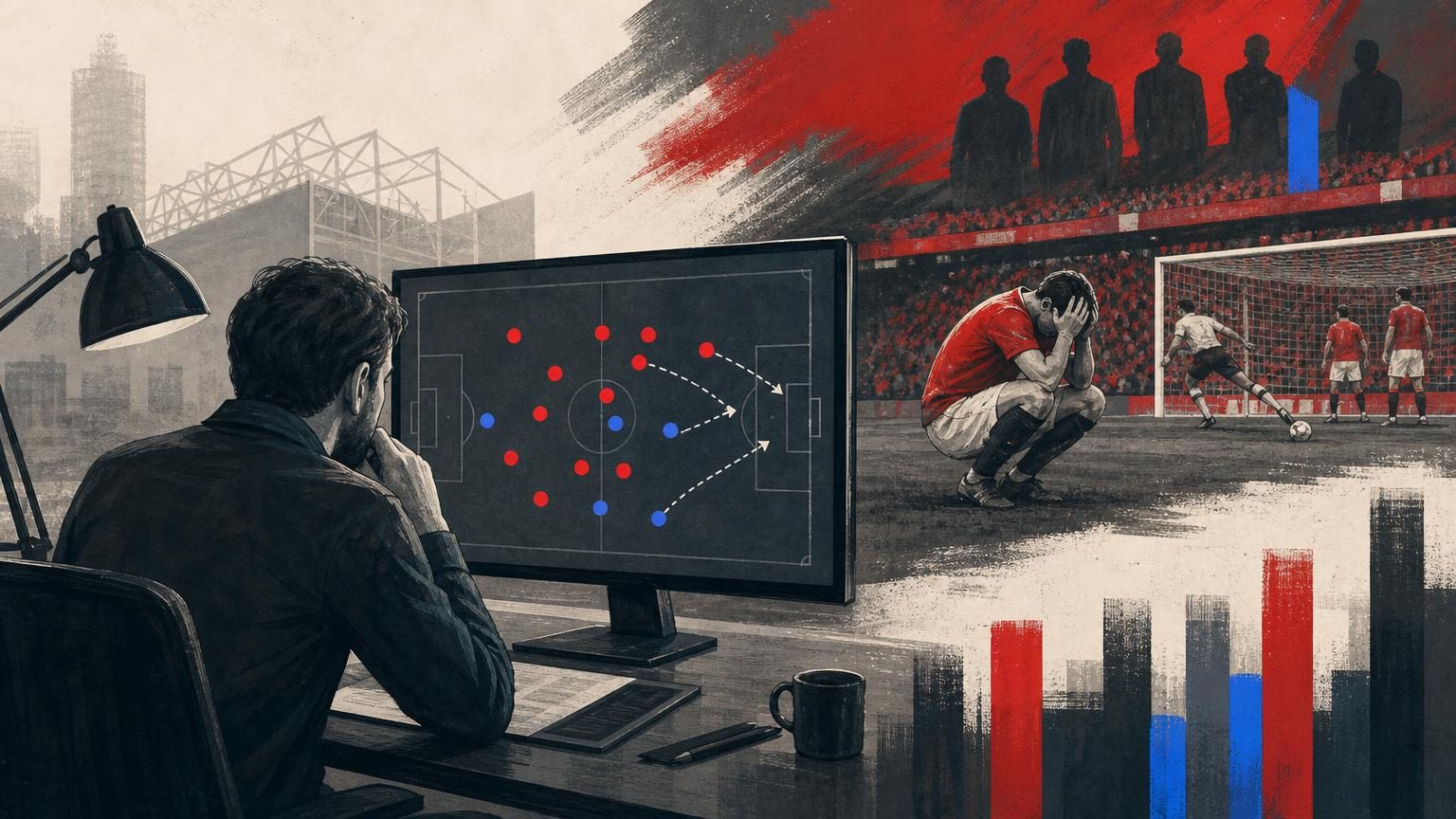
Manchester United led, held a numerical advantage, and still could not see out a win against Tottenham at Old Trafford on Saturday. That sentence alone tells much of the story of their season so far, according to data compiled by The Analyst (Opta).
Bryan Mbeumo had put United ahead with a well-placed finish, and five minutes later Rodrigo Bentancur was sent off for making contact with Luke Shaw's face after the full-back had shoved him to the ground. United needed only to see out roughly a dozen minutes plus stoppage time with an extra man on the pitch.
They did not manage it. Sandro Tonali's second-minute stoppage-time cross was glanced home by Dominic Solanke, who had been grappling with Lisandro Martínez in the build-up, and Tottenham left with a deserved point having been the better side for long stretches, particularly in the opening half hour, despite starting the day bottom of the Premier League table.
A third straight stumble against the bottom club
The draw marked the third consecutive match in which United failed to beat whichever team occupied last place in the table at kick-off, following earlier draws with Fulham before the international break and with Wolves in December 2025, per The Analyst.
The Wolves game stands out as the most alarming of the three. United managed only 0.84 expected goals (xG) to their visitors' 1.16, against a Wolves side that finished 2025 with a points-per-game ratio of 0.76 across the calendar year — the worst over a full year of Premier League football since Huddersfield Town's 0.62 in 2018, The Analyst reports.
Against Fulham, United were unlucky to go behind to a Martínez own goal but needed a deflected late effort from Matheus Cunha simply to salvage a draw, a reminder that fortune, not control, has shaped several of these results.
The ten-man problem has a track record
Saturday's draw was also the third successive occasion on which United failed to beat an opponent reduced to ten men, following last month's 1-0 home defeat to Manchester City after Phil Foden's dismissal, and a 2-1 loss at Newcastle in March, according to The Analyst.
In the Newcastle game, United had an entire second half to exploit the extra man, yet it was Newcastle who created the two clearest chances of that period, neither of which produced a goal. United still lost.
There is a longer history here too. Idrissa Gueye's 13th-minute red card for Everton last November, picked up in a tussle with his own teammate, should have handed United a straightforward route to victory. Instead, Kiernan Dewsbury-Hall scored 16 minutes later and that goal proved decisive in a 1-0 defeat.
What the numbers say beyond the anecdotes
The Analyst's figures put this in wider context. Since the start of last season, across all competitions, United have faced seven matches in which the opposition had a player sent off. They have won three and lost three, a win rate of 42.9% — only marginally below their 47.7% win rate in matches where the opposition stayed at full strength throughout.
Their loss rate tells a sharper story: 42.9% when facing ten men, compared with just 20.5% when facing eleven. The quality of United's chances also drops in these situations, with an xG per shot of 0.095 against ten men compared with 0.122 against a full side. Goals per 90 minutes fall too, from 1.63 to 1.55, despite United actually generating more shots per 90 against ten men — 19.1 compared with 14.4.
The Analyst is careful to note the obvious caveats: opponents set up differently when down to ten, and seven matches is a small sample next to 44. Those numbers should be read with appropriate caution rather than as definitive proof of a flaw.
What they do capture, though, is a tendency. United generate more volume but less quality when handed an advantage, suggesting they struggle less with creating opportunities than with finishing the ones a weakened opponent presents. Saturday against Tottenham fit that profile almost exactly — a lead built on a single clinical finish, followed by territory and chances squandered until a set-piece moment undid them in stoppage time.
Michael Carrick's side next have to show whether Saturday was another instance of a repeating pattern or an aberration they can correct before the next time fortune hands them a numerical edge.