
How Parma's Red Card Shaped a Tense Derby Defeat to Bologna
Reduced to ten men inside nine minutes, Parma still pushed Bologna to the final whistle before Arthur Theate and a Riccardo Orsolini penalty settled the Emilia-Romagna derby 2-1.
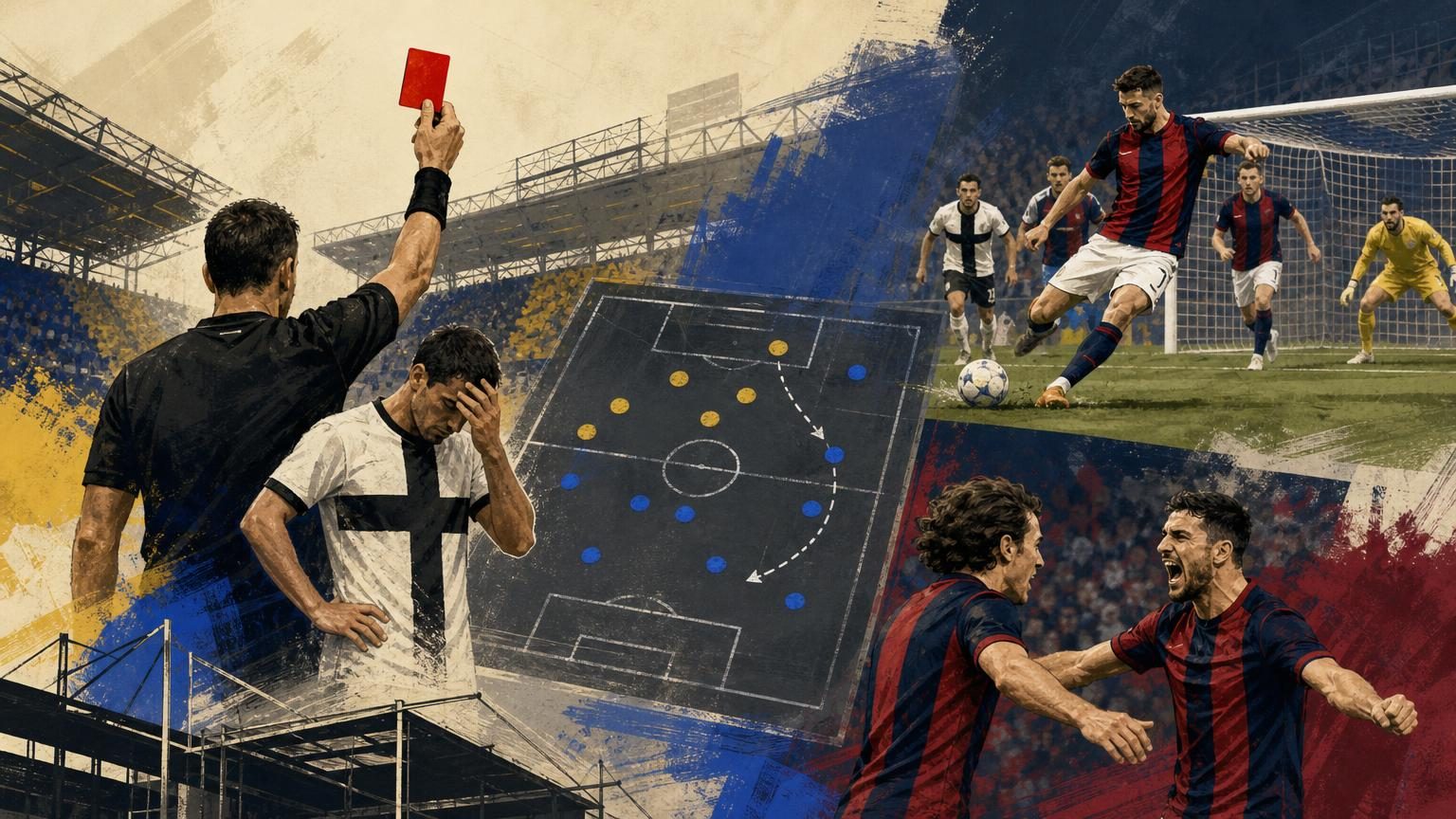
Parma's hopes of a result in the Emilia-Romagna derby were all but gone before the game had properly started. Abdoulaye Ndiaye was sent off in the ninth minute for denying a goalscoring opportunity, and Bologna made the numerical advantage count with a 2-1 win at Stadio Ennio Tardini, according to Football Italia.
Arthur Theate's header and a Riccardo Orsolini penalty either side of the hour mark put Bologna in command, a result that stretched Raffaele Palladino's side to a fourth straight victory. Vincent Sierro's late penalty gave Parma something to show for their resistance, but it was never enough to threaten a point.
A red card that reshaped the derby before it had begun
The incident that defined the match came when Ndiaye and Jens Odgaard went down together just outside the penalty area. The referee initially played on, judging the pair had fouled each other, but a VAR review changed that call. Odgaard's grab of Ndiaye's shorts was ruled insufficient to excuse a clear denial of a goalscoring opportunity, and the red card followed, per Football Italia.
That decision, inside the opening nine minutes, stripped Parma of any realistic plan to press or control territory. A team down a man cannot sustain an organised press high up the pitch for 80-plus minutes without conceding space somewhere else, and Alberto Gilardino's side had no choice but to retreat into a low block and defend what they could in and around their own penalty area.
Bologna's field tilt could not be converted until half-time
The imbalance showed immediately in the numbers: Bologna finished with 69 per cent possession to Parma's 31, and a staggering 33 shots to the hosts' 11, with ten corners to Parma's one. That gap in shots on target, 10 to 2, measures how often Bologna actually tested Giovanni Daffara rather than simply circulating the ball in front of a packed Parma block, and the Polish-trained goalkeeper was the difference for long spells.
Daffara denied Samuel Mbangula's curler, Odgaard at the near post, Tommaso Pobega, and then a Federico Bernardeschi volley off a Nicolò Cambiaghi cross at the start of the second half. Bologna's dominance of territory was not translating into goals, a reminder that a heavily tilted match can sit goalless for an hour if the defending side's goalkeeper is in form and its structure holds.
The breakthrough, when it came, was a set-piece pattern rather than a product of open-play pressure. Cambiaghi's cross from the right found Theate unmarked for a diving header from six yards in the 53rd minute, the kind of chance that ten-man sides concede when their low block cannot cover every runner into the box.
Parma's resistance bent only on penalties
Even at 10 against 11, Parma had their moment. On the hour mark El Bilal Touré drove at the Bologna defence from midfield and was only stopped by Lukasz Skorupski's trailing leg, a reminder that a disciplined low block can still spring a transition if the opposition overcommits numbers forward.
Soon after, a VAR review overturned an initial non-penalty call against Touré for a tackle on Cambiaghi, finding no contact with the ball, and Orsolini converted from the spot despite Daffara guessing correctly, putting Bologna two goals clear in the 72nd minute.
Parma's reply also came from a set piece review. Giovanni Fabbian's attempted backheel flick from six yards saw him caught by Martin Vitik, VAR awarded a penalty, and Sierro scored it to pull Bologna back to 2-1 with nine minutes left. Daffara then kept Parma in the contest by pushing away a Bernardeschi free kick, before Christian Ordonez fired over in stoppage time as the ten men pushed for an unlikely leveller to the last.
Both sides had already changed manager earlier in the campaign, and both arrived with form behind them. Gilardino had just taken his first win on the Parma bench, a 3-0 success away to Atalanta, though he was missing Adrian Bernabé and Dominik Drobnic for the derby. Palladino's Bologna were already on a three-match winning run, with Jay Enem, Emil Holm and Lorenzo De Silvestri absent but Roberto Piccoli back among the substitutes, Football Italia reported.
Parma also lost David Romero to what appeared to be a dislocated shoulder after a sliding challenge from Nicolò Casale, forcing an early substitution, while Bologna had to replace Juan Miranda because of a muscular injury. Those changes added to the attritional feel of a match already shaped by the ninth-minute sending-off.
The scoreline flatters neither the gulf in the underlying numbers nor Parma's refusal to simply absorb the result. Bologna's win keeps their momentum under Palladino intact heading into the next round of fixtures, while Gilardino's Parma will take some encouragement from a defensive performance that limited the damage to a single goal across more than 80 minutes played a man short.