
Franz Beckenbauer and the Attacking Libero
The sweeper began as a purely defensive safety net. Beckenbauer turned it into a platform for building play, stepping out from the back to lead attacks.
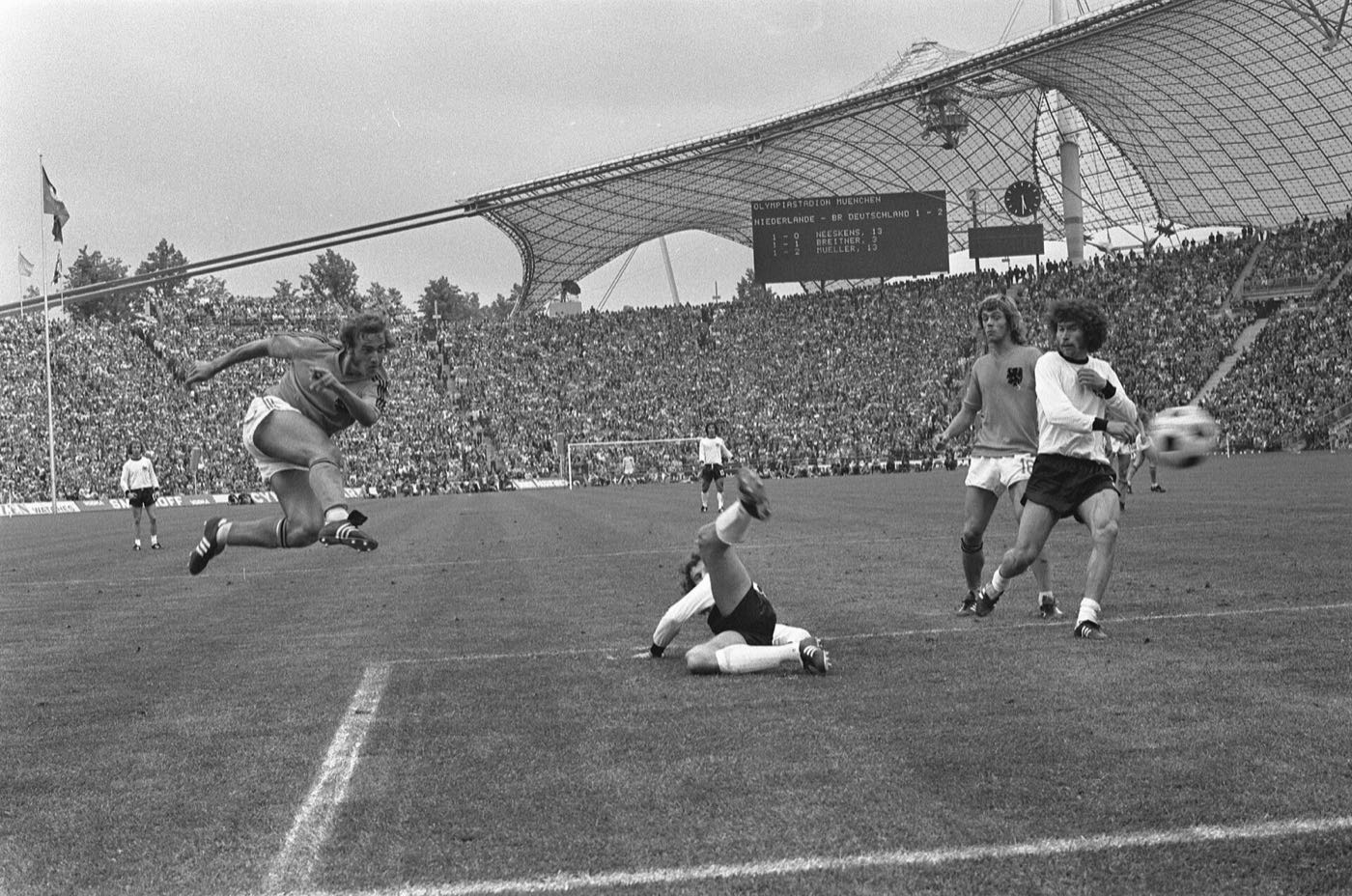
The libero, or sweeper, began life as a safety measure. In the defensive systems that developed in Switzerland and Italy in the middle decades of the twentieth century, an extra defender was stationed behind the markers to clear up anything that got past them. The role was about caution: an insurance policy against a lost duel.
Franz Beckenbauer changed what that position could mean. Playing for Bayern Munich and West Germany, he used the freedom of the spare man not merely to cover but to attack, stepping out from the back with the ball and turning defence into the first phase of build-up.
From midfield to the back
Beckenbauer first made his name as a midfielder, and he played in midfield for West Germany at the 1966 World Cup, including the final at Wembley. His later move into the libero role carried those midfield skills into a deeper position. That background explains much of what made him distinctive: he approached the sweeper's job with a midfielder's instincts, looking for passes and spaces rather than simply for the ball to clear.
What the attacking libero did
In a team built on man-marking, the libero was the one outfield player without a direct opponent. Beckenbauer used that freedom in several ways:
- Covering: he remained the last line of protection, reading danger and intercepting.
- Carrying: with no marker assigned to him, he could advance with the ball into midfield and create a numerical advantage.
- Distributing: his passing range allowed him to switch play or find forwards directly.
- Organising: from behind the line he could see the whole game and direct the players in front of him.
The key was timing. A sweeper who stepped forward at the wrong moment left the defence exposed. Beckenbauer's judgement of when it was safe to advance was as important as his technique on the ball, and it is the part of his game most easily overlooked in favour of the elegance of his carrying.
Beckenbauer showed that the spare defender was also the spare playmaker. The player with no one to mark was the player best placed to start an attack.
Success with club and country
The role sat at the centre of a remarkable period. Bayern Munich won three consecutive European Cups between 1974 and 1976, and West Germany won the European Championship in 1972 and the World Cup in 1974, with Beckenbauer as captain. He was twice named European Footballer of the Year.
Alongside him, Hans-Georg Schwarzenbeck handled much of the direct marking at Bayern, freeing Beckenbauer to play his more expansive game. The partnership illustrates a principle that still holds: one defender's freedom depends on another's discipline.
His part in the 1974 World Cup final showed the role's value in a high-stakes match. West Germany assigned a marker to Johan Cruyff while Beckenbauer provided cover and composure behind.
The libero's decline and its descendants
As zonal defending spread in the late 1980s and 1990s, particularly after the influence of flat back fours such as Arrigo Sacchi's Milan, the classical libero became less common. A flat line using offside had no need of a sweeper sitting deeper than everyone else.
Yet the attacking ideas Beckenbauer embodied did not disappear; they migrated. Several modern roles carry parts of his legacy:
- Ball-playing centre-backs who carry the ball into midfield to break a press.
- The central defender in a back three, who often has licence to step forward.
- Goalkeepers who act as an extra passer in build-up and cover the space behind a high line.
The history of three-man defences, including those built around a sweeper, is explored in the evolution of the back three. In each of these modern roles there is an echo of Beckenbauer's central idea: the defender with the clearest view of the game is well placed to begin the play.
Why it still matters
Beckenbauer's legacy is not only a list of trophies. He demonstrated that defensive positions could be creative positions, and that a team could gain an advantage by giving its most intelligent player freedom rather than a marking assignment.
That idea runs through much of modern tactical thinking. Whenever a coach asks a centre-back to step into midfield, or builds an attack from the back rather than bypassing it, the logic owes something to the player who made the sweeper's position the starting point of his team's football.