
Netherlands v West Germany, 1974: How the World Cup Final Turned
The Dutch led before West Germany had touched the ball, yet lost. The 1974 final turned on marking, control and what the Netherlands did with their lead.
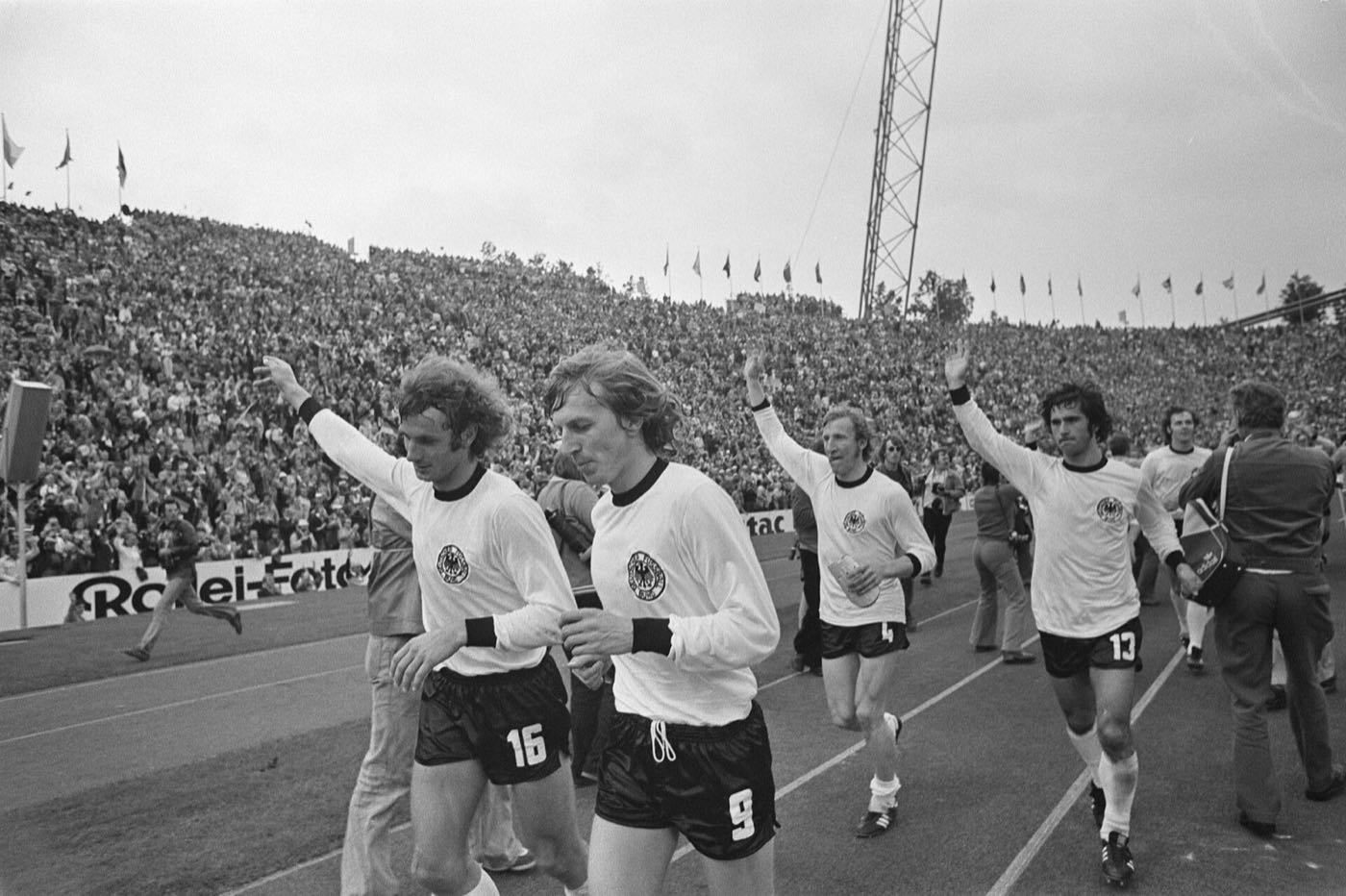
The 1974 World Cup final in Munich is remembered as a meeting of two footballing philosophies and two great players. On one side stood the Netherlands of Rinus Michels and Johan Cruyff, the embodiment of Total Football. On the other stood the hosts, West Germany, coached by Helmut Schön and captained by Franz Beckenbauer. The match turned on a handful of moments, but its tactical story is richer than the scoreline suggests.
West Germany won 2-1, having conceded in the opening minutes. Understanding how that happened means looking at what each side did with the ball, and at what the Dutch did with their advantage.
A lead without a German touch
The Netherlands kicked off and kept the ball through a long passing sequence before Cruyff advanced from deep, carried it into the penalty area and was brought down. Johan Neeskens converted the penalty. West Germany had not yet touched the ball.
It was an opening that seemed to confirm everything about the Dutch approach: patience in possession, a sudden change of pace, and a forward whose movement from deep positions was almost impossible to track. Yet the goal came so early that it left a long match to manage, and the question of how to manage it became decisive.
Vogts, Cruyff and the marking battle
West Germany's most important tactical decision concerned Cruyff. Berti Vogts was given the job of tracking him, and he did so closely and persistently. Cruyff's habit of dropping deep and drifting wide was designed to drag markers out of position; Vogts' task was to follow regardless.
- Man-marking Cruyff reduced his influence in and around the penalty area.
- It cost West Germany a defender's positional discipline, a price they were willing to pay.
- Beckenbauer, operating as a free defender behind the line, provided cover and the option to step into midfield with the ball.
Beckenbauer's role was a model of the attacking libero, discussed further in Franz Beckenbauer and the attacking libero. His presence allowed West Germany to combine tight marking on the most dangerous opponent with a spare man who could both protect and construct.
The German response
West Germany drew level through a penalty converted by Paul Breitner after Bernd Hölzenbein went down in the area. Before half-time Gerd Müller turned in the box and scored what proved to be the winner, a goal typical of a striker whose genius lay in finding a sliver of space in crowded penalty areas.
In the second half the Netherlands pushed for an equaliser, but West Germany held firm. Sepp Maier in goal and a well-organised defensive structure ensured that the Dutch pressure did not produce the goal it needed.
The Netherlands had the more celebrated idea, but West Germany had the better answer to the specific problem in front of them: contain Cruyff, stay compact and trust Müller.
What the Dutch did with their lead
A common interpretation of the final is that the Dutch, after scoring, became more interested in dominating their opponents than in extending their lead. That reading deserves caution, since it is partly narrative built with hindsight. What can be said with confidence is that the early goal did not lead to a sustained period of Dutch chances, and that West Germany were allowed back into the contest.
Several tactical explanations are worth weighing:
- Total Football relied on high intensity, and maintaining it for a whole match after an early lead is difficult.
- Vogts' marking removed the player who most often turned Dutch possession into danger.
- West Germany, as hosts and reigning European champions, were a strong and well-organised side in their own right.
It is also worth remembering how little margin separated the two teams. A final between sides of this quality rarely rewards the team with the better reputation; it rewards the team that solves the more pressing problems on the day.
Legacy of the final
The defeat did little to diminish the reputation of the Dutch team, whose principles are traced in Total Football under Rinus Michels. If anything, the final strengthened the sense that the Netherlands had changed how the game could be played even without winning its biggest prize.
For West Germany, the victory capped a period in which the national team and Bayern Munich, with Beckenbauer at the centre of both, stood at the summit of the European game. The final remains a useful case study in how a clear, specific plan can neutralise a more expansive idea.