
The false nine: how a striker who drops deep breaks a back line
A guide to the false nine role, how it grew out of the deep-lying forward tradition, and why pulling a centre-back out of position causes problems no orthodox striker creates.
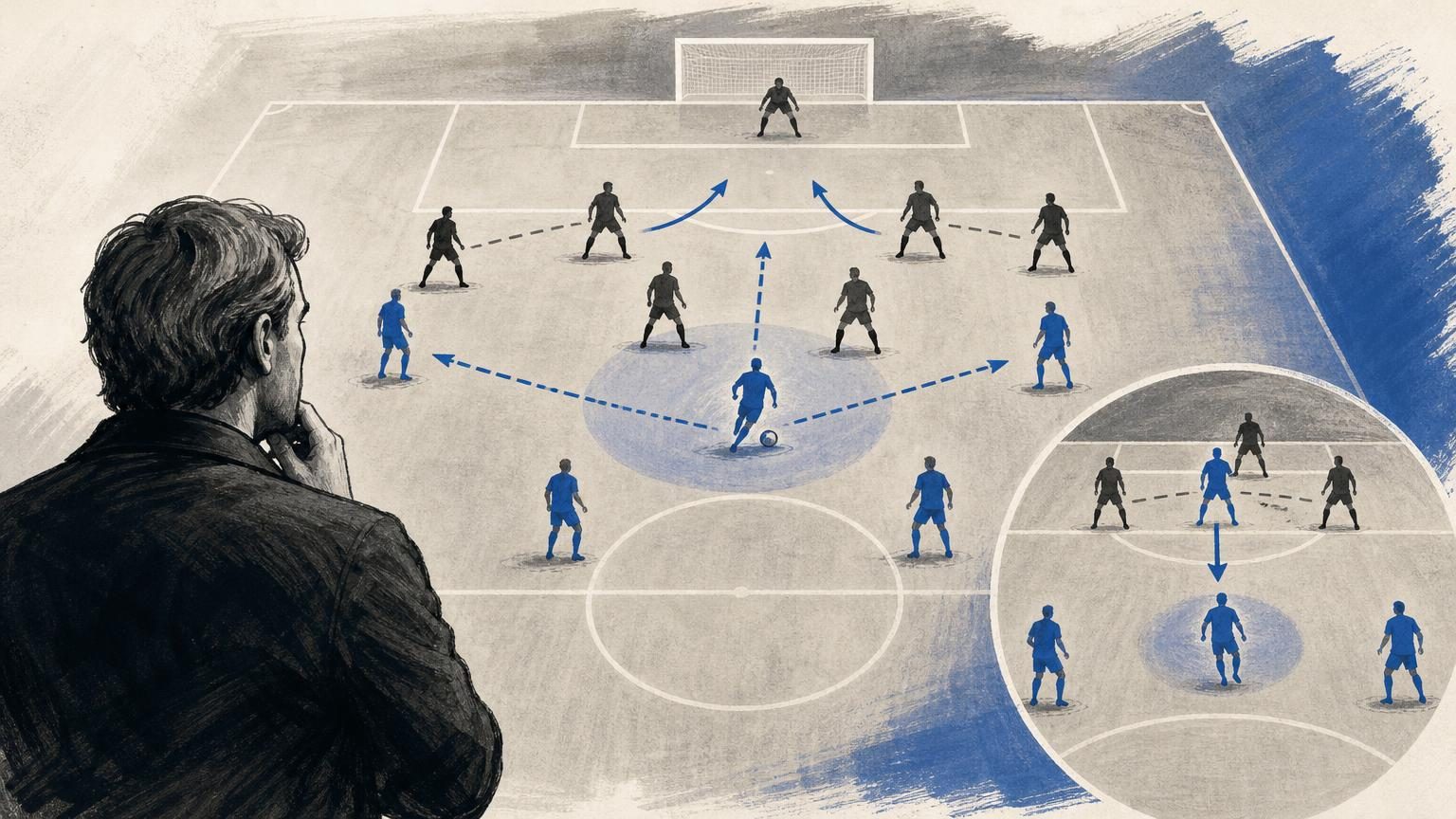
A false nine is a central forward who does not stay on the last line. Instead of holding the highest position and waiting for service, the player drops into midfield areas to collect the ball, link play and draw opponents out of their defensive shape.
That is the opposite job to a traditional centre-forward, whose value lies in occupying the last line permanently, stretching the defence vertically and finishing chances created by others.
According to Wikipedia, the deep-lying forward is not a recent invention. Long before the phrase "false nine" became common, such players were called inside forwards or creative centre-forwards, sometimes nicknamed sub forwards, because their main contribution came from withdrawn positions rather than the penalty box.
Why the false nine is not simply a number 10
Wikipedia distinguishes the false nine and its relatives from the number 10 position, even though both operate in deep, creative zones. The number 10, exemplified by players such as Zinedine Zidane or Lionel Messi when used as an advanced playmaker, is treated as a distinct position built around orchestrating attacks from an attacking-midfield base.
The second striker, or support striker, sits closer to the old deep-lying forward model. Wikipedia describes this role as loosely defined, somewhere between an out-and-out striker and a number 10, showing some of the characteristics of both without being either.
Players in that role are expected to combine mobility, dribbling, vision and passing with the capacity to finish, since they must still function as a goal threat even while dropping deep to find possession.
Wikipedia notes that a second striker does not usually involve as many teammates in building attacks as a true number 10, because the responsibility for orchestration is shared rather than concentrated in one player.
Michel Platini's term for this hybrid, the "nine-and-a-half", used to describe Roberto Baggio's role at Juventus, captures the idea of a forward who is neither a fixed target man nor a conventional playmaker but something between the two.
The problem a false nine sets for centre-backs
The tactical difficulty a false nine creates stems from a simple decision a centre-back is forced to make every time the forward drops short.
If the centre-back follows the forward out of the defensive line, space opens behind for runners from midfield to exploit. If the centre-back stays in position, the false nine receives the ball unmarked in a pocket of space between the lines, able to turn and play forward passes.
Neither choice is free of cost, and that is precisely the mechanism the role exploits: it manufactures a structural dilemma rather than simply beating a defender with pace or power.
This differs from how a traditional centre-forward is defended. An orthodox number nine who stays high can be marked tightly by a single centre-back for the whole match, since the forward's starting position rarely changes.
A false nine's movement means the defender assigned to track them is repeatedly pulled out of the back line, disrupting the defensive shape itself rather than testing one player in a fixed duel.
Formations built around a withdrawn forward
Wikipedia's account of team formations shows this is not only an individual role but something that has reshaped entire systems.
The WW formation, created by the Hungarian coach Márton Bukovi, developed because his side lacked an effective orthodox centre-forward. He moved a forward back into midfield to act as a playmaker, turning the old 3–2–2–3 WM shape into a 3–2–3–2.
In attack this became a 3–2–1–4, and it reverted to 3–2–3–2 once possession was lost, according to Wikipedia. The same approach was later used successfully by Bukovi's compatriot Gusztáv Sebes with the Hungarian national team of the early 1950s.
That history matters for understanding the false nine today. The role did not appear as a sudden innovation but as a recurring solution to the same tactical question: what to do when the orthodox centre-forward is unavailable or unsuitable, and how a team can use that absence to pull opposition defenders out of shape instead.
Related ideas sit alongside it in the modern game. Wikipedia describes the raumdeuter, or "space interpreter", associated with Thomas Müller, as a wide or advanced player who seeks gaps centrally rather than holding a fixed position, and the "false winger", a nominally wide player who moves inside to congest midfield and free space for an overlapping full-back.
Both share the false nine's underlying logic: positioning on paper is not positioning in practice, and a defence organised to mark where a player is supposed to stand can be unpicked by a player who refuses to stand there.