
Zonal Marking Versus Man-to-Man: What Each System Asks of a Defender
Two defensive philosophies – tracking a player or covering a patch of grass – demand different disciplines from defenders, and fail in different ways.
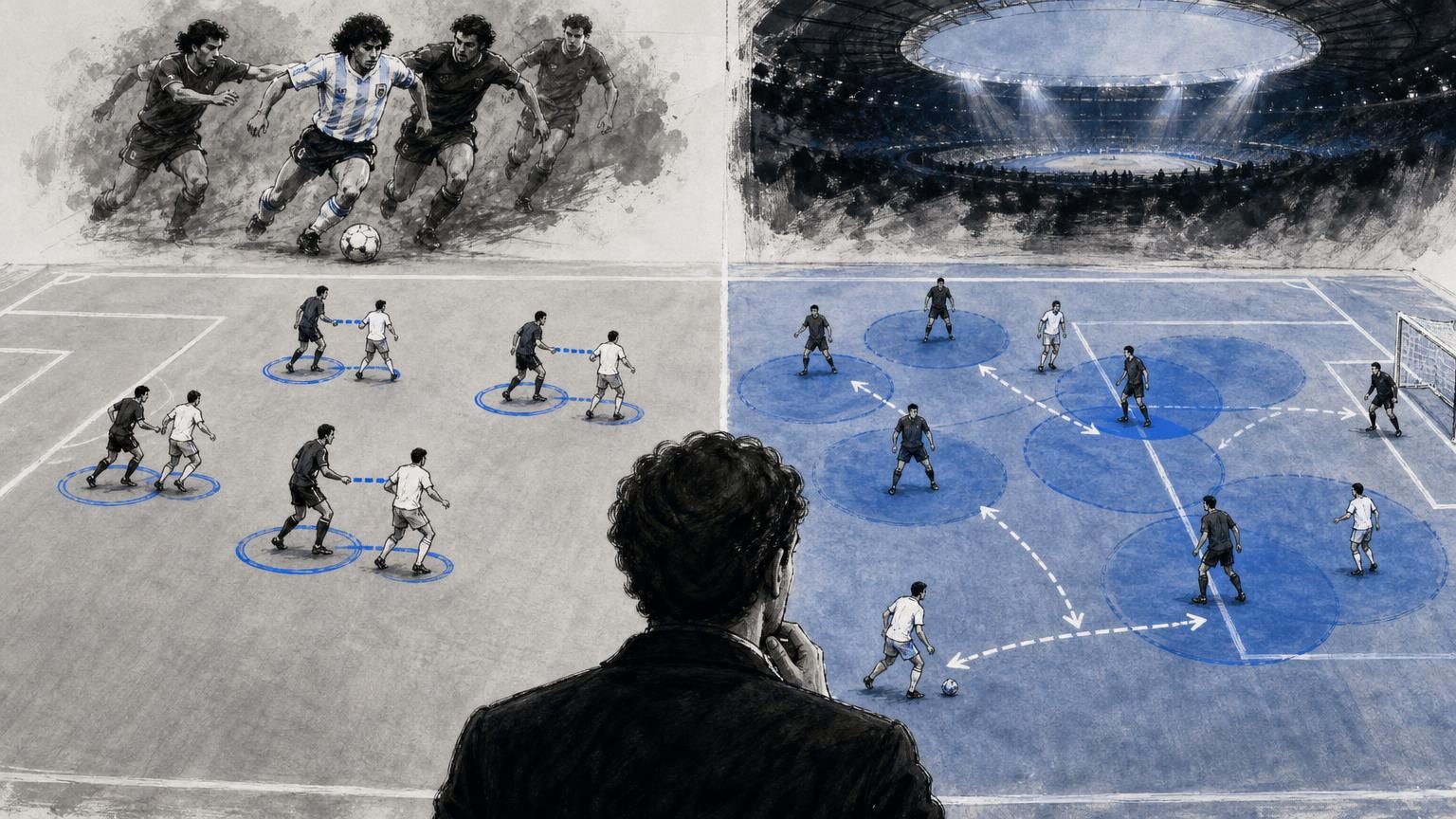
Football's defensive organisation reduces, at root, to one choice: does a defender follow a man, or does he hold a zone? Man-to-man marking assigns each defender a specific opponent to shadow wherever that opponent goes. Zonal marking assigns each defender an area of the pitch, with responsibility for an attacker passing from one defender to the next as he crosses zones, as Wikipedia explains.
The two systems produce entirely different pictures of a back line. In man-marking, a defender's position on the pitch is dictated by where his opponent happens to be standing. In zonal marking, a defender's position is dictated by the team's shape, and he only engages an opponent who enters his patch.
What man-marking asks of a defender
Man-to-man marking demands a defender who can move to any part of the field, because his job is defined by a person rather than a space. Wikipedia notes this tactic underpinned the catenaccio systems of Inter Milan and A.C. Milan, where four man-markers played in front of a free-roaming sweeper.
The discipline required is personal and relentless: a single defender tracks a single attacker for the duration of the game. Some of football's most cited individual duels were built on exactly this job description, among them Berti Vogts shadowing Johan Cruyff in 1974, Claudio Gentile man-marking Diego Maradona and Zico in 1982, and Guido Buchwald following Maradona in 1990.
The same approach has been used by weaker sides against stronger opposition, Wikipedia records, citing Aleksandr Khatskevich on Predrag Mijatović for Dynamo Kyiv, Park Ji-sung on Andrea Pirlo for PSV Eindhoven, Michael Essien on Steven Gerrard and José Bosingwa on Lionel Messi for Chelsea, and Danny Welbeck on Xabi Alonso for Manchester United. Marcelo Bielsa continued using man-marking into the 21st century, employing it as late as 2020, while Greece's victorious 2004 European Championship campaign is noted as a modern example of the system succeeding at the highest level.
Why man-marking breaks down
The cost of man-marking is structural. Because each defender's movement is slaved to an opponent rather than to his teammates, the defensive line can be stretched, dragged out of position or opened up entirely whenever an attacker makes a decoy run. Wikipedia observes that defenders tied up in individual duels can become reluctant or absent contributors going forward, since their attention stays fixed on a marking job rather than the game around them.
A related weakness sits in what the broader defensive framework calls the third defender's role: the player providing deeper cover and reading danger across the pitch. That role functions very differently under man-marking than under a zonal system, because a man-marker who has been pulled into his opponent's run is less available to cover space behind him.
What zonal marking asks of a defender
Zonal marking inverts the logic. A defender holds a patch of the pitch and only picks up an opponent who steps into it; once that opponent leaves the zone, marking responsibility passes to whichever teammate's zone he has entered. Wikipedia identifies the system's chief advantage as flexibility: because players remain roughly in their own areas of the pitch, a team can launch an attack more quickly once possession is regained.
This demands something different of a defender than man-marking does: constant communication with teammates rather than close physical attention to one opponent, because gaps between zones only stay closed if players talk to each other and hand off responsibility cleanly. Zonal systems are the more common professional approach — Wikipedia records that 15 of the 16 teams reaching the knockout stages of the 2004 UEFA Champions League used zonal marking — and they tend to pair with a flat back four in a 4-4-2 rather than with a sweeper system.
Where zonal marking tends to fail
The system's recognised weak point is set pieces. Wikipedia states that ensuring no gaps are left during corners and free kicks is difficult under zonal marking, which is why most teams switch to man-marking specifically for those situations. A zone can be held perfectly in open play and still be exploited the moment an opponent arrives in the right space at the right instant, because no individual defender is pre-assigned to deal with him.
Communication failure is the everyday version of the same problem: if a handoff between adjacent zones is missed, an attacker can run straight through the seam between two defenders who each believed the other had picked him up.
Few modern teams run either system in pure form. Wikipedia describes the 3-5-2 formation becoming a 5-3-2 out of possession, combining two man-marking stoppers, a zonal sweeper, and two wing-backs operating almost as auxiliary midfielders. Other sides commit fully to zonal defending across the pitch. The underlying trade-off persists regardless of the blend chosen: man-marking buys certainty over one opponent at the cost of defensive shape, while zonal marking buys shape and a faster transition to attack at the cost of vulnerability whenever a gap opens between zones, most visibly at the dead ball.