
Formations Tell You Where Players Start, Not What They Do
The numbers in a formation like 4-3-3 describe rows of players, not the fluid roles, cover and trade-offs that actually decide how a team defends and attacks.
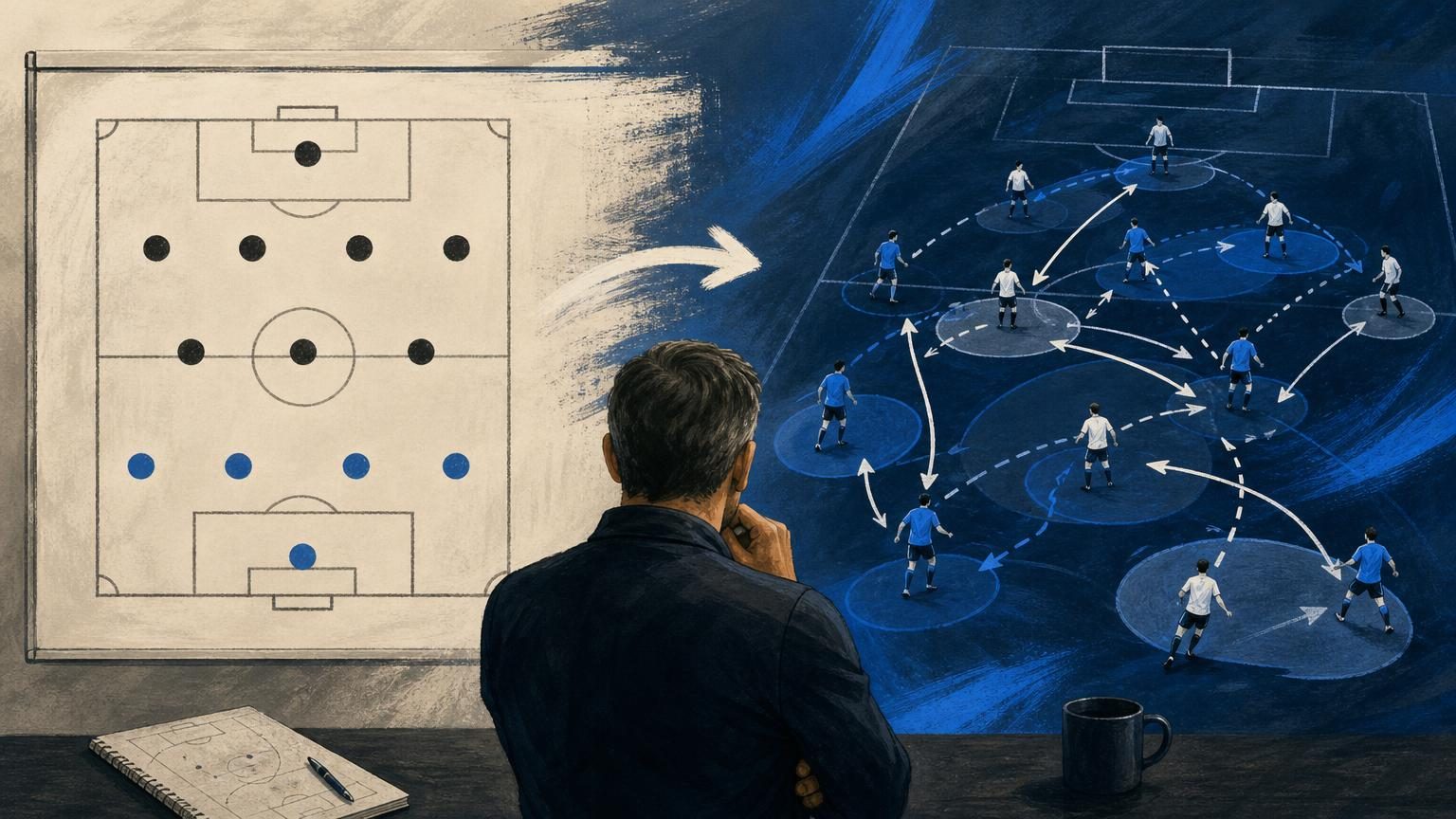
A formation is a shorthand. It lists how many players occupy each row of a team's shape, counted from the defensive line forward, so a 4-5-1 means four defenders, five midfielders and one central forward, according to Wikipedia.
That number is useful because it is simple, but simplicity is also its limit. Wikipedia notes that outfield positions in football are not fixed the way a position is in rugby, and there are no stoppages forcing players back into formation as there are in gridiron football.
A formation therefore tells a reader roughly where a player starts and whether their job leans defensive or attacking, central or wide. It does not describe what that player does once the ball moves, how far they roam, or who covers when they do.
Why the same number can mean different teams
Wikipedia points out that modern tracking methods can identify a team's formation from positional data, and that this data shows formations shifting depending on match context. A side nominally set up in one shape can occupy a different one in and out of possession.
This matters because two teams both labelled 4-3-3 can play entirely differently. One version, common in Italy, Argentina and Uruguay in the 1960s and 1970s, staggered the midfield three with a defensive player behind two attacking ones. Another, associated with Johan Cruyff's Ajax and later Pep Guardiola's Barcelona, organised the same numbers around fluid rotation and possession.
Jürgen Klopp's Liverpool used a 4-3-3 built around high pressing and a front three of Mohamed Salah, Sadio Mané and Roberto Firmino, winning the Premier League and the Champions League with it, Wikipedia states. The label 4-3-3 captures none of that pressing structure by itself.
The trade-off between width, depth and cover
Every formation distributes the same eleven players across the same pitch, so adding numbers in one area means fewer somewhere else. A 4-4-2 keeps two banks of four across the width of the field, which Wikipedia describes as strong protection against sides trying to get beyond them, but it leaves only two central midfielders to control possession.
That central shortage became the formation's chief weakness against opponents fielding three or more midfielders, since being outnumbered in the middle makes it harder to both win and keep the ball, per Wikipedia. England's elimination from the 2010 World Cup by a 4-2-3-1 Germany side was cited at the time as evidence the 4-4-2 was becoming outdated, though the shape later had a revival under managers including Diego Simeone and Carlo Ancelotti.
A 4-3-3 trades some of that defensive width for central control. The extra midfielder helps a team win and circulate the ball through the middle, and the three forwards spread across the width of the attack, sometimes doubling as the first line of defensive pressure on the opposition full-backs rather than tracking back to help their own, Wikipedia explains.
Wikipedia's account of team tactics adds the layer formation numbers cannot show on their own: teams choose how much risk to accept in possession, with higher-risk passing offering more reward against a settled defence but more exposure to counter-attacks, while cautious passing retains the ball at the cost of creating fewer chances.
Zone defence further complicates a static reading of a formation. Wikipedia describes defenders and midfielders organising into two lines across the pitch, supporting each other to block space between and in front of them, with a straight defensive line also used to apply the offside law against attackers.
What the oldest and newest shapes share
The earliest recorded formations were almost entirely attacking. At the first international match, Scotland against England in 1872, Wikipedia records England fielding seven or eight forwards in roughly a 1-1-8 or 1-2-7 arrangement, while Scotland used six forwards in a 2-2-6 shape and were noted for actually passing between assigned partners rather than dribbling individually.
The 2-3-5, nicknamed the Pyramid, became the standard set-up by the 1890s and lasted into the 1930s. Wikipedia credits it with the first real balance between attack and defence, since the three half-backs met forwards first and the two full-backs formed a last line, with the centre half both marking the opposition's most dangerous forward and organising attacks.
That balance is the same trade-off every formation since has managed in its own way: how many players stay back to cover space, how many push forward to create it, and how the gaps between those two groups get filled. The number only states the ratio. What a team actually does with the width, the depth and the cover those numbers imply is the part that still has to be coached, and watched, match by match.