
Catenaccio: how Italy's sweeper system turned defence into control
A look at how the libero, man-marking and the counter-attack combined to make catenaccio the defining Italian tactical system of the 1960s.
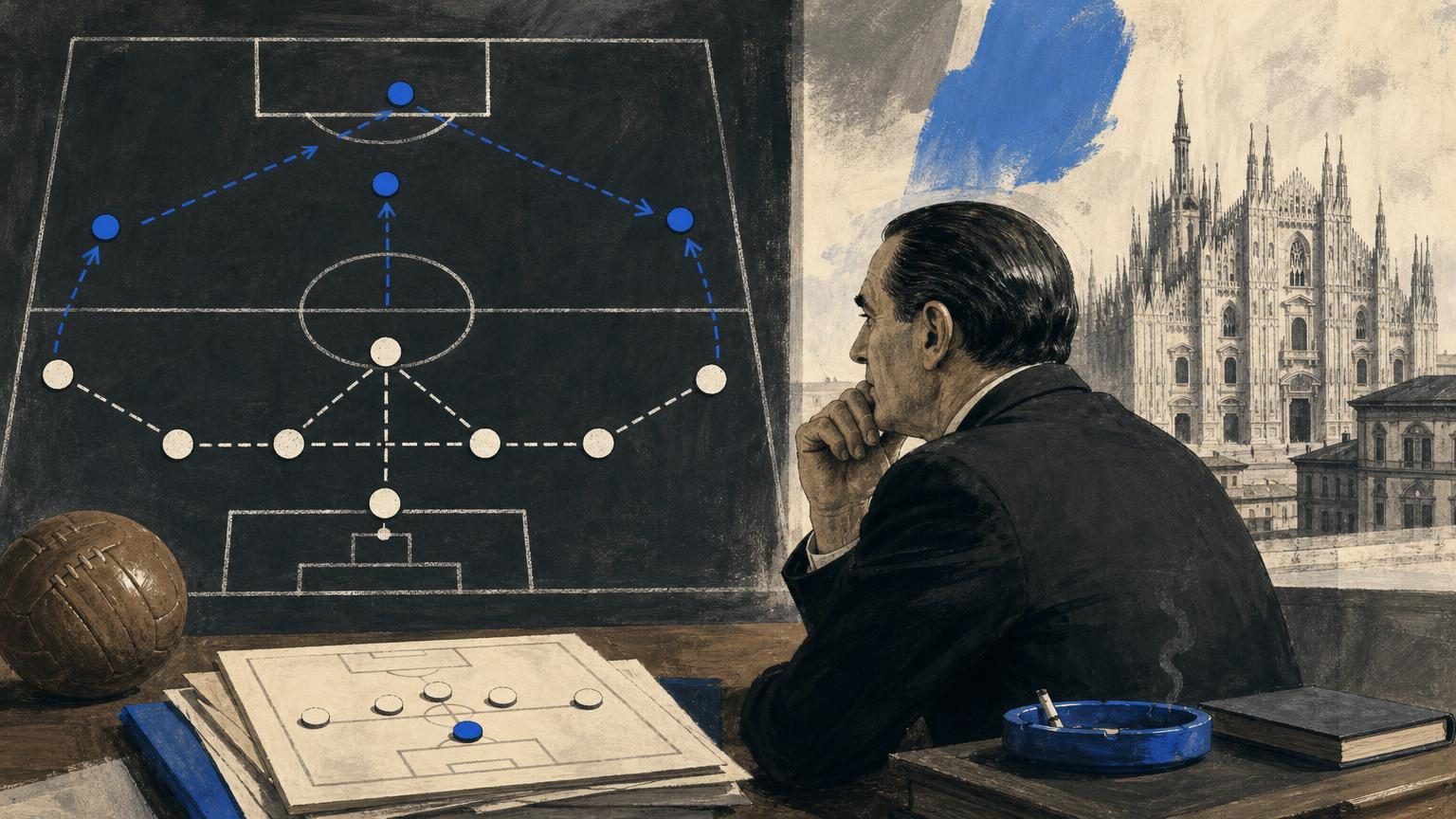
Catenaccio translates from Italian as "door-bolt", and the name describes the intent precisely: a settled, organised backline built to shut down an opponent's attack before it reaches the goal, according to Wikipedia.
The system traces to Nereo Rocco, whose modified version at Triestina in 1947 used a defensive-minded 1-3-3-3 shape and produced a surprise second-place finish in Serie A, Wikipedia reports. Rocco later took the approach to Padova and then Milan, where he won two Serie A titles, three Coppa Italia titles, two European Cups and other honours.
The sweeper was the mechanism, not just a position
The defining innovation was the libero, or sweeper, stationed behind a line of defenders rather than marking an opponent directly. According to Wikipedia, the sweeper's job was to mop up loose balls, close down the opposing striker and double up on a man-marker when an attacker threatened to get through.
This solved a specific problem. If each of a team's other defenders was tied to a man-marking job on a particular forward, any one of them could be beaten by pace, skill or a blind-side run. The sweeper was the free man behind that line, with no direct opponent of his own, free to read the game and step in wherever the breach opened.
Alfredo Foni's Inter in the early 1950s produced an early version of this through Ivano Blason, the right-back, who shifted into the sweeper role while winger Gino Armano dropped back to cover for him; Blason is often credited as the first true sweeper in Italian football, Wikipedia states. He also played as a sweeper under Rocco.
Helenio Herrera built the system's best-known version at Inter in the 1960s, deploying a 5-3-2 formation in which four defenders man-marked the opposition's attackers while a fifth player, the sweeper, covered whatever got past them, per Wikipedia. Armando Picchi held that sweeper role for Herrera's side.
Why defence did not mean the team stopped attacking
The second pillar of catenaccio was the counter-attack, built on long passes out of defence once possession was won back. A settled defensive structure let a team absorb pressure and then break at speed with fewer players committed forward, rather than attempt to dominate the ball for long periods.
Herrera's Inter were also known for scoring goals in few touches from these sudden transitions, helped by his use of attacking, overlapping full-backs. Herrera himself argued, shortly before his death, that his system had been misunderstood by those who copied it: "the problem is that most of the people who copied me copied me wrongly. They forgot to include the attacking principles that my Catenaccio included. I had Picchi as a sweeper, yes, but I also had Facchetti, the first full back to score as many goals as a forward."
Under Herrera, Inter won three Serie A titles, two European Cups and two Intercontinental Cups, Wikipedia records. The Italy national team later carried a related approach into international football: manager Ferruccio Valcareggi built his back line around a libero, stationed behind a full-back and two central defenders who each picked up a direct opponent, favouring stability and narrow leads over expansive attacking play. That approach won Euro 1968 on home soil and reached the 1970 World Cup final, where Italy lost 4-1 to a more attacking Brazil side.
How Italian football came to be defined by it
Catenaccio's spread through Rocco's Milan, Foni's and Herrera's Inter, and Valcareggi's national side gave Italian football a recognisable defensive identity through the 1960s and into the 1970s. The trophies that followed — league titles, European Cups, an Intercontinental Cup — reinforced the association, as did the emphasis the system placed on disciplined, hard-tackling defenders, a type of player Wikipedia notes the approach helped bring to prominence in Italy.
That reputation outlasted the system's peak. Total football, developed by Rinus Michels in the 1970s, exposed catenaccio's reliance on fixed man-marking once opponents began interchanging positions freely; Jock Stein's Celtic had already beaten Herrera's Inter in the 1967 European Cup final with an attacking approach that Wikipedia describes as a forerunner to that Dutch model. Michels' Ajax then beat Inter in the 1972 European Cup final and thrashed Cesare Maldini's Milan 6-0 in a European Super Cup leg the following year, prompting Dutch newspapers to announce catenaccio's destruction.
Italian coaches responded by blending man-marking with zonal coverage into a hybrid known as zona mista, a development Giovanni Trapattoni, who had played under Rocco, helped carry forward from the 1970s onward.
The label has since drifted from its original meaning. Heavily defensive, low-block approaches associated with managers such as Jose Mourinho and Diego Simeone are often called catenaccio by pundits and players, but Wikipedia is explicit that this misapplies the term: the original system combined deep, disciplined defending with man-marking, a sweeper tasked with both protecting the back line and launching attacks, and fast counter-attacking football, not merely containment without attacking intent.