
Kaka at his peak: the seven moments that defined a Ballon d'Or year
Before Messi and Ronaldo settled the debate for over a decade, Kaka's dribbling, vision and end product made him the best player in the world.
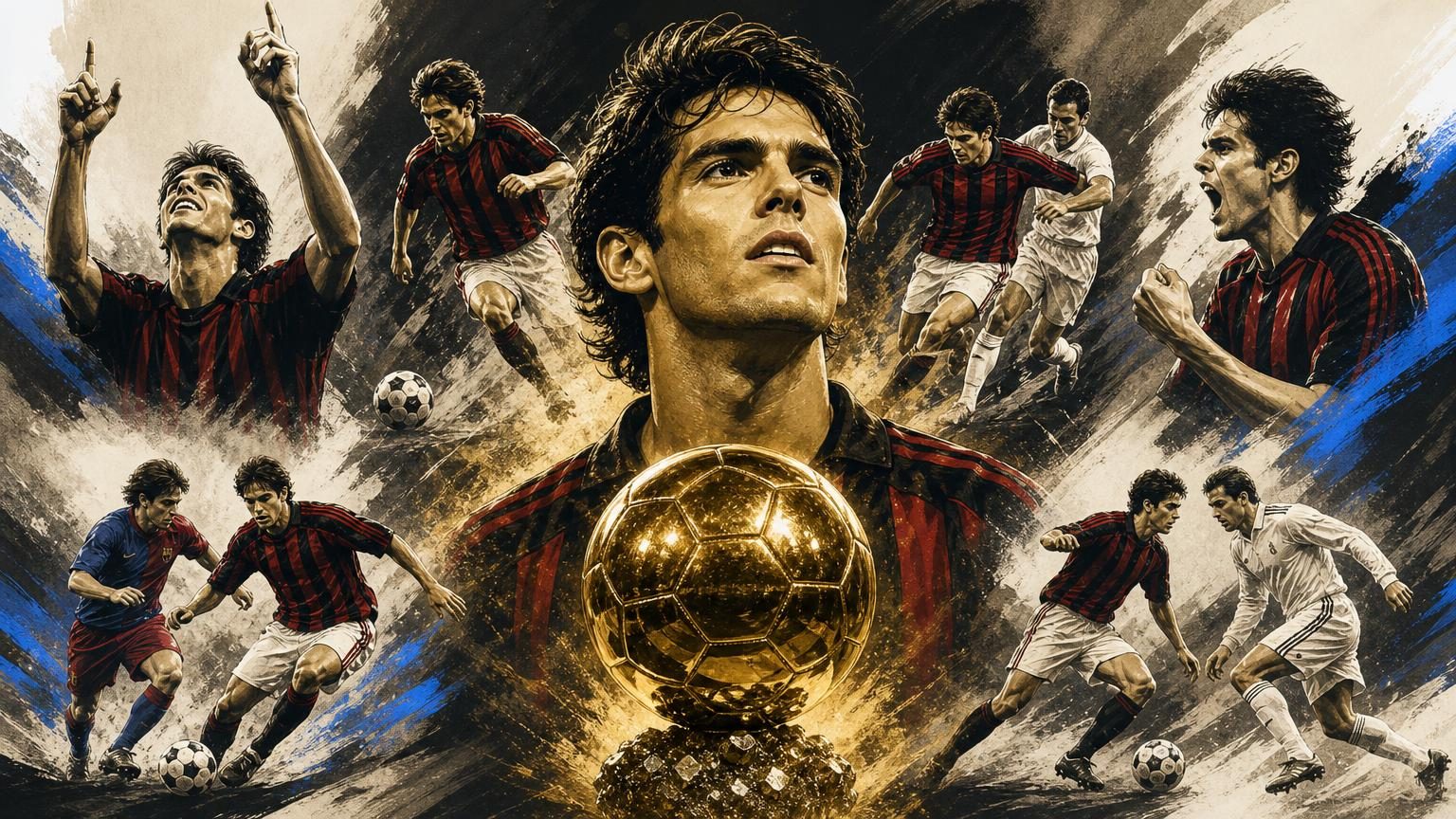
Kaka never had the longevity to be ranked among the all-time greats, but for a short period in the mid-2000s he was, by consensus, the best footballer on the planet. He is the last player to win the Ballon d'Or before Cristiano Ronaldo and Lionel Messi turned the award into a two-man contest, and that alone makes his peak worth revisiting, as Planet Football did in a recent look back at his career.
An instant fit as Milan's attacking midfielder
Kaka joined AC Milan from Sao Paulo in 2003 for a fee of €8.5million, later described by club owner Silvio Berlusconi as peanuts, according to Planet Football. Most South American imports need time to adapt to Serie A's defensive rigour. Kaka did not.
He displaced Portugal international Rui Costa as Milan's attacking midfielder almost immediately, scoring 10 goals in 30 league appearances as Carlo Ancelotti's side won the title by 11 points over Roma, who had actually scored more and conceded fewer goals that season. Kaka was named Serie A Player of the Season at 21.
That positional shift mattered tactically. An attacking midfielder who can beat a man and still finish removes the need for a team to manufacture chances through pure combination play, and Milan built much of their attacking structure around Kaka's capacity to carry the ball through the lines rather than simply receive it between them.
Speed in transition, and a Messi cameo
Kaka's physical profile is often underrated next to his technique. At 6ft1in he was difficult to dispossess, but it was his speed in transition that separated him from most attacking midfielders of his era. Many regard his second goal in a 3-1 Champions League win over Fenerbahce in 2005 as his finest for the club.
Describing the goal himself, Kaka said: "I just kept running with the ball past one player, then another, then one more on the edge of the Fenerbahce box before finishing low under Volkan Demirel." It was a counter-attack finished almost entirely through individual ball-carrying, from inside his own half to the edge of the opposition box.
That same explosiveness in broken play was on show in a 2006 international friendly between Brazil and Argentina at the Emirates, where Kaka drove at the Argentina defence from a corner and left a young Lionel Messi behind him in the process, footage of the sequence shows.
Proving it against Liverpool and United
Kaka's defining year came in 2007. He won the Ballon d'Or with 444 votes, 167 more than Messi and 189 more than Ronaldo. "They win it every year now, but I could beat them back then," he said later, according to Planet Football. He added that it mattered to him because he had faced the best possible opponents for the award.
That recognition followed Milan's only Champions League triumph of the decade, a 2-1 final win over Liverpool in Athens that Kaka has called his prime. It also avenged Milan's collapse against the same opponents in the 2005 final in Istanbul, a result Kaka has described as one of the most important lessons of his career.
Milan fielded the oldest average starting XI in a Champions League final at that point, and Kaka was central to both key moments rather than simply a passenger in an ageing team. He won the free-kick from Xabi Alonso that led to Pirlo's deflected opener, and he later played a perfectly weighted split pass that drew Pepe Reina off his line, allowing Filippo Inzaghi to round the goalkeeper and finish into an empty net.
Milan reached that final having eliminated Manchester United in the semi-finals despite losing the first leg 3-2 at Old Trafford. Kaka's second goal in that tie, scored from a long pass out of Dida's hands, remains one of his favourite memories. He told the Daily Mail: "When the ball dropped from Dida's long pass all I was thinking about was trying to do something special." He added that scoring it at a stadium with so much history made the moment feel amazing.
The semi-final defeat still prompted Sir Alex Ferguson to take note of the Brazilian, underlining how thoroughly Kaka's performances that season had registered even with the manager on the losing side of the tie.
Taken together, the 2005 Fenerbahce goal, the 2006 run past Messi, the Ballon d'Or margin and the two Athens contributions describe a player whose value came from range: a midfielder capable of carrying the ball through a counter-attack, delivering a defence-splitting pass, and still influencing a Champions League final without dominating it individually. That combination, more than any single statistic, explains why Kaka stood alone at the top of the game before Messi and Ronaldo made that position permanently theirs.