
Kanu's Stamford Bridge hat-trick still explains his cult status at Arsenal
Nwankwo Kanu never had the numbers of Henry or Bergkamp, but a stoppage-time winner at Chelsea showed why Arsenal fans adored him anyway, writes Planet Football.
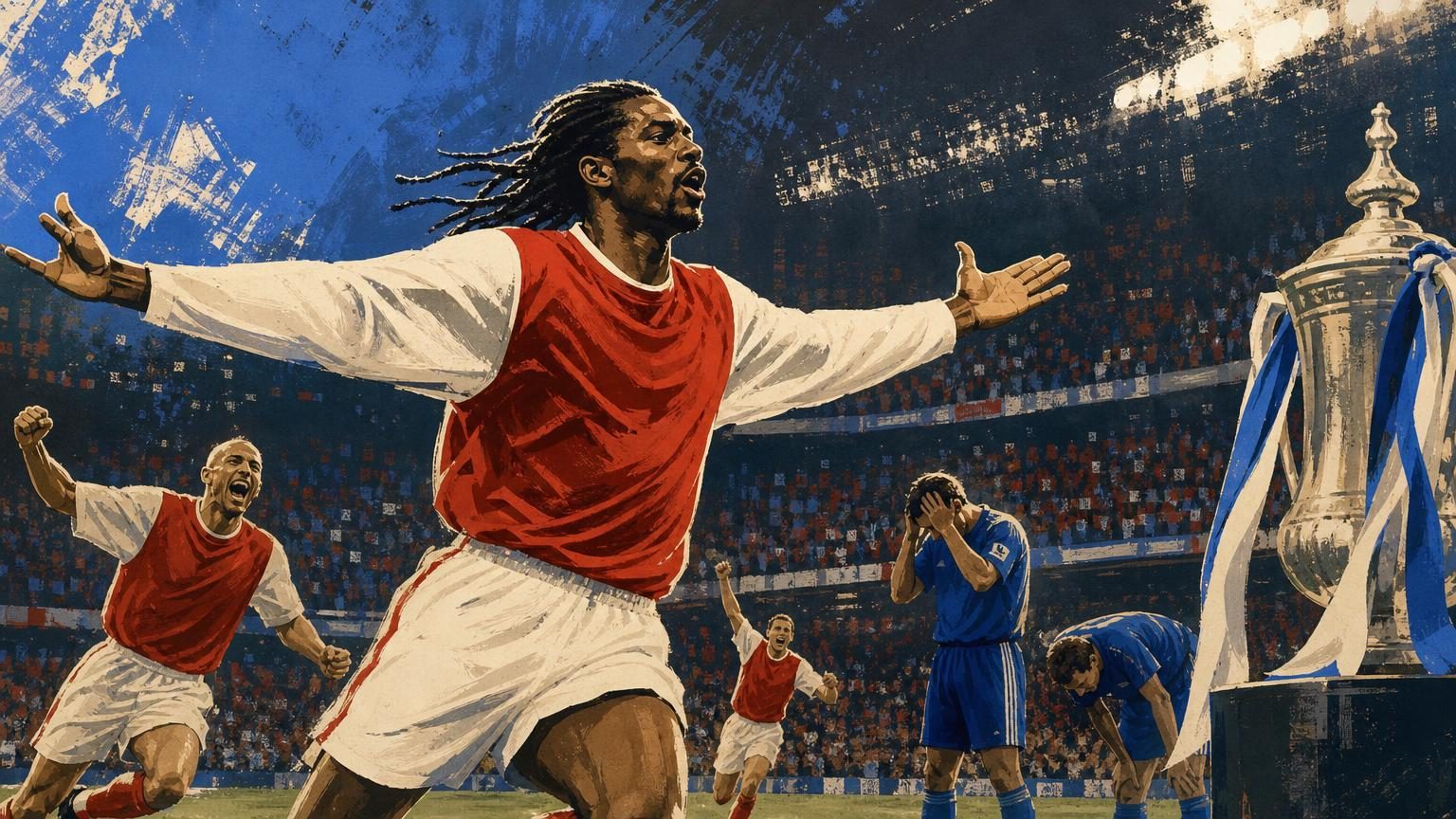
Arsenal were two goals down at Stamford Bridge with the game seemingly gone when Nwankwo Kanu, a late introduction who would finish with a hat-trick, chased down a loose Marc Overmars pass and threw himself at an attempted clearance from Albert Ferrer, according to Planet Football.
The ball broke to him in space in front of the away end. What followed, long strides carrying him at Ed de Goey before a touch that sent the ball pinballing across the goalkeeper's legs, has become one of the defining images of his time in north London.
He finished calmly over Marcel Desailly and Frank Leboeuf, sending the ball into the top corner after two earlier, scrappier goals in the same match had already dragged Arsenal back into contention, Planet Football reported.
Why the winner still stands up as a tactical moment
The third goal is worth examining for what it says about transition play rather than just the finish. Kanu did not receive the ball in settled possession; he won it by reading a loose pass and closing down a defender under pressure, turning a stray clearance into an attack before Chelsea could reorganise.
That is the essence of a well-executed transition: exploiting the gap between a team losing the ball and regaining its defensive shape. Desailly and Leboeuf, as the Chelsea centre-back pairing, were left reacting rather than dictating, which is precisely why a lob over two experienced defenders was possible at all.
The footwork past de Goey matters too. Planet Football described his movement in that sequence as almost spidery, and that awkwardness was functional: his first touch absorbed the goalkeeper's block rather than being knocked away by it, which is a different skill to outright pace or strength and one that suited his unusual physical frame.
A career built on contrast rather than consistency
Kanu's broader Arsenal career reflects a similar duality. Planet Football notes he could be a poacher scoring from close range, as with the toe-poked finish earlier in that same Chelsea match, while also capable of the kind of instinctive, inventive finishing that produced his backheeled goal against Tottenham, in which he flicked the ball over Luke Young before scoring at White Hart Lane.
He arrived at Highbury from Inter Milan, having made his name at Ajax before a difficult spell in Serie A complicated further by surgery for a serious heart defect, according to Planet Football. That context shaped the player Arsenal got: never the guaranteed goalscorer that Nicolas Anelka or Thierry Henry were, but a forward capable of moments neither reliably produced.
His role in the squad changed accordingly. He was never the first-choice centre-forward during his peak years, arriving as Anelka's scoring form crested and departing not long after Henry had established himself, which left Kanu operating more often as a rotation option than an automatic starter.
That pattern deepened over time. Planet Football records that his number of starts declined through his Arsenal career, reaching its lowest point in the 2003-04 season, yet he still featured enough to collect a league medal and be counted among the Invincibles squad from that campaign.
Why the celebration became as famous as the goals
The two-fingered salute, first performed after a backheeled goal against Middlesbrough according to Planet Football, became his trademark well before similar gestures were adopted by players such as Cristiano Ronaldo. It read as unpolished rather than choreographed, which suited a forward whose game was built on spontaneity rather than rehearsed movement patterns.
Planet Football also places his international career in context: as well as reaching the knockout stages of France 98 with Nigeria, he won Olympic gold and outperformed a Brazil side built around Ronaldo, giving him a status in Nigeria the outlet describes as closer to that of a national treasure than a conventional cult hero.
By the time he left Arsenal in 2004, he had collected two Premier League titles and two FA Cups, a return built less on regular starts than on an ability to change games from unlikely positions, exactly as he had done that night at Stamford Bridge.