
How Mourinho's lead unravelled in injury time at Stamford Bridge
Manchester United built a two-goal cushion against Chelsea in 2018 only to concede deep into stoppage time, triggering the touchline flashpoint that defined Jose Mourinho's first return to Stamford Bridge.
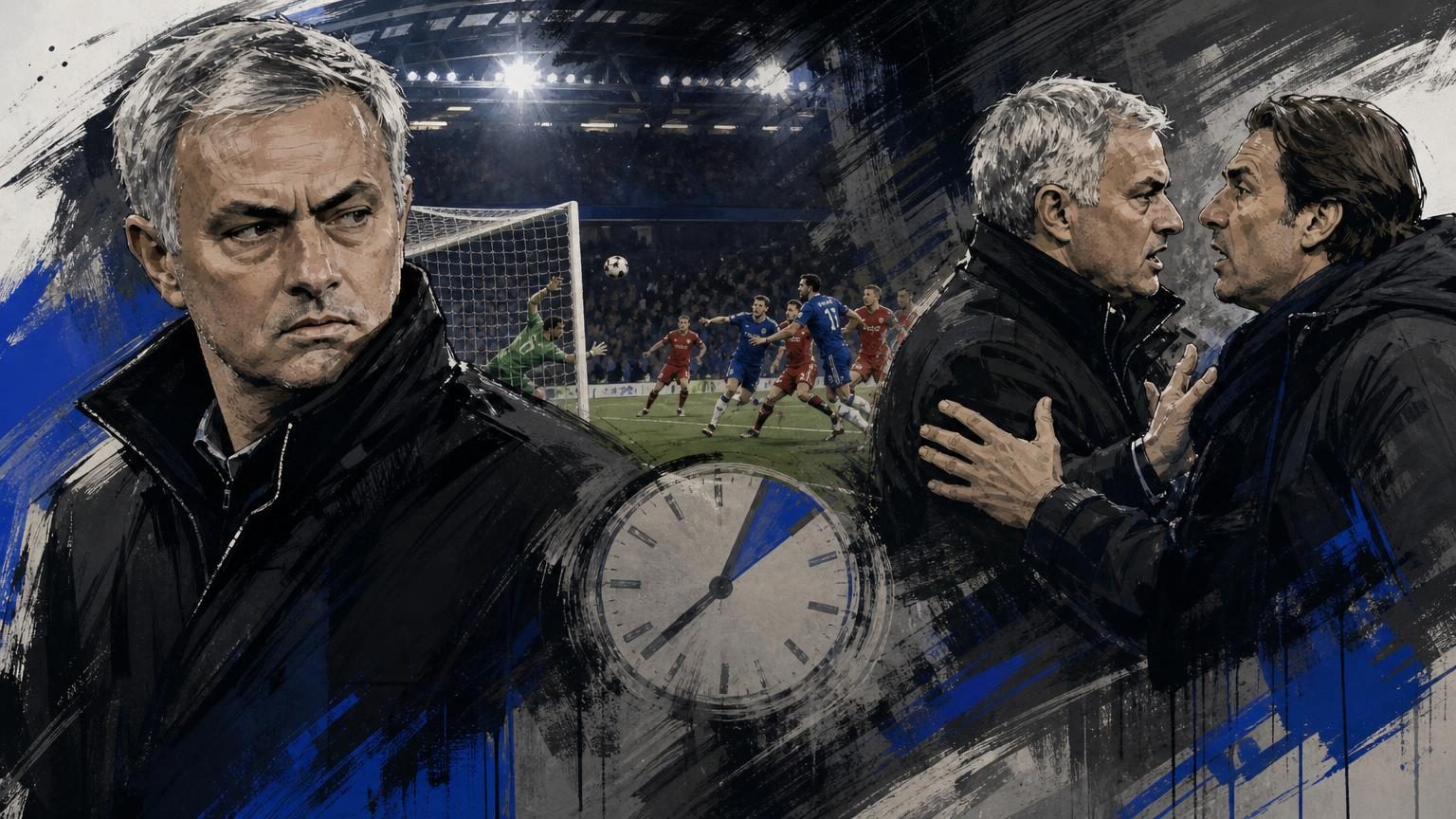
Jose Mourinho's first match back at Stamford Bridge as Manchester United manager turned on a single passage of play deep into injury time, when a scrambled Ross Barkley equaliser wiped out a lead his side had defended for the best part of an hour. Planet Football's retrospective on the afternoon captures how a routine result turned into one of the Premier League's most chaotic touchline scenes.
Anthony Martial's double had put United 2-1 ahead, and Mourinho allowed himself only a muted fist pump when the second went in. The restraint mattered: his side were not dominating the match, they were managing a lead against the run of play, which is a different tactical problem altogether.
Why a two-goal lead still felt fragile
Holding a slender advantage away from home typically means inviting pressure and defending in a low block, condensing the space between the lines and accepting territorial inferiority in exchange for defensive solidity. United's approach that afternoon fits that pattern: a side built to counter-attack through Martial was, by the closing stages, no longer looking to spring forward in transition but simply to see out the clock.
That is the trade-off of game management in the final ten minutes of a one-goal or two-goal lead. A team that drops deep cedes what analysts call field tilt — the balance of territorial control and sustained pressure in the attacking third — and accepts that the opponent will generate chance after chance, banking on quality or luck to survive the volume.
United's defending held until the 98th minute. Chelsea, playing under Maurizio Sarri's possession-based build-up, kept recycling the ball into advanced areas rather than forcing hopeful crosses, and eventually created the scramble from which Barkley forced the ball home at the third attempt.
The moment the truce broke
It was not the goal itself that defined the afternoon but what followed it. Chelsea coach Marco Ianni ran down the touchline pumping his fists directly in Mourinho's direction, according to Planet Football's account of the incident. Mourinho, who had sat almost motionless as the equaliser went in, reacted instantly and had to be physically restrained by stewards and United staff as he tried to confront Ianni.
Mourinho then turned to the home end and held up three fingers, a reference to the three league titles he won during his time at Chelsea, directed at supporters who had spent the match abusing him.
Asked about the confrontation afterwards, Sarri said he had not personally seen what happened but had dealt with the matter by speaking to Mourinho and to his own member of staff. He explained his reasoning in blunt terms: "If I speak to a member of staff and am very hard [with him] I cannot come here and tell everything because then I am not credible with the staff."
Mourinho, for his part, tried to steer the conversation back to the football itself. "Oh come on, I can tell you that 97 minutes of the game was so good that you have to focus on that," he said, before adding that the hostile reception from Chelsea supporters was not something he considered his responsibility.
A fine, an apology, and an unlikely defence
The FA fined Ianni £6,000 after he admitted an improper conduct charge, with both clubs and Mourinho reminded of their responsibilities in the aftermath, Planet Football reported. What followed was more surprising than the flashpoint itself: Mourinho publicly defended the young coach rather than press for a harsher sanction.
He said he did not want the incident to derail Ianni's career, framing it as an understandable mistake by someone he believed had genuine coaching potential. "His club was strong with him and he went through a situation he recognises he was wrong," Mourinho said, adding that he hoped others would show the same restraint he had and let Ianni continue working. "It's the end of story, with me. Let him work, everybody makes mistakes, I made mistakes."
The sequence captures something particular about game-state psychology in football: a manager who had kept his own emotions locked down for 97 minutes of tense defensive management lost control in seconds once the scoreline turned against him, only to recover his composure enough, days later, to argue for leniency toward the man who provoked him.
The scoreline finished 2-2, with United's lead undone by a Chelsea build-up that patiently waited for one opening, and Mourinho's homecoming remembered less for Martial's finishing than for the ninety seconds of chaos that followed Barkley's goal.