
John Terry's slip for Robin van Persie, and why Chelsea fans still wince
Planet Football revisits the October 2011 Stamford Bridge collapse that let Robin van Persie complete Arsenal's comeback after John Terry lost his footing.
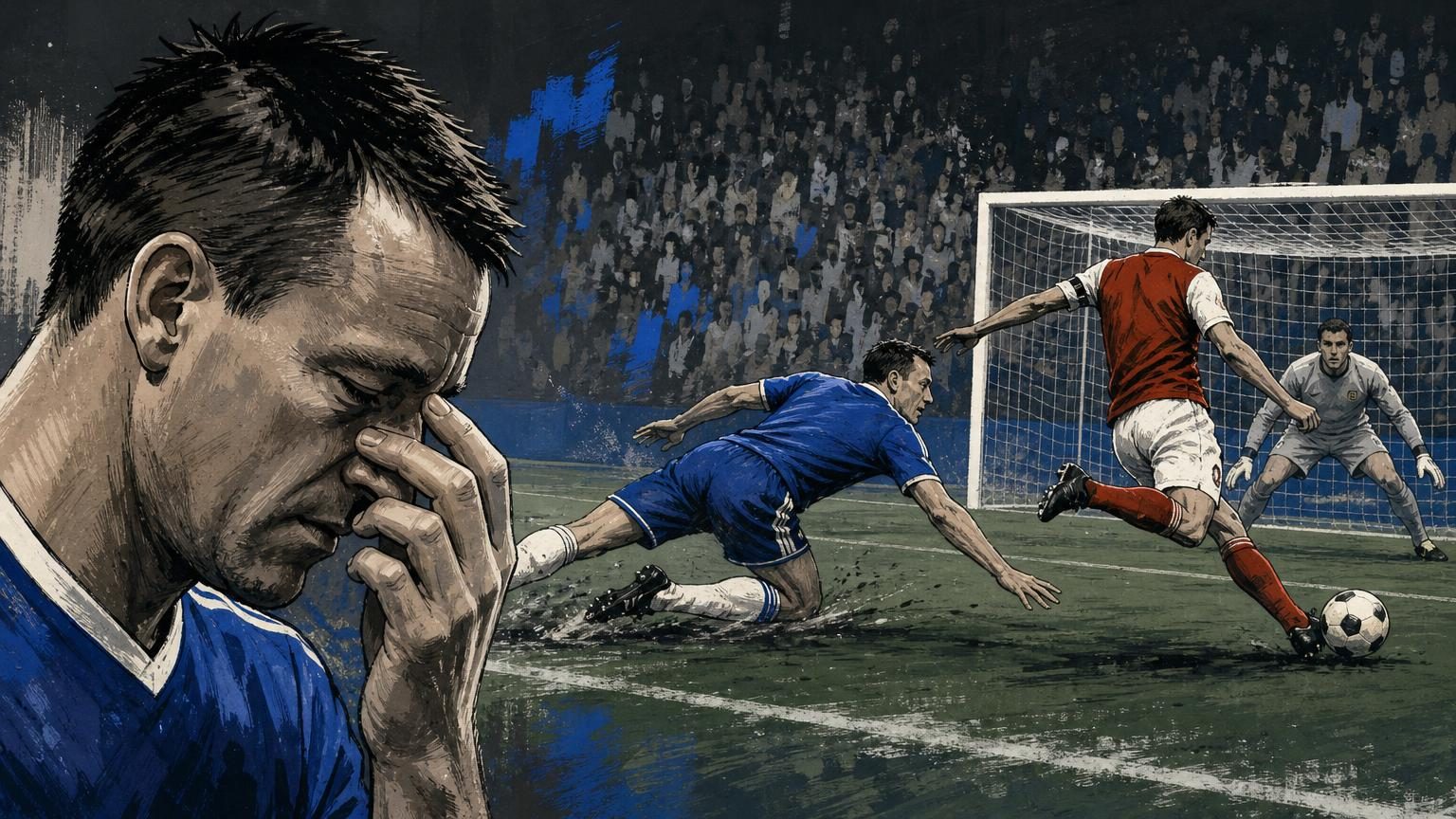
On October 29, 2011, John Terry slipped in the closing stages of a wild draw between Chelsea and Arsenal, letting Robin van Persie through to extend the visitors' comeback at Stamford Bridge, Planet Football recalled in a retrospective marking the anniversary.
The outlet frames the moment as one of the rare times football handed supporters outside a club a genuine pantomime beat: a player cast as the villain of the piece undone by his own legs giving way.
Arsenal arrived at Stamford Bridge still reeling. Planet Football notes they had been thrashed 8-2 at Old Trafford earlier that season, a result that pushed Arsène Wenger into the transfer market on deadline day for Mikel Arteta and André Santos.
Other results that autumn compounded the sense of chaos around the club: a home defeat to Liverpool in which Emmanuel Frimpong was sent off, and a 4-3 loss at Blackburn that included a Laurent Koscielny own goal scored while sprinting back to cover a counter-attack, as described by Planet Football.
Robin van Persie was carrying the team through it all. He had scored seven of Arsenal's 15 league goals before the Chelsea fixture and would finish the season with 37 in all competitions, according to the outlet.
A game that kept changing hands
Chelsea, managed by André Villas-Boas, had their own wobble that season, including a defeat at Old Trafford in which Fernando Torres missed an open goal, Planet Football notes.
Against Arsenal, the lead swapped repeatedly. Frank Lampard put Chelsea ahead before Van Persie equalised, and Terry himself scored right on half-time to restore the home side's lead. Santos and Theo Walcott then turned the game Arsenal's way within ten minutes of the restart, only for Juan Mata to drag Chelsea level again with ten minutes left.
That equaliser is the hinge the rest of the story turns on. Chelsea, level at 3-3 and sensing a winner, pushed players forward into the final stages rather than settling for a point against a direct rival.
Why the slip mattered more than most
A back line committing numbers forward late in a match is a calculated gamble: it raises the chance of scoring but widens the space behind the last defender if possession is lost in transition.
That is the shape of what followed. With Chelsea stretched and Terry operating as effectively the last man, his footing went at the exact moment Arsenal broke, and Van Persie was played clean through to finish.
Planet Football's reading of the moment leans on timing rather than technique: a slip from a senior defender in the closing minutes of a 3-3 game against one of the division's bigger sides, rather than in a routine fixture early in a match, is what gives it lasting comic weight.
The outlet places the incident alongside two other Terry moments that had already made him football's nearest thing to a scripted villain: being kicked in the head by Abou Diaby in 2007 and recovering, and slipping as he struck the penalty that would have won the 2008 Champions League final before missing.
Planet Football describes him as close to the sport's version of "a Disney-scripted villain in the Premier League this century," built not from malice but from a pattern of high-stakes moments undone by small physical failures.
That penalty miss sits in the same category as the Van Persie slip for a specific reason the outlet draws out: both arrived on stages too big for the mistake, a Champions League final and a Premier League derby in its final ten minutes, rather than in the lower-stakes matches where such errors are more easily absorbed and forgotten.
A moment that outlived the result
The broader point Planet Football makes is less about Chelsea or Arsenal specifically and more about football's appetite for watching its most composed figures lose composure in public, however briefly, even when the underlying football explains exactly why it happened.
Terry's role that afternoon had been central rather than peripheral. He had scored to put Chelsea back ahead before half-time, making the manner of his late error, as the side pushed for a winner he had helped set up, the part of the game people kept returning to.
Arsenal's wider season in 2011 was defined by instability around a single outstanding forward, and Van Persie's finish after Terry's slip fit neatly into a campaign where moments of individual brilliance repeatedly covered for a team still finding its feet.