
Bayern's 6-1 win over Leipzig came from the same failure, repeated
Spielverlagerung's goal-by-goal breakdown shows Leipzig's 6-1 defeat stemmed not from six isolated errors but from two or three recurring structural problems that Bayern exploited again and again.
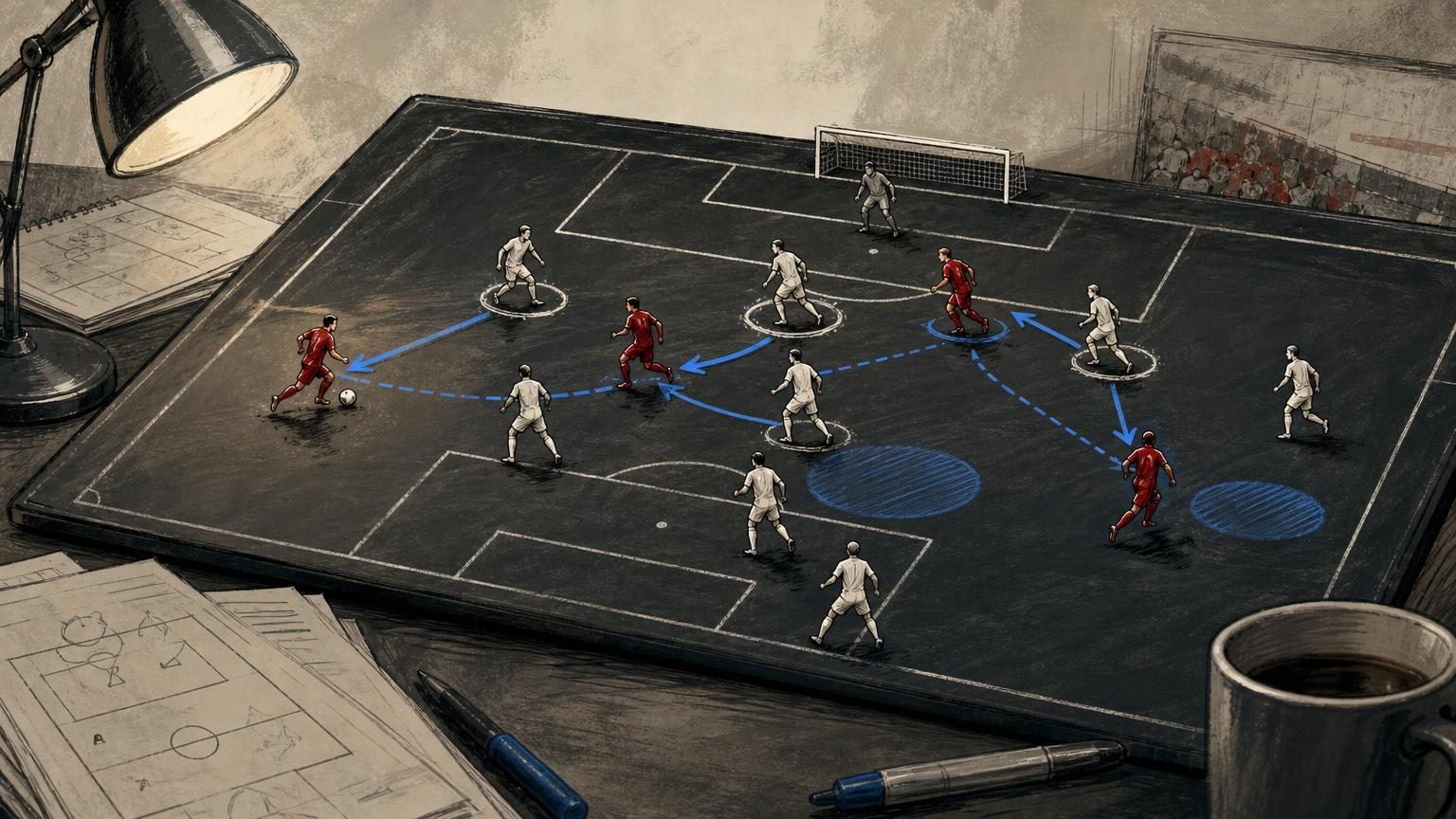
A 6-1 scoreline invites the assumption that everything collapsed at once. Spielverlagerung's analysis of how each goal was built suggests something narrower: Bayern did not solve six different problems, they found two or three and punished them in seven variations.
The common thread running through almost every goal conceded is straightforward to state and harder to fix: no pressure on the ball-carrier, marking breakdowns in central zones, and a back line whose movements did not sync with the players in front of it.
Leipzig never worked out who to press
According to Spielverlagerung, Bayern pressed very high from the start, stayed tight to their markers and pushed through centrally without hesitation. Vandevoordt was pressed specifically from Bayern's right side, an approach designed to cut off Leipzig's left-sided build-up and force long balls instead.
Nusa and Brajan Gruda angled their runs deep against Nathaniel Brown and Konrad Laimer, while Kimmich dropped as an extra central body. Had Leipzig gone short to their right, Kimmich could have stepped out onto Raum — instead he stayed central, and Leipzig were left with long balls that generated almost no second-ball regains.
On the other side of the pitch the problem was different but related. Bayern built with a rotating back three — Kimmich dropping right, Pavlović tucking left, Upamecano holding a wide position — and Leipzig, per the analysis, never found a consistent trigger against it. The identity of the three shifted constantly, so whoever was meant to step out of midfield first had to re-read the picture every time, and the handover of pressing duties out of central midfield broke down repeatedly.
Pinning and switching produced Díaz's one-on-ones
Further up the pitch, Bayern staggered their attacking shape specifically to turn Leipzig's narrowness against them. Olise drifted into the ten-space, Nathaniel Brown worked the half-lane and ran beyond it, Luis Díaz held the left touchline, and Saibari and Kane pinned central defenders while pulling out of the centre themselves.
Because Leipzig pressed narrow, this created the exact picture Bayern wanted: once an opponent was drawn toward the ball, the switch went to the far side, where a one-on-one was waiting. Díaz's three finishes were not isolated pieces of individual quality — Spielverlagerung frames them as the direct product of this pin-and-switch sequence repeating itself.
The goals trace the same failure four times
The opener in the 12th minute contains, in Spielverlagerung's words, the full diagnosis of the night. Kimmich received centrally with no pressure on him and turned with an open body. Saibari and Kane occupying the box forced Orban and Lukeba to step out — the intended reaction — but the full-backs failed to push up with them, staying too deep while Raum's position played the runner onside. Klostermann stayed wide and left the inside channel unguarded, and Díaz ran straight into it before Kimmich chipped the ball in behind. Four decisions, none of them fitting together.
The second goal, Pavlović's in the 26th minute, came from the same root cause via a different route. Kane dropped deep without Leipzig shifting as a unit — frustration was visible in the reactions on the pitch, according to the analysis — and the long ball that followed flew straight through Leipzig's narrow central zone. Díaz won the race to control it ahead of Klostermann, drove at Orban in a four-against-three break, pinned both centre-backs, and squared for Pavlović's overlapping run to finish with two touches.
Olise's goal in the 34th minute stemmed from Bayern's press rather than their attack: a misplaced pass from Raum under pressure could not be recovered because neither the tracking run nor the duel was sharp enough to disrupt it. Kane opened up centrally, Banzuzi and his midfield partner failed to pick up Olise's run inside, and Díaz dragged Orban away while Klostermann was pinned wide by Saibari. Olise finished across his own standing leg into the far corner, wrong-footing Vandevoordt completely.
The fourth goal, Díaz's second of the game in first-half stoppage time, followed a regain and a quick switch that again isolated him one-on-one. Leipzig could not close the situation in three attempts — the centre stayed open, Orban stepped out too late, and Klostermann was caught between covering the run and covering the man.
Taken together, the sequence Spielverlagerung describes is less a story of individual error than of a structural mismatch: Bayern's rotating build-up denied Leipzig a pressing trigger, their staggered front line turned compactness into a liability, and the back four's spacing broke down in near-identical fashion from goal to goal. The scoreline looked chaotic. The causes, on this reading, were anything but.