
Carrick's Position Weakens as Fernandes's Pressing Critique Turns Scrutiny on Himself
Michael Carrick's future is in the balance after the 4-1 defeat at Como, and while Bruno Fernandes blamed the tactics, data suggests his own pressing added to the problem — with Eddie Howe waiting as a contrasting option.
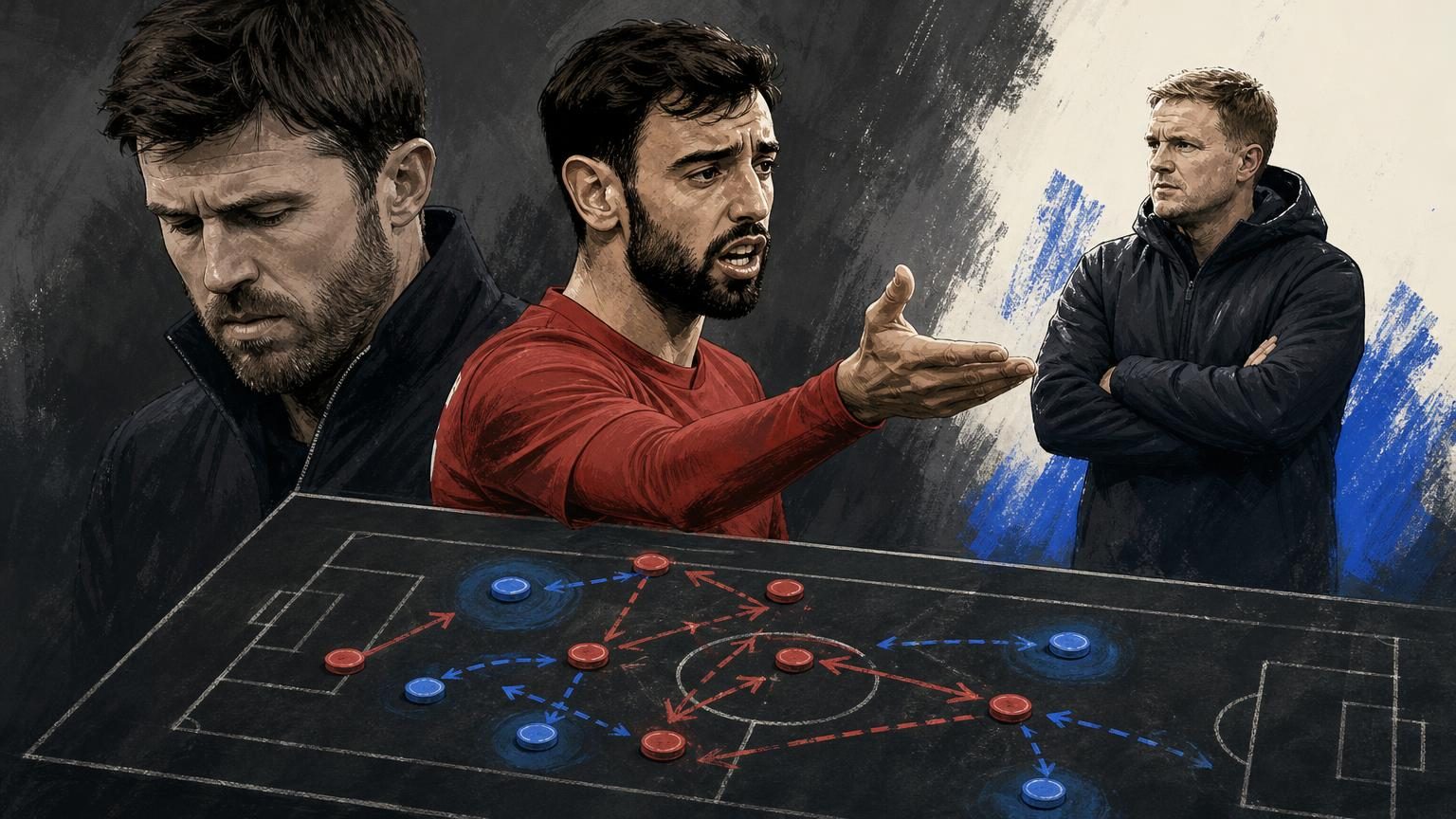
Michael Carrick's position as Manchester United manager is under serious threat after a 4-1 Champions League defeat at Como, a club that was playing only its third European fixture, according to Guardian Football.
Jason Wilcox, the director of football, chief executive Omar Berrada and co-owner Sir Jim Ratcliffe are expected to discuss Carrick's future before Bournemouth's visit to Old Trafford on Sunday, the Guardian reported.
Carrick apologised to supporters after the defeat, and the crisis deepened when captain Bruno Fernandes publicly criticised the team's pressing approach in his post-match interview.
Fernandes told TNT Sports, as reported by The Analyst: "It's a decision from the staff to not press man to man and sometimes leave space behind and try to get the ball, but sometimes when you give too much [of] the ball to these teams they get confidence."
Asked directly whether Carrick had got his tactics wrong, Fernandes replied: "That's on the manager and staff to see it, not me. Sometimes you have to be more brave under pressure, take the risk of pressing high and making them uncomfortable."
Carrick's reply was brief. He pointed out that United had half-pressed man to man in the second half, according to The Analyst, pushing back against the idea that the system had been purely passive.
Fernandes named the problem he helped create
The Analyst's own reading of the Como defeat complicates Fernandes's version of events. Opta's data-led assessment argues that Fernandes himself was one of United's biggest issues, not simply a frustrated observer of a flawed plan.
A half-press, by definition, relies on coordinated triggers across the team rather than individual players stepping out of their lines to chase the ball in isolation. If one midfielder presses man to man while those around him hold a structured block, the gaps Fernandes described opening up behind United are a predictable consequence of his own positioning rather than solely a top-down instruction.
That distinction matters for how Carrick's tactics are judged. A manager choosing a half press as a control mechanism against a technically superior side is a defensible idea; a team where one senior player presses alone while covering midfielders hold shape is a coordination failure, and the data presented by The Analyst points towards the latter against Nico Paz and Como.
What a Howe appointment would actually demand
Eddie Howe is reported by Planet Football to be the leading candidate to replace Carrick, and his record at Bournemouth and Newcastle offers a clear tactical contrast. Both sides were consistently among the highest-pressing teams in their respective leagues and ranked near the top of distance-covered metrics, built primarily around a 4-3-3 with a defined deeper six.
At Newcastle, that role belonged overwhelmingly to Bruno Guimaraes, who started 132 games there as a holding midfielder before later advancing into the eight alongside Sandro Tonali in the six, Planet Football reported. Howe's wide forwards were chosen for pace and directness in both crossing and shooting, with Anthony Gordon's speed a particular asset and the second-most used attacker under Howe at Newcastle.
Physicality mattered too: of Howe's five most-used players, only Jacob Murphy stood under six feet tall, and Planet Football rated the repositioning of Joelinton from striker to central midfielder as one of Howe's most effective tactical decisions at St James' Park.
Why United's defence is the obstacle, not the midfield
The gap between that profile and United's current squad is clearest at centre-back. Planet Football's analysis points to the Como defeat itself as evidence: Matthijs de Ligt and Harry Maguire, tall and physically imposing but comparatively slow, were repeatedly exposed by quicker forwards in behind a high defensive line.
A pressing system built around aggressive man-to-man principles and a high defensive line, as Howe deployed at Newcastle, depends on centre-backs who can defend space in transition, not just in the air. Lisandro Martinez, undersized by the standards of a typical Howe centre-back, could end up redeployed rather than retained in that role if Howe takes charge, Planet Football suggested.
Howe also inherits a dressing room with established egos in a way Newcastle's squad, largely built from the ground up, never presented him with. Whether senior United players respond to the same demanding pressing structure that triggered Fernandes's criticism of Carrick is, for now, an open question rather than a settled one.
United face Bournemouth at Old Trafford on Sunday, with Carrick's future expected to be discussed by the club's hierarchy before kick-off.
Sources
- Planet Football: Manchester United predicted XI under Eddie Howe as ex-Newcastle boss tipped to replace Michael Carrick
- Guardian Football: ‘Angry’ Carrick on the brink as Fernandes hits out at Manchester United tactics
- The Analyst (Opta): Bruno Fernandes Blamed Michael Carrick, But His One-Man Press Played into Como’s Hands