
Total Football: how Ajax turned positional interchange into a system
Total Football asked every outfield player to fill any role on the pitch, provided a teammate immediately filled the gap he left behind.
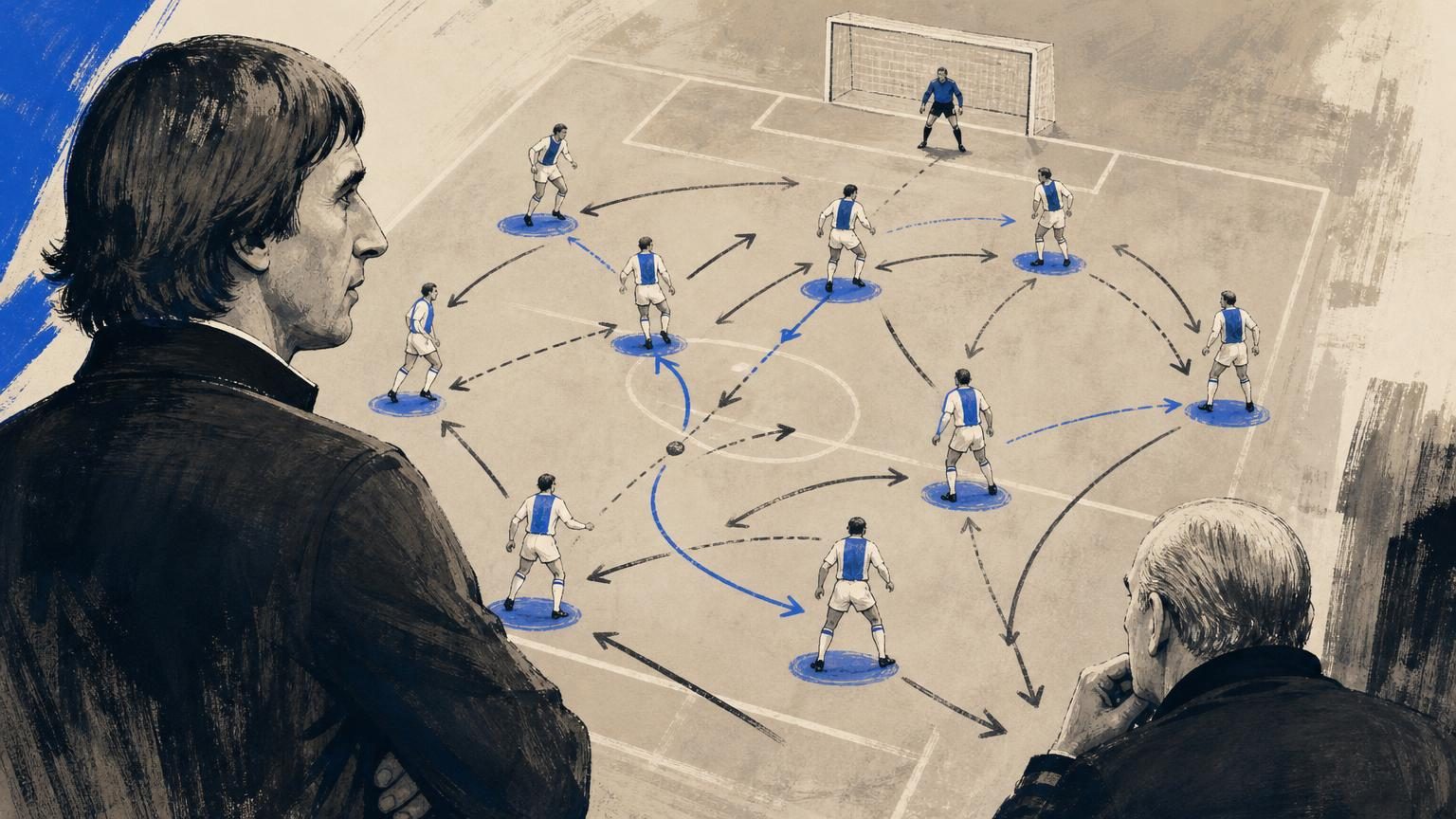
Total Football, or totaalvoetbal, was a tactical approach in which any outfield player could take on the role of any other, according to Wikipedia. The rule that made it workable rather than chaotic was simple: a player who left his position had to be replaced by a teammate, so the team's intended shape stayed intact even as the individuals occupying it changed.
No outfield player held a fixed role. Over the course of a match the same man might defend, build play through midfield and finish an attack, depending on where the ball and the space were.
How the interchange actually worked
The mechanism depended on constant, coordinated movement rather than free-for-all swapping. If a full-back pushed forward into midfield, a midfielder or winger had to drop into the space he vacated, preserving defensive cover and passing options alike.
Former Ajax defender Barry Hulshoff described this as the subject the team talked about constantly, saying Johan Cruyff "always talked about where to run and where to stand, and when not to move". That last clause matters: interchange was not only about who moved, but about who stayed still so the structure did not collapse.
Hulshoff also linked the system to spatial awareness, arguing that switching positions only worked because players understood where space existed and how to create more of it. Manufacturing space was treated as central to the whole idea, not a byproduct of it.
Pressing was the other half of the equation. Hulshoff described Total Football as proactive, built around winning the ball back quickly or pinning the opposition under pressure rather than waiting to defend a settled shape.
What it demanded of players and of the team
Because any player could be asked to fill any role, the system required technically capable, tactically literate individuals comfortable operating across multiple positions. A full-back needed a midfielder's passing range; a forward needed a defender's reading of danger.
Cruyff himself was nominally a centre-forward under manager Rinus Michels, but Michels encouraged him to roam across the pitch and exploit gaps in the opposition using his technique and game intelligence. His teammates then had to continually reorganise around him so that every tactical function — defending, building, attacking — remained covered.
That put huge weight on the relationship between coach and key player. Michels and Cruyff drove the Ajax project together, but Cruyff repeatedly overrode Michels' instructions on the pitch, which produced real friction between them even as the system flourished.
The style did not begin or end with Ajax
The roots of the approach stretch earlier than Michels' Ajax. Jimmy Hogan's combination game influenced Hugo Meisl's Austria side of the 1930s and, two decades later, Gusztáv Sebes' Hungary, whose federation president Sandor Barcs said "Jimmy Hogan taught us everything we know about football".
Torino's Grande Torino side of the 1940s played a comparable style, and Argentina's River Plate built an attacking unit nicknamed La Máquina between 1941 and 1947 that perfected the false nine role and constant positional rotation. Jack Reynolds had already introduced related ideas at Ajax in the 1940s, and Vic Buckingham carried similar principles through West Bromwich Albion, Ajax and Barcelona before Michels' arrival.
Under Michels from 1970, and later under the more relaxed Ștefan Kovács, Ajax turned the idea into sustained success: eight Eredivisie titles, three European Cups and one Intercontinental Cup. Ajax's 1972 European Cup final win over Inter Milan was widely read at the time as marking the decline of Catenaccio, the defensively organised Italian system that had dominated the previous decade.
The approach was not invulnerable. In the 1974 World Cup final, West Germany nullified the Dutch system in the second half through Berti Vogts' man-marking of Cruyff, which allowed Franz Beckenbauer, Uli Hoeneß and Wolfgang Overath to take control of midfield and win the match 2–1.
Total Football's influence did not stop with that generation. Its principles developed further within Barcelona, particularly under Pep Guardiola, and the Spain national team, forming the basis of what became known as Juego de Posición, or tiki-taka.