
Maradona in others' words: the testimony behind the myth
Planet Football has gathered quotes from opponents, team-mates and writers that explain, in their own terms, why Diego Maradona remains the reference point for footballing genius.
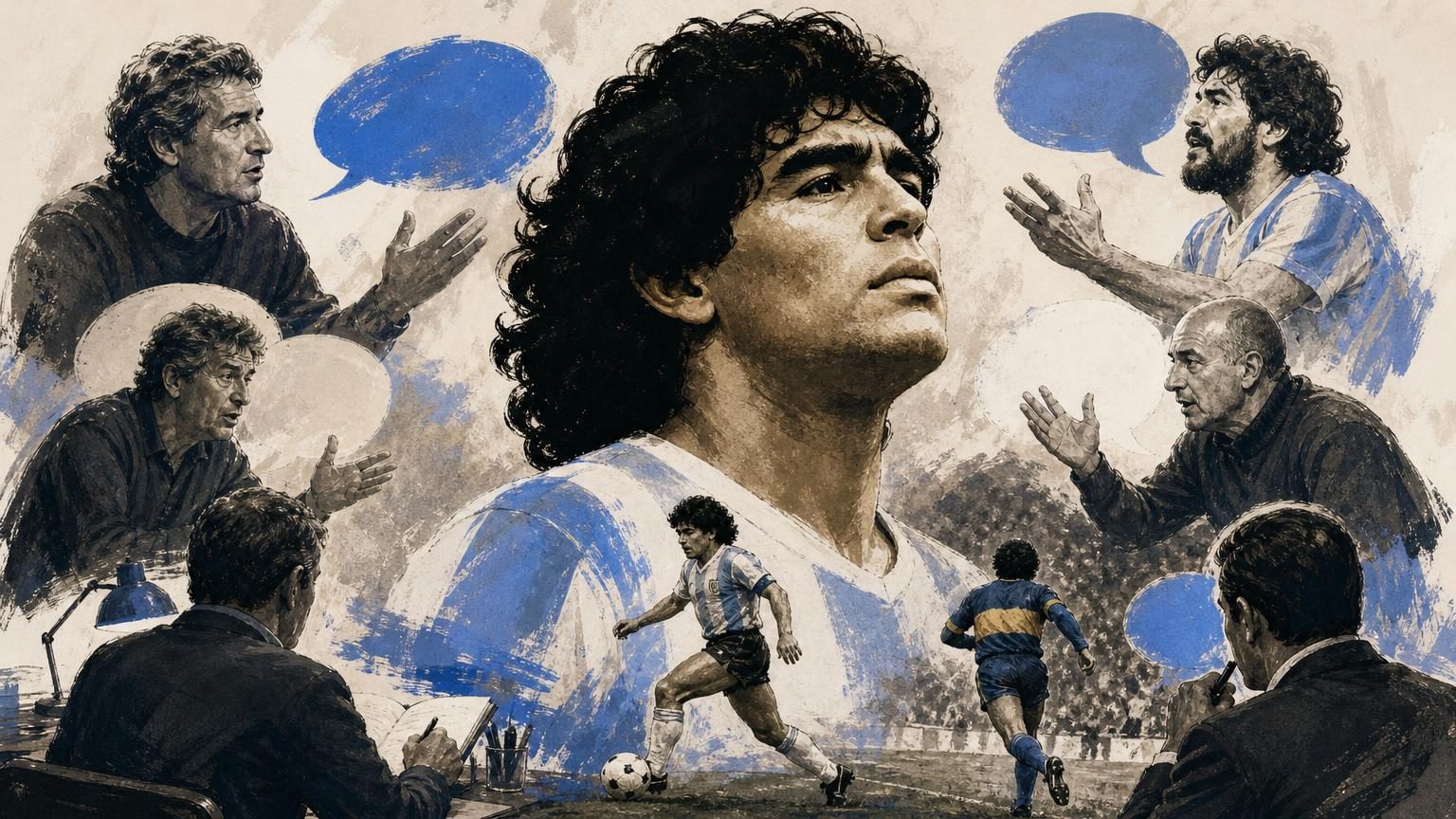
Diego Maradona never needed a statistic to prove his case. The testimony of the players who faced him, the team-mates who stood beside him and the writers who tried to explain him does the work instead, according to a collection of quotes gathered by Planet Football.
Maradona inspired Argentina to the 1986 World Cup, scored the goal later voted the greatest of the century against England in that tournament, and twice became the world's most expensive player despite a modest trophy haul at club level, Planet Football notes. The quotes collected span opponents, team-mates, journalists and Maradona himself.
Opponents describe an impossible match-up
Terry Butcher, who played against Maradona in the 1986 World Cup quarter-final, called him "the best player I've ever played against, miles ahead of anyone else," adding that he "just couldn't get near him" and saw little beyond his number 10 shirt.
Butcher's explanation is specific rather than vague: he pointed to Maradona's "low centre of gravity that shielded the ball," alongside his strength, pace and passing. That description matches a recurring theme in how defenders talk about him — man-marking assignments built to cut off a conventional runner were of little use against a player whose balance let him absorb contact at close range and still turn.
John Barnes made a similar point about the psychological effect before the physical one, saying Maradona "scared absolutely everybody" and that facing him was simply unplayable. Gary Lineker, on the receiving end of the solo goal that would later be voted the best of the century, said he "felt like applauding" and called Maradona "the greatest player of all time, by a long way."
Team-mates and rivals on the technical detail
Jose Mourinho's description gets at the same idea from a different angle: with Maradona in possession, he said, "you didn't know where he finished and where the ball started." That is a description of close control so complete that the dribble stopped looking like a technique and started looking like an extension of the body.
Jorge Valdano, his Argentina team-mate in 1986, framed it almost the same way, saying no ball "ever had a better experience than when it was at his left foot." Gianfranco Zola, who played alongside him at Napoli, said the things Maradona did in training were as striking as what he produced in matches, while also noting he carried none of the star behaviour the ability might have excused.
Zico called him simply "the best of the lot" of his generation, adding that Maradona kept producing moments of quality even while permanently marked. Marcel Desailly made the tactical consequence explicit, saying Maradona "decided matches alone, carrying average teams like Napoli, and Argentina in 1986, to glorious achievements." That is the clearest statement in the collection of what it means for one individual to function as a team's entire creative structure rather than one part of it.
The myth beyond the pitch
Lionel Messi's contribution is the shortest and arguably the most pointed: "If anyone inspired me, it was undoubtedly (Maradona)." Coming from the player most often compared to him, it reframes the rest of the quotes as not just tributes to a past great but an account of an influence still active in the modern game.
Away from football analysis, the quotes lean into cultural myth-making. Julio Grondona, the Argentina FA president, said there was "a before and an after Maradona" in Argentine football. Spanish journalist Manuel Vazquez Montalban linked him to "the mystique of the working class revolution," while Italian journalist Luciano de Crescenzo cast him through Greek mythology, as someone who embodied "the worst of Apollo, but the best of Dionysus."
Maradona's own words, included in the collection, strike a more combative note than any tribute paid to him: "I worked hard all my life for this. Those who say I don't deserve anything, that it all came easy, can kiss my arse."
Taken together, the quotes build a picture from two directions at once — the concrete, technical detail from those who marked him or played beside him, and the broader cultural framing from those who watched from outside the game. Both point to the same conclusion the collection sets out to make: that Maradona's case as the greatest rests on testimony as much as on trophies.