
Ranieri Backs Maldini's Timeline but Admits He Never Read His Plan
Italy's technical director says fixing the country's development pipeline will take eight to ten years, laying out a funnel system for teenagers and a January pilot project while distancing himself from his predecessor's unread blueprint.
Claudio Ranieri has set out the reforms he wants to push through as Italy's technical director, 100 days into a role he took up after Paolo Maldini's abrupt resignation, Football Italia reports.
Ranieri told Sky Sport Italia he agrees with Maldini's own estimate that repairing Italian football's structural problems will take "eight to 10 years", even though he has not read the plan Maldini and special advisor Leonardo drew up before leaving.
The appointment itself followed a chaotic spell. Maldini quit just 17 days into the job after failing to install any of his preferred head coaches, having reportedly tried and failed with Carlo Ancelotti and Pep Guardiola before a collapsed approach for Andrea Pirlo proved decisive. Ranieri was named his replacement on July 28, the same day Roberto Mancini was confirmed as head coach.
Where the pipeline actually breaks
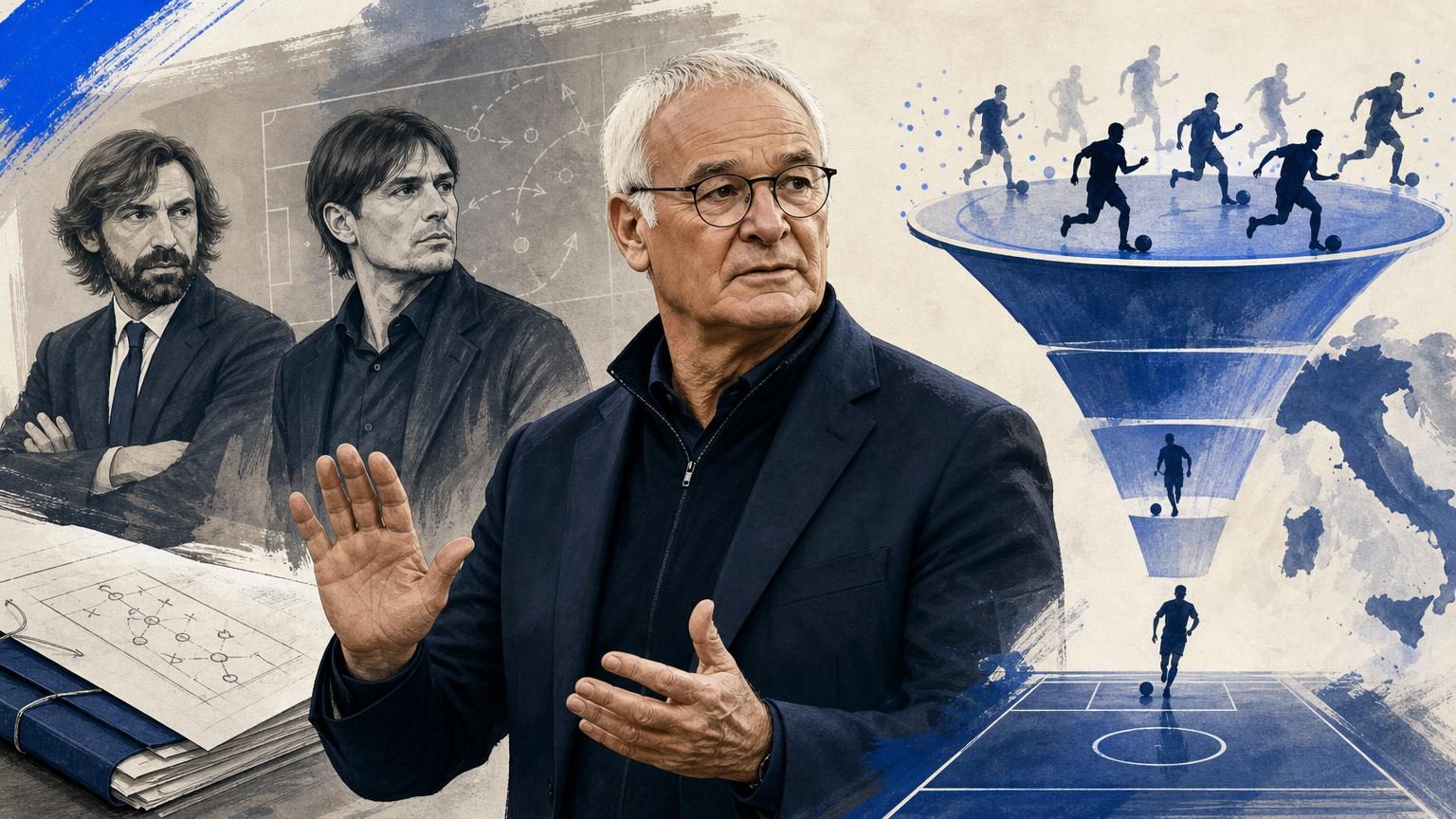
Ranieri identified two specific points of failure in Italian football's development structure rather than speaking in generalities. The first is the basic formation sector for children aged five to 13. The second, which he described as a funnel, concerns 18 to 20-year-olds who struggle to move from youth football into the professional game.
That second bottleneck is the more diagnostic of the two. Ranieri noted that Primavera squads are increasingly stocked with players who have already reached physical maturity, which blunts the competitive value of youth football as a proving ground and leaves genuinely young prospects under-tested against peers rather than develop-and-promote properly through it.
Serie C already operates a system that incentivises clubs to field younger players, and Ranieri wants to extend something similar to Serie B. That is a structural lever rather than a coaching one: it does not ask coaches to play youth for its own sake, it changes the competitive incentives clubs face when picking a team.
Ranieri was explicit that football cannot solve this alone. He pointed to the growth decree, a fiscal incentive scheme that lapsed in 2024, as the kind of external support he wants revived specifically for young players. "Football alone can't make that happen, we need the government and other institutions to do something," he said, according to Football Italia.
A pilot project to test alignment
Beyond individual measures, Ranieri's broader aim is to get Club Italia, the technical sector, the amateur leagues and the academy system working to the same methodology rather than in parallel. He confirmed a pilot project will run from January 11 to June, after which the various stakeholders will assess what has worked before adjusting the approach for the following season.
The stated ambition, in his words, is for the whole system to end up "speaking the same language" from the grassroots level up to the national team. That phrasing matters: it frames the current problem as one of fragmented methodology across Italian football's various tiers rather than a single tactical or coaching deficiency at the top.
Distance from, and agreement with, Maldini
Ranieri was candid that he has deliberately not engaged with Maldini's own document, preferring to build his own working model with collaborators including Gianfranco Zola, Vincenzo Viscidi and Michele Milani at Club Italia. That is a notable position for a technical director inheriting an unfinished project: continuity of personnel without continuity of plan.
Where he does align with his predecessor is on scale. Ranieri called the broader project "valid" and endorsed the same long horizon Maldini had set out, repeating that meaningful change will take the better part of a decade rather than one or two coaching cycles.
He declined to comment on the separate governance dispute over Giovanni Malagò's possible re-election as FIGC president, saying he prefers to stay within his own remit.
The pilot scheme's January 11 start and its review in June will be the first concrete test of whether Ranieri's structural changes, rather than his predecessor's unread plan, can move the needle before the next international window.