
Total Football: How Rinus Michels Rewired Ajax and the Netherlands
Total Football is remembered as romance. Under Rinus Michels it rested on discipline, collective pressing and a ruthless approach to space.
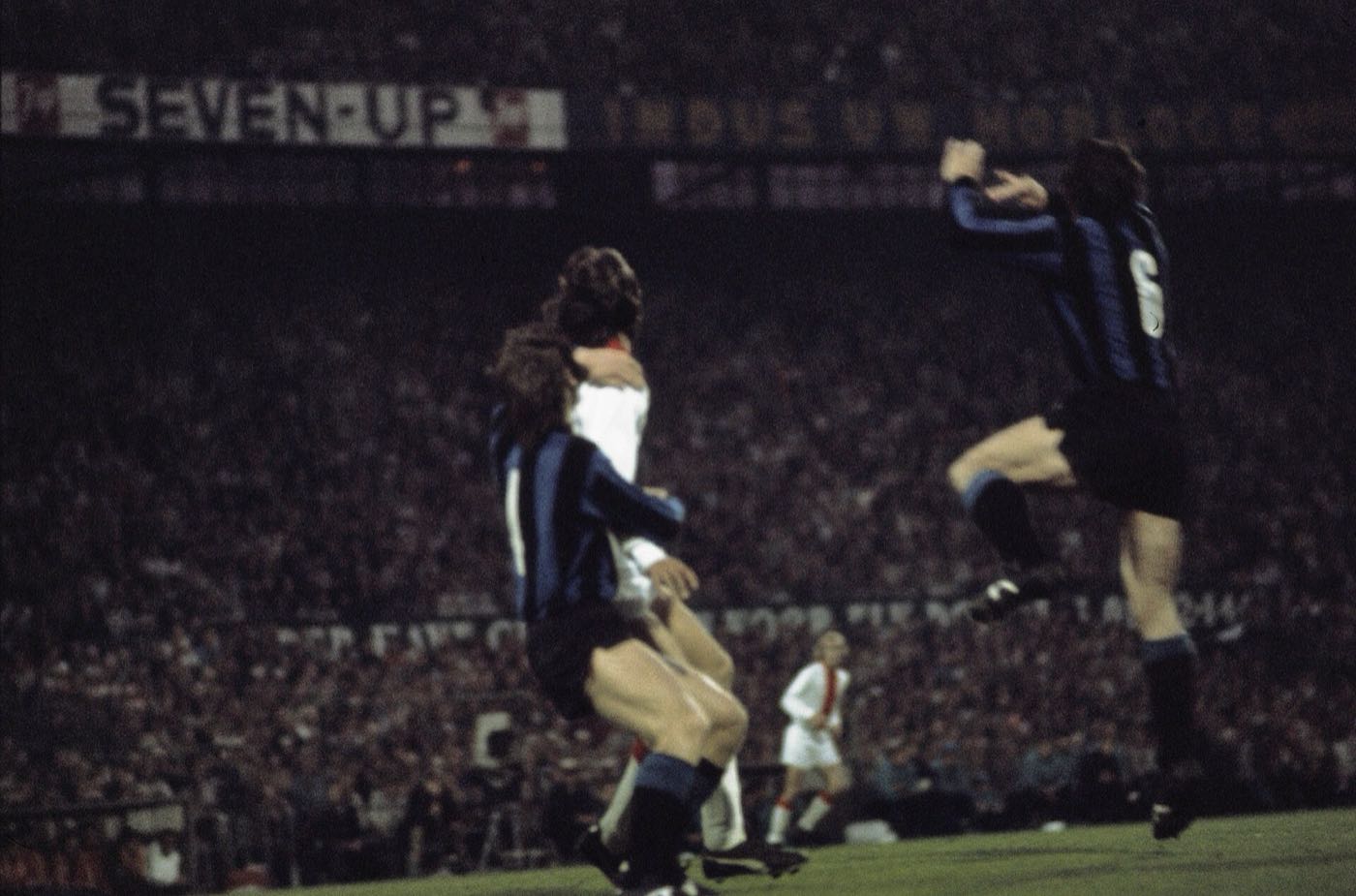
Few phrases in football carry as much mythology as Total Football. It is often described as though the Ajax and Netherlands sides of the late 1960s and early 1970s simply played with a freedom others lacked: a team of gifted individuals wandering wherever instinct took them. The reality was more demanding. Rinus Michels, who took charge of Ajax in 1965, built a team whose apparent freedom rested on hard work, rigorous conditioning and a shared understanding of how the space on a pitch could be made bigger or smaller at will.
That understanding is the real legacy. The interchange of positions that made Total Football famous was a consequence of the idea, not the idea itself.
From positions to functions
Most teams of the era were organised around fixed roles. A full-back defended his flank, a winger stayed wide, a centre-forward waited to be served. Michels' Ajax treated positions as functions to be filled rather than territory owned by a particular player. If a defender carried the ball into midfield, a midfielder would drop to cover him; if a forward drifted wide, someone else would occupy the space he had left.
The point was not movement for its own sake. Rotation made the team hard to mark, because man-marking systems depended on opponents staying roughly where they were expected to be. It also meant that the overall shape of the team could survive any individual leaving his nominal slot.
For this to work, players needed a broad technical and tactical base. Defenders had to be comfortable in possession, and attackers had to understand their defensive responsibilities. A player who could only do one job was a weak link in a system that might ask him to do three in a single move. Ajax's youth development and Michels' demanding training regime both pushed in the direction of more complete footballers.
Pressing and the offside line
The less romantic half of Total Football concerned the ball the team did not have. Michels' sides defended by squeezing the pitch. The back line pushed high, using the offside law aggressively to compress the area in which opponents could play, while midfielders and forwards hunted the ball in numbers.
- A high defensive line shortened the distance between the units of the team.
- A compressed team could press as a group rather than as isolated individuals.
- Winning the ball high up the pitch left opponents little time to reorganise.
This was pressing in something close to its modern sense, decades before the vocabulary of pressing metrics existed. The same underlying logic, shrinking the space around the ball, reappeared in Arrigo Sacchi's zonal Milan and, later still, in the counter-pressing sides of the Bundesliga.
Total Football was not freedom from structure. It was a structure demanding enough that every player could briefly become any other.
Ajax, Europe and the national team
Michels' Ajax won the European Cup in 1971, beating Panathinaikos in the final at Wembley. He left for Barcelona shortly afterwards, yet Ajax retained the trophy in 1972 and 1973 under his successor. That continuity says a great deal: the principles had been absorbed so thoroughly by the players that they no longer depended on the man who introduced them.
Johan Cruyff was the on-field expression of the approach. Nominally a centre-forward, he roamed across the front line and deep into midfield, pulling markers out of position and opening space for team-mates. His reading of the game turned the rotations into something coherent rather than chaotic.
Michels then took charge of the Netherlands for the 1974 World Cup. The Dutch squad, drawn heavily from Ajax and Feyenoord, carried the same ideas onto the international stage and reached the final in Munich, where they lost to West Germany. That match, examined in our analysis of the 1974 final, remains one of the defining contests of the era. Michels later led the Netherlands to the European Championship in 1988.
Why the ideas outlasted the team
Total Football as a specific style faded as its players aged and dispersed. The principles it demonstrated have remained central to coaching:
- Space is something a team can manipulate, not merely occupy.
- Defending begins with the positioning of the whole team, not the individual duel.
- Positional flexibility requires technical breadth across the whole squad.
- A playing idea survives only if the players understand it well enough to apply it without instruction.
These ideas travelled to Barcelona, first through Michels himself and later through Cruyff as coach, and from there into the positional-play tradition now associated with Pep Guardiola. Tracing that lineage, as in From Michels to Guardiola, shows how much of modern football's vocabulary began with a Dutch coach insisting that his team think collectively about space.
The romance of Total Football is real enough. But it was earned through preparation, and its most durable contribution was a way of thinking rather than a particular way of playing.