
Rome 2009: How Barcelona's Midfield Decided the Final
Guardiola's first season ended with a 2-0 win over Manchester United in Rome. Busquets, Xavi and Iniesta turned a tense opening into a game on Barcelona's terms.
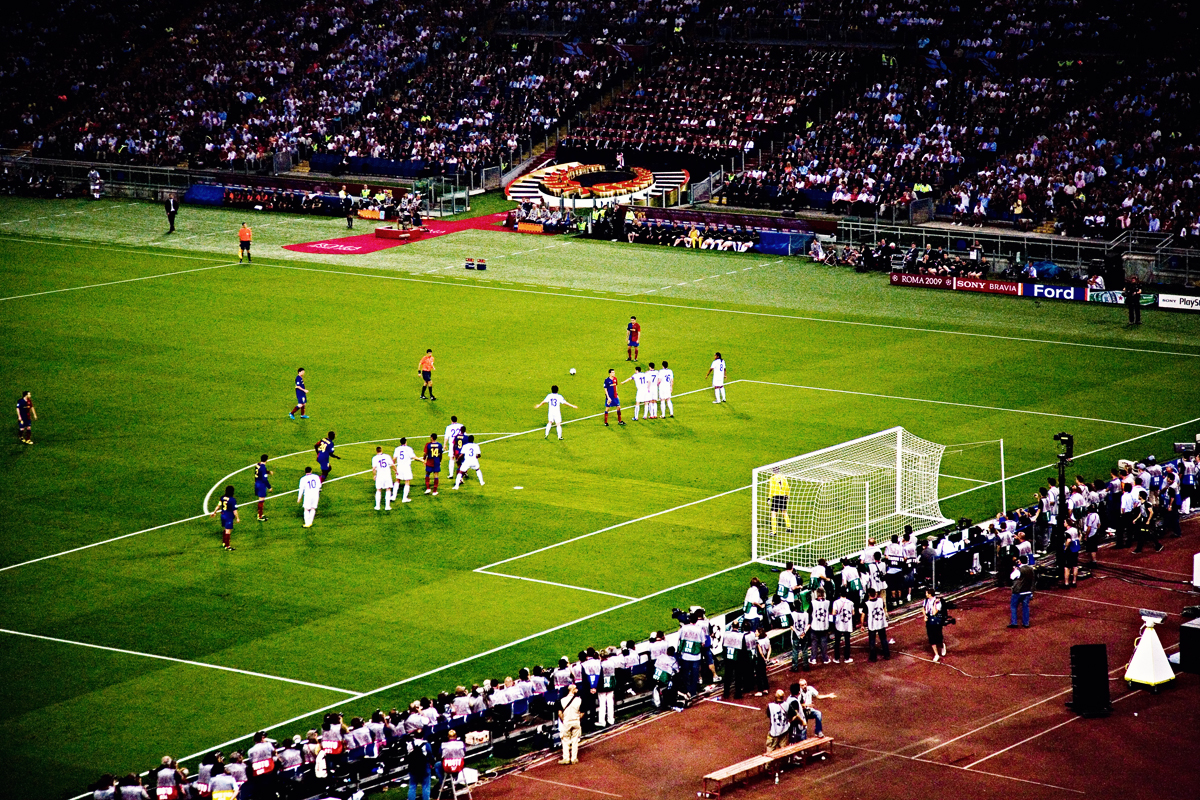
Pep Guardiola's first season as Barcelona coach ended in Rome with a Champions League final against Manchester United, the holders. Barcelona won 2-0, with goals from Samuel Eto'o and Lionel Messi, completing a treble of league, cup and European Cup. The final is often recalled for the elegance of Barcelona's passing, but it also shows how a positional structure can absorb an uncomfortable start and gradually take control.
A patched-up back line
Barcelona came into the match without several regular defenders, with Dani Alves and Éric Abidal among those unavailable. Carles Puyol played at right-back and Yaya Touré, usually a midfielder, partnered Gerard Piqué in central defence, with Sylvinho on the left.
That context matters. Barcelona's build-up depended on defenders who could start attacks, and the enforced changes placed extra responsibility on the midfield to provide safe options and to organise possession from deep.
Busquets at the base
Sergio Busquets, in his first season in Barcelona's first team, played as the single pivot in front of the defence. His role was less about spectacular passing than about positioning: being available as a passing angle, drawing pressure towards himself, and moving the ball on quickly so that Xavi and Andrés Iniesta could receive facing forward.
- Busquets offered a constant outlet to the centre-backs.
- Xavi dictated rhythm, circulating the ball and choosing when to accelerate.
- Iniesta carried the ball through pressure and linked midfield with the forwards.
The relationship between the pivot and the two interiors is examined more fully in Xavi, Busquets and the logic of positional play.
Messi through the middle
Barcelona's front three had a notable arrangement. Messi, who had spent much of the season on the right, played centrally, with Eto'o moving to the right and Thierry Henry on the left. Messi's tendency to drop from the centre-forward position into midfield posed a problem for United's centre-backs: follow him and leave space behind, or hold position and allow Barcelona an extra man in midfield.
The idea of a forward vacating the central striking area to overload midfield is often associated with the term false nine. In this final it contributed to Barcelona's gradual command of the central areas, where their passing game was strongest.
Barcelona did not win in Rome by overwhelming United from the first whistle. They won by surviving the early storm and then using their midfield structure to decide where the game would be played.
The goals and the shift in control
United began strongly, and Barcelona had to endure an early spell of pressure. Eto'o then scored, receiving on the right, cutting inside his marker and finishing at the near post. The goal allowed Barcelona to settle into their preferred rhythm.
From there, the midfield trio increasingly monopolised the ball. United found it hard to press effectively because Barcelona's positioning created numerical superiority around the ball, and passes could be moved away from pressure before it arrived. In the second half Messi headed the second goal from a Xavi cross, an unusual finish for a player of his stature and a fitting product of Xavi's vision.
The contrast with the opening minutes is the key to the match. The same structure that had looked stretched under early pressure became, once Barcelona had the ball in their preferred areas, the means by which they suffocated the game.
Lessons from Rome
The final is a useful study in several enduring ideas:
- A team built around possession needs a pivot who can receive under pressure, even when the defence behind him is disrupted.
- A central forward who drops deep can create superiority in midfield without adding a player to it.
- Control can be established gradually; the first twenty minutes do not always define a match.
- Positional structure supports defending too, because well-spaced players can press immediately after losing the ball.
It also connects to a longer tradition. Guardiola had himself played as the pivot in Johan Cruyff's Barcelona, and in Busquets he found a player who could carry that role into a new era. The final in Rome was an early, public demonstration that the inheritance had been understood.