
Xavi, Busquets and the Logic of Positional Play
Positional play is about creating the free man through structure. Xavi and Sergio Busquets were among its most eloquent practitioners in Guardiola's Barcelona.
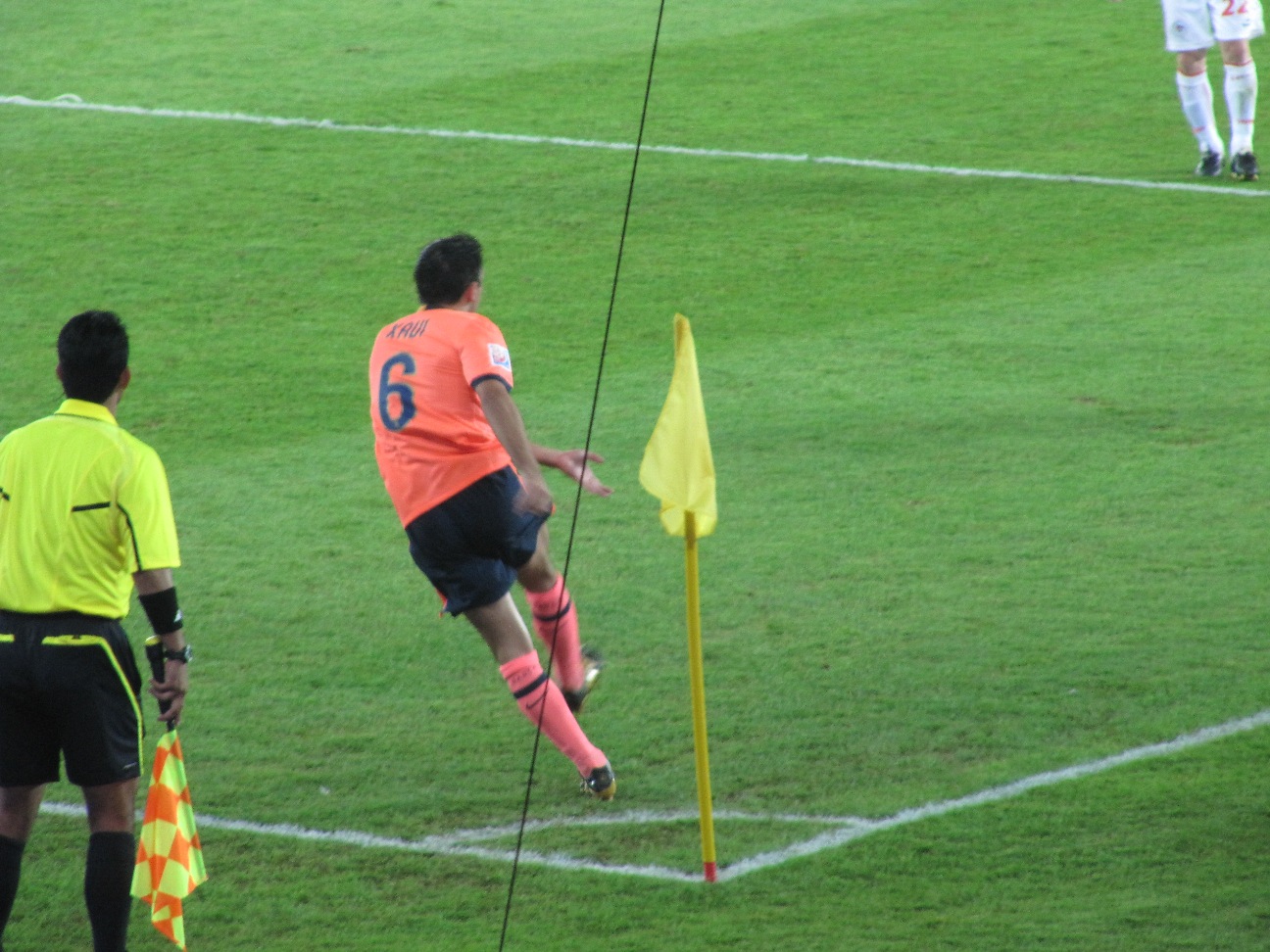
Positional play, from the Spanish juego de posición, is one of the most influential ideas in modern football and one of the most misunderstood. It is sometimes reduced to keeping the ball, or to passing sideways patiently. Its real concern is structure: placing players across the pitch so that, wherever the ball is, the team has good options and can find a free player to progress.
Few players illustrated this better than Xavi Hernández and Sergio Busquets in Pep Guardiola's Barcelona. Neither relied heavily on pace or physical power. Their influence came from positioning, perception and the speed with which they understood what the structure required.
The principles
Positional play rests on a few connected ideas:
- Occupying zones: players spread across the pitch so that key areas, including the full width and the spaces between the opponent's lines, are filled.
- Creating superiority: numerical, positional or qualitative advantages near the ball.
- Finding the free man: moving the ball to a player with time and space, ideally one who can face forward.
- Progressing in stages: using circulation to disorganise the opponent before attacking.
A frequently discussed feature is the use of the half-spaces, the vertical channels between the centre and the flanks. A player receiving there can face goal at an angle, has more options than a wide player and is harder to close down than one in the congested centre. Positional teams often aim to place players in those channels, between the opponent's midfield and defence.
Busquets: positioning as a skill
Busquets, at the base of Barcelona's midfield, shows how positioning can itself be a defining skill. His role in possession was to be available: moving into places from which he could receive and pass on quickly, often with a single touch or a turn that took an opponent out of the game.
- He helped the team move the ball away from pressure.
- His position shielded the centre-backs and supported the defensive structure.
- After a loss of possession he was often well placed to intercept or delay the opponent.
His value was frequently underestimated by observers looking for spectacular passes or tackles. His contribution lay in countless small actions that kept the structure stable and allowed others to take risks.
Xavi: tempo and circulation
Xavi, operating slightly further forward, was the team's metronome. He was exceptional at receiving under pressure, checking his surroundings before the ball arrived and choosing the right pass for the moment, whether to keep possession, change the point of attack or break a line.
His game embodied a principle central to positional play: the pass is a tool for manipulating the opponent. A sequence of short passes might draw the opposing midfield to one side, opening space on the other. Xavi's decisions, often simple in execution, were designed to move defenders as much as the ball.
Positional play is not about possession for its own sake. It is about arranging players so that the ball can always find the one who is free.
Guardiola's framework
Guardiola's Barcelona, between 2008 and 2012, gave these players a clear framework. The team typically played a 4-3-3 with Busquets as the single pivot and Xavi and Andrés Iniesta as the interiors. Wide forwards stretched the pitch, and Lionel Messi often dropped from a central position to add a man to midfield. The 2009 final in Rome, discussed in our analysis of that match, showed the midfield trio at work on the biggest stage.
The structure also supported defending. Because players were well spaced and close to the ball, Barcelona could press immediately after losing it. Positional play and counter-pressing, often presented as rival philosophies, are in practice complementary.
Limits and misreadings
Positional play has been criticised when it becomes sterile, with teams passing without penetration. That is usually a failure of execution rather than of principle: the aim is always to progress, and circulation is only the means. The approach also demands players with particular qualities, above all press resistance and awareness, which are not easy to find or to develop.
It is also worth separating the idea from its most famous practitioners. Not every positional team needs a Xavi or a Busquets; what it needs is players who understand where to stand and why. The roots of these ideas run through Johan Cruyff's Barcelona and further back to the Dutch school. In Xavi and Busquets, they found two of their clearest expressions.